
- Keneitsino Lydia
- April 30, 2026
Master The Concept Fast: Heterozygous Tall Dwarf Cross Percentage MCQs Explained for Class 12 Biology
Understanding Mendelian genetics is essential for aspirants preparing for Class 12 Biology, and one of the most commonly tested concepts is explained through Heterozygous Tall Dwarf Cross Percentage MCQs Explained for Class 12 Biology. This topic not only builds a strong conceptual base but also helps aspirants tackle application-based questions with confidence.
The concept behind Heterozygous Tall Dwarf Cross Percentage MCQs Explained for Class 12 Biology revolves around Mendel’s monohybrid cross. In such crosses, traits like plant height are controlled by alleles, where tall (T) is dominant and dwarf (t) is recessive. Practicing Heterozygous Tall Dwarf Cross Percentage MCQs Explained for Class 12 Biology helps aspirants understand how dominant and recessive traits are inherited.
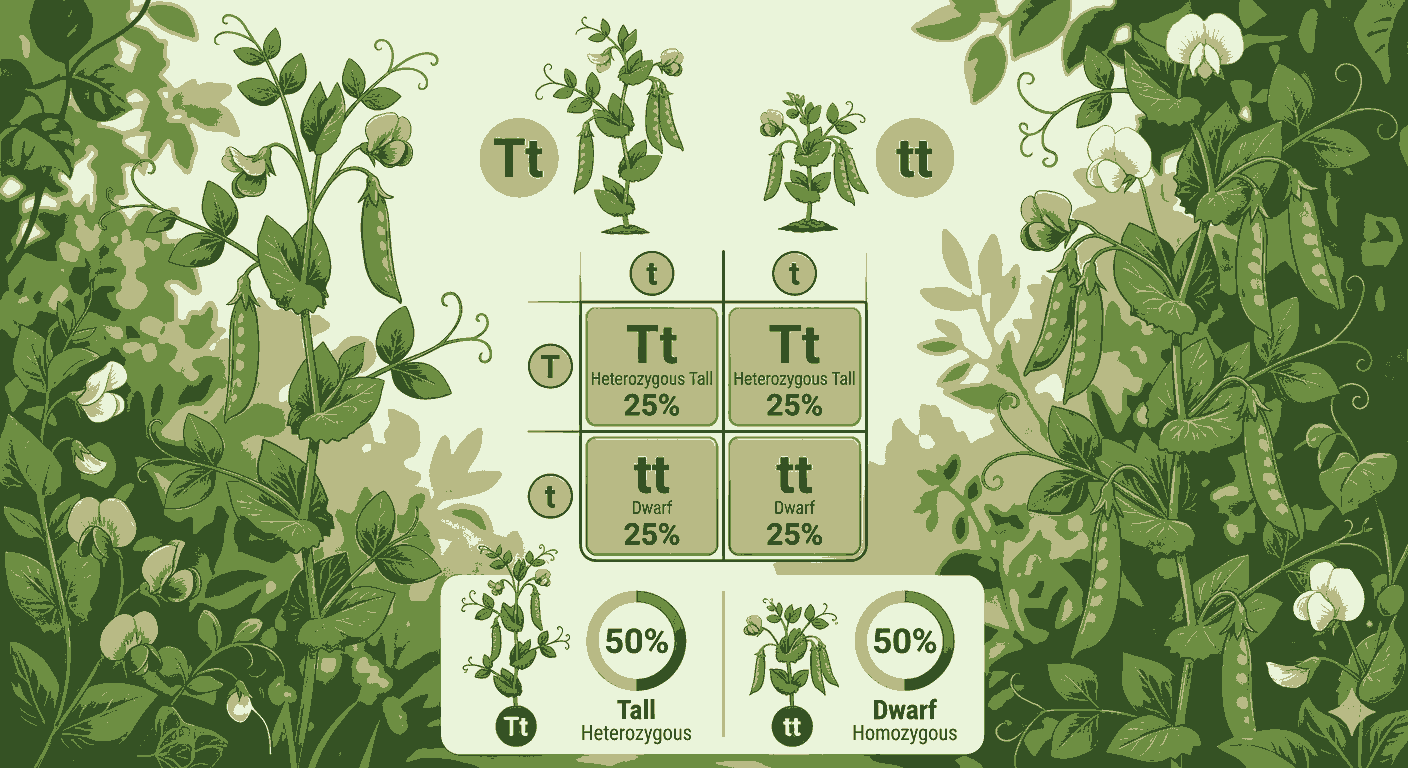
When a heterozygous tall plant (Tt) is crossed with a dwarf plant (tt), the outcomes become clearer through Heterozygous Tall Dwarf Cross Percentage MCQs Explained for Class 12 Biology. The cross results in 50% tall (Tt) and 50% dwarf (tt) offspring. This fundamental ratio is frequently tested, making Heterozygous Tall Dwarf Cross Percentage MCQs Explained for Class 12 Biology extremely important.
Aspirants often find it easier to visualize this concept using Punnett squares. By applying this method in Heterozygous Tall Dwarf Cross Percentage MCQs Explained for Class 12 Biology, they can systematically determine genotypic and phenotypic ratios. This approach improves accuracy and reduces confusion during exams.
Another key aspect of Heterozygous Tall Dwarf Cross Percentage MCQs Explained for Class 12 Biology is understanding genotype versus phenotype. While genotype refers to genetic makeup (Tt or tt), phenotype refers to observable traits (tall or dwarf). Practicing Heterozygous Tall Dwarf Cross Percentage MCQs Explained for Class 12 Biology strengthens this distinction.
The importance of Heterozygous Tall Dwarf Cross Percentage MCQs Explained for Class 12 Biology also lies in reinforcing Mendel’s Law of Segregation. According to this law, allele pairs separate during gamete formation, ensuring that each gamete carries only one allele. Regular practice of Heterozygous Tall Dwarf Cross Percentage MCQs Explained for Class 12 Biology helps aspirants internalize this concept.
Moreover, Heterozygous Tall Dwarf Cross Percentage MCQs Explained for Class 12 Biology play a vital role in preparing for competitive exams like NEET. Many questions are framed around simple crosses but require conceptual clarity to solve quickly. Aspirants who consistently practice Heterozygous Tall Dwarf Cross Percentage MCQs Explained for Class 12 Biology gain a significant advantage.
Another benefit of focusing on Heterozygous Tall Dwarf Cross Percentage MCQs Explained for Class 12 Biology is improved problem-solving skills. These questions often require logical thinking and step-by-step analysis, which becomes easier with repeated exposure.
Aspirants should also understand that Heterozygous Tall Dwarf Cross Percentage MCQs Explained for Class 12 Biology are not just about memorizing ratios. Instead, they help build analytical thinking, allowing learners to predict outcomes of different genetic crosses.
Time management is another reason why Heterozygous Tall Dwarf Cross Percentage MCQs Explained for Class 12 Biology are essential. In exams, solving such questions quickly and accurately can save valuable time for more complex problems.
Additionally, Heterozygous Tall Dwarf Cross Percentage MCQs Explained for Class 12 Biology help identify common mistakes. For example, confusing genotype ratios with phenotype ratios can lead to incorrect answers. Regular practice ensures these errors are minimized.
The repeated exposure to Heterozygous Tall Dwarf Cross Percentage MCQs Explained for Class 12 Biology also improves retention. Aspirants become more familiar with patterns and can recall concepts effortlessly during exams.
Consistency is key when practicing Heterozygous Tall Dwarf Cross Percentage MCQs Explained for Class 12 Biology. Instead of solving randomly, aspirants should focus on understanding each step involved in deriving the final answer.
Heterozygous Tall Dwarf Cross Percentage MCQs Explained for Class 12 Biology:
1. For whom is the technique called gamete intrafallopian transfer (GIFT) recommended?
A. Who cannot provide suitable environment for fertilization
B. Who cannot produce an ovum
C. Who cannot retain the foetus inside uterus
D. Whose cervical canal is too narrow to allow passage for sperms
Answer: B
Explanation: GIFT is recommended for females who cannot produce ova but have a normal fallopian tube for fertilization.
2. What stage is transferred into the uterus after induced fertilization of ova in the laboratory?
A. Zygote
B. Embryo at 4 blastomere stage
C. Embryo at 2 blastomere stage
D. Morula
Answer: D
Explanation: In IVF, embryos at the morula stage are transferred into the uterus for further development.
3. Which statement is correct regarding GIFT?
A. Ova collected from a donor are transferred to fallopian tube for fertilization
B. Zygote is transferred to fallopian tube
C. Zygote is transferred to uterus
D. Ova transferred to uterus
Answer: A
Explanation: In GIFT, ova are placed into the fallopian tube where fertilization occurs naturally.
4. What is the procedure where ova are transferred to fallopian tube for zygote formation?
A. GIFT
B. IUI
C. ZIFT
D. IUT
Answer: A
Explanation: GIFT involves transfer of gametes into fallopian tube for fertilization.
5. How is diffusion of food solved in coelomates?
A. Coelomic fluid
B. Churning of food
C. Circulatory system
D. Gut glands
Answer: C
Explanation: Circulatory system helps transport nutrients efficiently.
6. Intermediate community between pioneer and climax is called?
A. Seral community
B. Biotic community
C. Temporary community
D. Ecosere
Answer: A
Explanation: Seral communities are transitional stages in ecological succession.
7. Norman Borlaug is associated with which revolution?
A. Green Revolution
B. White Revolution
C. Yellow Revolution
D. Blue Revolution
Answer: A
Explanation: Norman Borlaug is known as the father of Green Revolution.
8. In which ART method are >8 blastomeres transferred into uterus?
A. IUI
B. IUT
C. GIFT
D. ZIFT
Answer: B
Explanation: IUT involves transfer of embryos (>8 blastomeres) into uterus.
9. Main cause of infertility?
A. Low sperm production
B. Failure of ovulation
C. Both A and B
D. None
Answer: C
Explanation: Both male and female factors contribute to infertility.
10. Incorrect option for ART?
A. IUT transfers ≤8 blastomeres
B. ICSI injects sperm into ovum
C. GIFT transfers ovum to tube
D. ZIFT transfers embryo to tube
Answer: A
Explanation: IUT involves transfer of embryos >8 blastomeres.
11. Normal fertility sperm requirement?
A. 60% normal shape, 40% motile
B. 40% shape, 60% motile
C. 50% both
D. 70% both
Answer: A
Explanation: Proper morphology and motility are essential.
12. Direct sperm injection into ovum is called?
A. GIFT
B. ZIFT
C. ICSI
D. IVF-ET
Answer: C
Explanation: ICSI involves injecting sperm directly into ovum.
13. Surrogate mother is used for?
A. Lactation
B. Artificial insemination
C. Embryo development for another couple
D. Ovulation
Answer: C
Explanation: Surrogate carries embryo for infertile couple.
14. GIFT stands for:
A. Gametogenesis in fallopian tube
B. Gene in fallopian tube
C. Gamete intra fallopian transfer
D. Gamete intra follicular transfer
Answer: C
Explanation: GIFT stands for Gamete Intra Fallopian Transfer, where sperms and ova are placed in the fallopian tube for in vivo fertilization.
15. Testicular Sperm Aspiration (TESA) involves:
A. Collection of eggs
B. Insemination into uterus
C. Collection of sperms from testis surgically
D. Collection from efferent ducts
Answer: C
Explanation: TESA is used in male infertility where sperms are directly aspirated from testicular tissue.
16. Arrange the steps in GIFT in correct order:
A. Collection → Transfer → Fertilization → Cleavage
B. Transfer → Collection → Fertilization → Cleavage
C. Fertilization → Transfer → Cleavage → Collection
D. Cleavage → Transfer → Fertilization → Collection
Answer: A
Explanation: First ova are collected, then transferred to fallopian tube, fertilization occurs, followed by cleavage.
17. Which is an ART technique?
A. Artificial insemination
B. Lactational amenorrhea
C. ZIFT
D. ICSI
Answer: A (best single choice as given)
Explanation: Artificial insemination is a basic ART method. Lactational amenorrhea is a natural contraceptive, not ART.
18. Surrogate mother is:
A. Female that develops another’s embryo
B. Male sperm donor
C. Egg donor
D. IVF recipient
Answer: A
Explanation: A surrogate mother carries the embryo for another couple.
19. ART does NOT include:
A. IVF-ET
B. GIFT
C. Zygote extra fallopian transfer
D. Artificial insemination
Answer: C
Explanation: Zygote extra fallopian transfer is not a recognized ART technique.
20. Heterozygous plants in 390 tall : 130 dwarf ratio?
A. 130
B. 260
C. 390
D. 520
Answer: B
Explanation: Ratio is 3:1 → total = 520 → heterozygous = 2/4 = 260.
21. Mendel’s factors and contrasting traits:
A. Alleles and genes
B. Genes and alleles
C. Genotype and phenotype
D. Genes and genotype
Answer: B
Explanation: Genes are units of inheritance, alleles are contrasting forms.
22. % dwarf plants (Tt × tt):
A. 25
B. 75
C. 50
D. 65
Answer: C
Explanation: Cross gives 50% Tt and 50% tt → 50% dwarf.
23. Choose the correct statements regarding alleles and genes:
- Alleles do not blend with each other
- Alleles are alternate forms of a gene
- Mendel’s laws did not prove existence of genes
- Genes segregate independently
Options:
A. I, II, IV
B. I, II, III
C. I, III, IV
D. II, III, IV
Answer: A
Explanation:
- Alleles remain discrete (no blending)
- Alleles are alternative forms
- Mendel indirectly proved gene existence
- Independent assortment is valid
24. F1 resembles both parents in:
A. Incomplete dominance
B. Co-dominance
C. Pleiotropy
D. Complete dominance
Answer: B
Explanation: In codominance, both alleles express equally (e.g., blood group AB).
25. Ratio of homozygous tall : dwarf in F2:
A. 2 : 1
B. 1 : 2 : 1
C. 3 : 1
D. 1 : 1
Answer: D
Explanation: Homozygous TT : tt = 1 : 1 in F2.
26. Mendel’s experimental plant:
A. Pisum sativum
B. Oryza sativa
C. Mirabilis jalapa
D. None
Answer: A
Explanation: Pea plant was chosen for clear traits and easy breeding.
27. Mendel called genes as:
A. Traits
B. Characters
C. Factors
D. Qualities
Answer: C
Explanation: Mendel used the term “factors” for genes.
28. Mendel’s work rediscovered by:
A. Huxley
B. Aristotle
C. Correns
D. Elder
Answer: C
Explanation: Correns, de Vries, and Tschermak rediscovered Mendel’s laws.
29. Father of genetics:
A. de Vries
B. Mendel
C. Darwin
D. Morgan
Answer: B
Explanation: Gregor Mendel established laws of inheritance.
30. Mendel’s genes located on how many chromosomes?
A. 7
B. 4
C. 5
D. 6
Answer: B
Explanation: The 7 traits studied are located on 4 different chromosomes.
Conclusion on Heterozygous Tall Dwarf Cross Percentage MCQs Explained for Class 12 Biology
In conclusion, Heterozygous Tall Dwarf Cross Percentage MCQs Explained for Class 12 Biology are a powerful tool for mastering Mendelian genetics. They simplify complex concepts and make learning more structured and effective.
Ultimately, by regularly practicing Heterozygous Tall Dwarf Cross Percentage MCQs Explained for Class 12 Biology, aspirants can strengthen their fundamentals, improve accuracy, and perform confidently in exams.