
- Keneitsino Lydia
- April 8, 2026
Ultimate Guide: Reaction Mechanism Based Polymer MCQs With Solutions to Score High
Reaction Mechanism Based Polymer MCQs With Solutions is a highly effective way to master one of the most important topics in Class 12 chemistry. Polymer chemistry is not just about memorizing names of polymers and monomers; it requires a deep understanding of reaction mechanisms. This is where Reaction Mechanism Based Polymer MCQs With Solutions becomes extremely valuable for aspirants preparing for board exams and competitive exams like NEET and JEE.
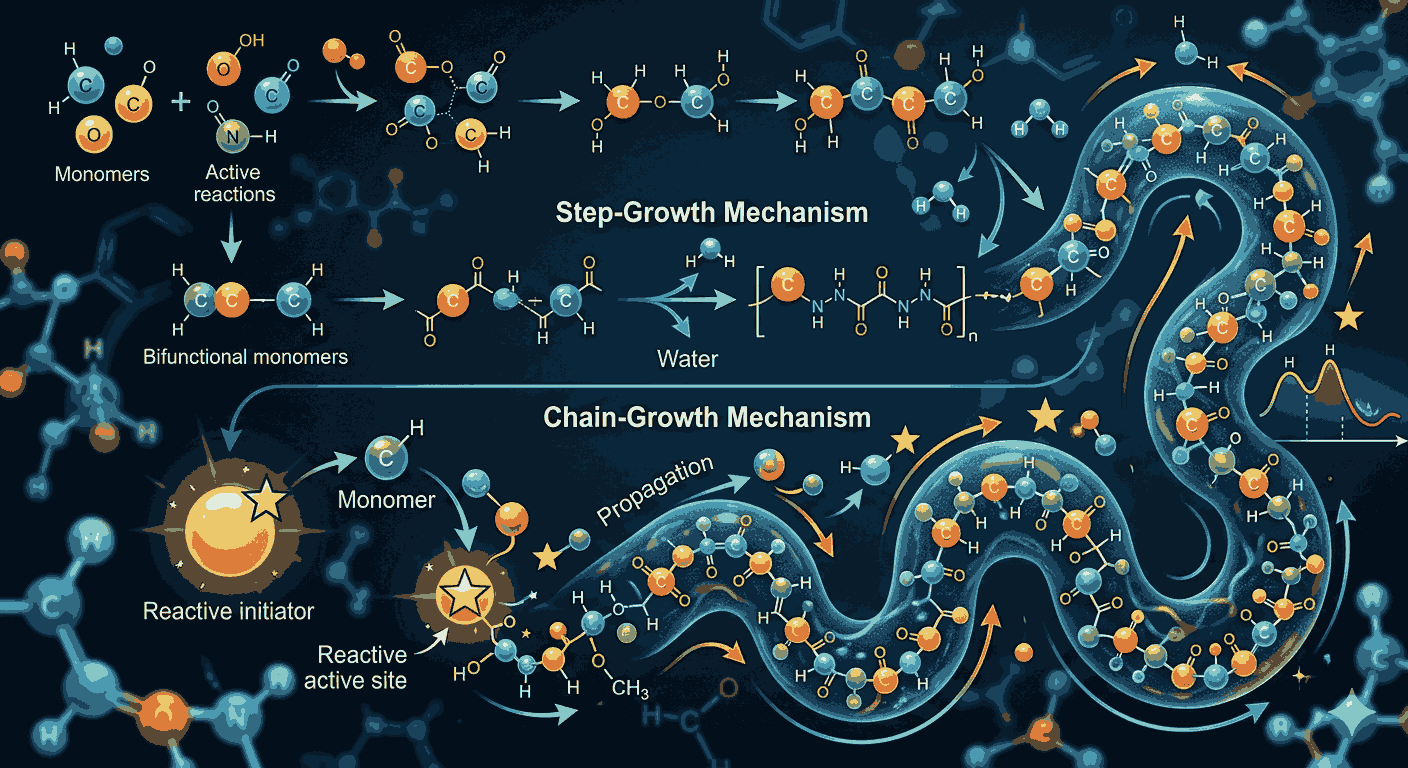
When aspirants practice Reaction Mechanism Based Polymer MCQs With Solutions, they gain clarity about how polymerization reactions actually occur. Concepts such as free radical polymerization, condensation polymerization, and copolymerization become easier to understand. Regular exposure to Reaction Mechanism Based Polymer MCQs With Solutions helps aspirants visualize each step of the reaction, including initiation, propagation, and termination in chain reactions.
One of the key benefits of Reaction Mechanism Based Polymer MCQs With Solutions is that it strengthens conceptual understanding rather than rote learning. Instead of simply remembering that a polymer is formed, aspirants learn how and why it is formed. Reaction Mechanism Based Polymer MCQs With Solutions encourages learners to think critically about reaction intermediates, catalysts, and conditions required for polymer formation.
Another advantage of practicing Reaction Mechanism Based Polymer MCQs With Solutions is improved problem-solving ability. Many exam questions are designed to test whether aspirants can apply their knowledge to new situations. By solving Reaction Mechanism Based Polymer MCQs With Solutions, aspirants become familiar with different types of questions, making it easier to tackle unfamiliar problems during exams.
Time management is also enhanced through consistent practice of Reaction Mechanism Based Polymer MCQs With Solutions. Competitive exams often have strict time limits, and aspirants need to solve questions quickly and accurately. Regular practice with Reaction Mechanism Based Polymer MCQs With Solutions helps aspirants develop speed while maintaining accuracy, which is crucial for achieving high scores.
Reaction Mechanism Based Polymer MCQs With Solutions also plays an important role in revision. Before exams, aspirants often struggle to revise large portions of the syllabus efficiently. Reaction Mechanism Based Polymer MCQs With Solutions provides a quick and effective way to review important concepts and identify weak areas. This makes last-minute preparation more structured and productive.
Furthermore, Reaction Mechanism Based Polymer MCQs With Solutions helps aspirants understand the role of catalysts and initiators in polymerization reactions. For example, initiators like benzoyl peroxide generate free radicals that start the reaction. By practicing Reaction Mechanism Based Polymer MCQs With Solutions, aspirants can better understand these mechanisms and their applications in real-life polymer production.
Another important aspect of Reaction Mechanism Based Polymer MCQs With Solutions is its ability to improve analytical thinking. Instead of focusing only on theoretical knowledge, aspirants learn to analyze reaction pathways and predict products. This analytical approach developed through Reaction Mechanism Based Polymer MCQs With Solutions is essential for higher-level chemistry studies.
In addition, Reaction Mechanism Based Polymer MCQs With Solutions exposes aspirants to a variety of question patterns. From conceptual questions to mechanism-based problems, students gain a comprehensive understanding of the topic. This variety ensures that aspirants are well-prepared for any type of question that may appear in exams.
Consistency is the key to success, and Reaction Mechanism Based Polymer MCQs With Solutions supports this by providing regular practice opportunities. Aspirants who make Reaction Mechanism Based Polymer MCQs With Solutions a part of their daily study routine tend to perform better in exams. It not only boosts confidence but also reduces exam anxiety.
Reaction Mechanism Based Polymer MCQs With Solutions:
1. The monomer of the polymer is
<p><img alt=”” src=”https://itquiz.in/wp-content/uploads/2024/09/chem_YCT_Chem_Vol_II_ch15.Q327.png” style=”height:200px; width:200px” /></p>
A. <p><img alt=”” src=”https://itquiz.in/wp-content/uploads/2024/09/chem_YCT_Chem_Vol_II_ch15.Q327.option1.png” style=”height:200px; width:200px” /></p>
B. CH₂=CH-CH₂
C. CH₂=CH-C₆H₅
D. (CH₃)₂C=C(CH₃)₂
Answer: A
2. Which one of the following statements is not true?
A. Buna-S is a copolymer of butadiene and styrene
B. Natural rubber is a 1,4-polymer of isoprene
C. In vulcanization, sulphur bridges make rubber stronger
D. Natural rubber has trans-configuration at every double bond
Answer: D
3. Of the following which one is classified as polyester polymer?
A. Terylene
B. Bakelite
C. Melamine
D. Nylon-6,6
Answer: A
4. Which is the monomer of neoprene in the following?
A. <p><img alt=”” src=”https://itquiz.in/wp-content/uploads/2024/09/chem_YCT_Chem_Vol_II_ch15.Q330.option1.png” style=”height:200px; width:200px” /></p>
B. CH₂=CH-C≡CH
C. CH₂=CH-CH=CH₂
D. <p><img alt=”” src=”https://itquiz.in/wp-content/uploads/2024/09/chem_YCT_Chem_Vol_II_ch15.Q330.option4.png” style=”height:200px; width:200px” /></p>
Answer: A
5. Which compound polymerizes to form dacron?
A. Propylene + para HO-(C₆H₄)-OH
B. Benzoic acid + ethanol
C. Terephthalic acid + ethylene glycol
D. Benzoic acid + para HO-(C₆H₄)-OH
Answer: C
6. Which polymer is prepared by addition polymerization?
A. Dacron
B. Teflon
C. Nylon-6,6
D. Novolac
Answer: B
7. Bakelite is obtained from phenol by reacting with
A. Acetaldehyde
B. Acetal
C. Formaldehyde
D. Chlorobenzene
Answer: C
8. Which of the following is cross-linked polymer?
A. Teflon
B. Orlon
C. Nylon
D. Bakelite
Answer: D
9. Teflon polymer is formed by polymerization of
A. CH₂=CH-CN
B. F₂C=CF₂
C. CCl₂=CH₂
D. H₂C=CHCl
Answer: B
10. Teflon is an example of
A. Polyamide
B. Addition polymer
C. Polyester
D. Formaldehyde resin
Answer: B
11. F₂C=CF₂ is a monomer of
A. Teflon
B. Nylon
C. Glyptal
D. Buna-S
Answer: A
12. Which one of the following is a condensation polymer?
A. PVC
B. Teflon
C. Dacron
D. Polystyrene
Answer: C
13. Among the following the branched chain polymer is
a) Polyvinyl chloride
b) Bakelite
c) Low density polythene
d) High density polythene
Answer: c
14. Which one of the following polymer is a copolymer formed by condensation polymerisation?
a) Buna-S
b) Neoprene
c) Polythene
d) Melamine-formaldehyde
Answer: d
15. Natural rubber is a polymer of monomer isoprene. During polymerisation
a) 1,4-addition takes place
b) 1,2-addition takes place
c) 1,3-addition takes place
d) Both double bonds are converted into single bond
Answer: a
16. Which of the following is not true?
a) In vulcanisation the rubber becomes harder and stronger
b) Natural rubber has trans configuration at every double bond
c) Buna-S is a copolymer of butene and styrene
d) Natural rubber is 1,4-polymer of isoprene
Answer: d
17. The monomers used for preparation of nylon 2-nylon 6 is/are
a) ε-caprolactam
b) Alanine and amino caproic acid
c) Glycine and amino caproic acid
d) Hexamethylenediamine and adipic acid
Answer: c
18. Which among the following polymer does not show cross linking in it?
a) Nylon-6
b) Bakelite
c) Melamine
d) Vulcanised rubber
Answer: a
19. The monomers used in the preparation of dextron are
a) Glycine and α-amino caproic acid
b) 3-hydroxy butanoic acid and 3-hydroxy pentanoic acid
c) Glycine and lactic acid
d) Lactic acid and glycolic acid
Answer: d
20. Lactic acid and glycolic acid are the monomers used for preparation of polymer
a) Nylon-2-nylon-6
b) Dextron
c) PHBV
d) Buna-N
Answer: b
21. Which of the following can absorb over 90% of its own mass of water and also does not stick to wounds?
a) Saran
b) Thiokol
c) Rayon
d) Gun cotton
Answer: c
22. Adipic acid is used in the preparation of
a) Nylon-6
b) Dacron
c) Nylon-66
d) Novolac
Answer: c
Conclusion on Reaction Mechanism Based Polymer MCQs With Solutions
In conclusion, Reaction Mechanism Based Polymer MCQs With Solutions is an essential tool for mastering polymer chemistry. It enhances conceptual clarity, improves problem-solving skills, and prepares aspirants for competitive exams. By consistently practicing Reaction Mechanism Based Polymer MCQs With Solutions, aspirants can build a strong foundation in chemistry and achieve excellent results.