
- Keneitsino Lydia
- March 7, 2026
Brilliant 30 Reaction Progress Graph MCQs with Answers for Smart Exam Practice
Understanding graphical interpretation is extremely important in chemical kinetics, especially when aspirants prepare for board exams and competitive tests. One of the most common areas tested in kinetics is the concept of Reaction progress graph MCQs with answers. These questions evaluate whether aspirants can correctly interpret how concentration, rate, and time are related during the course of a reaction. Studying Reaction progress graph MCQs with answers helps aspirants develop a deeper understanding of reaction mechanisms and rate laws.
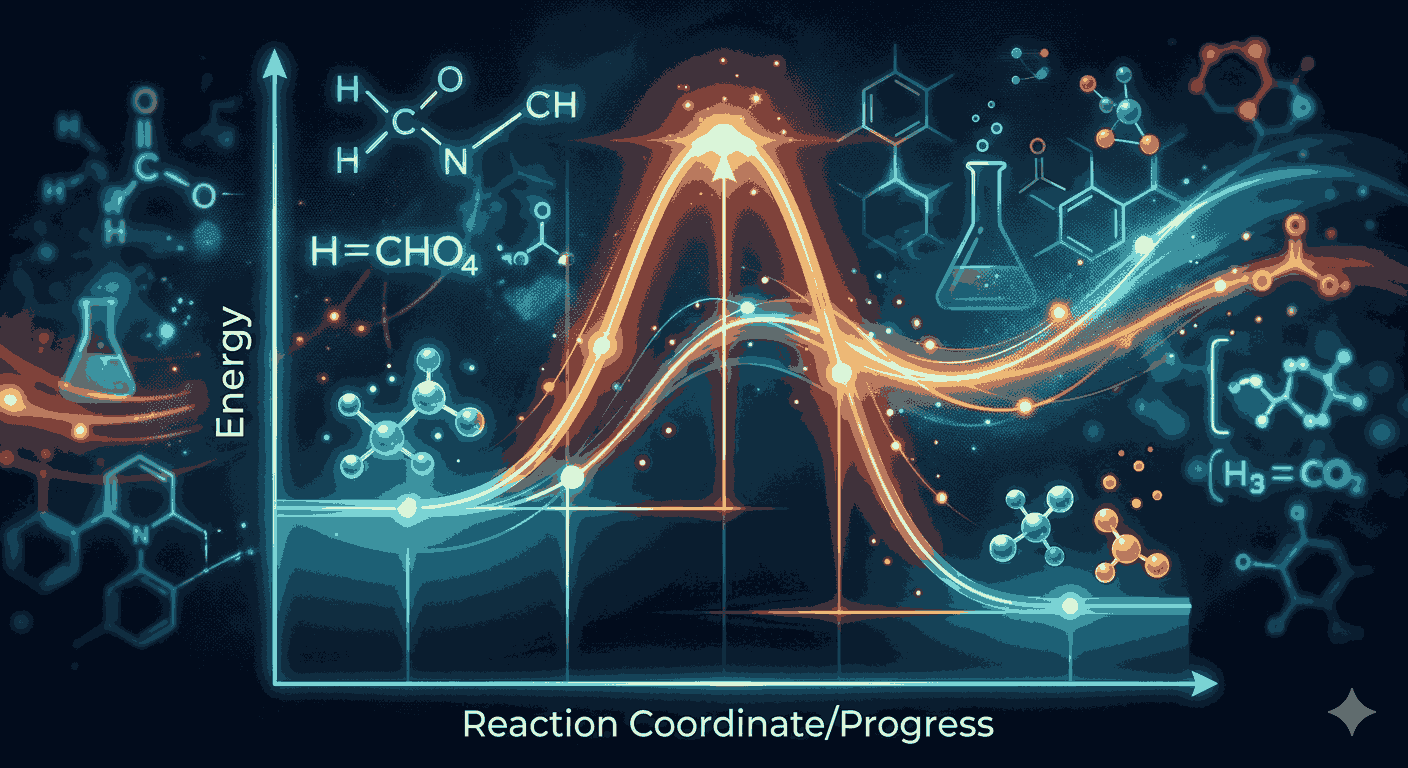
In chemical kinetics, a reaction progress graph usually represents how the concentration of reactants decreases and the concentration of products increases as time passes. Many Reaction progress graph MCQs with answers focus on identifying reaction order using graphical trends. For example, in a zero order reaction, the concentration of reactant decreases linearly with time, producing a straight line in a concentration versus time plot. In Reaction progress graph MCQs with answers, aspirants must recognize this linear relationship as a characteristic feature of zero order kinetics.
For first order reactions, the reaction progress graph looks different. Instead of a straight line, the concentration versus time curve becomes exponential. The reactant concentration decreases rapidly at first and then slows down gradually as the reaction proceeds. In Reaction progress graph MCQs with answers, aspirants are often required to identify that the logarithmic transformation of concentration versus time gives a straight line for first order reactions.
Second order reactions provide another important pattern in reaction progress graphs. The concentration decreases more sharply at higher concentrations and gradually flattens as the reaction progresses. Many Reaction progress graph MCQs with answers test whether aspirants can distinguish this curvature from first order decay. Recognizing these graphical differences allows aspirants to determine reaction order quickly without performing complex calculations.
Another important concept frequently explored in Reaction progress graph MCQs with answers is half-life behavior. In first order reactions, the half-life remains constant regardless of the initial concentration. This leads to a repeating pattern in reaction progress graphs where equal time intervals reduce the concentration by half. In contrast, for zero order reactions, half-life depends on the initial concentration, which changes the slope of the reaction progress graph. Understanding these patterns is essential when solving Reaction progress graph MCQs with answers.
Rate of reaction is also closely related to the shape of the reaction progress graph. At the beginning of a reaction, the rate is usually highest because the concentration of reactants is maximum. As the reaction proceeds and reactants are consumed, the rate decreases. In Reaction progress graph MCQs with answers, aspirants must interpret this gradual decline in rate as a natural consequence of decreasing reactant concentration.
Temperature effects also influence reaction progress graphs. When temperature increases, the rate constant increases, which makes the reaction proceed faster. In many Reaction progress graph MCQs with answers, aspirants compare graphs at different temperatures and determine which reaction proceeds more rapidly based on the slope of the curve.
Another feature highlighted in Reaction progress graph MCQs with answers is the difference between reactant and product curves. While reactant concentration decreases over time, product concentration increases until it reaches a maximum when the reaction is complete. These opposite trends form the basis for many conceptual questions in Reaction progress graph MCQs with answers.
Reaction progress graphs are also useful for identifying reaction completion. In zero order reactions, the graph touches the time axis at a definite point, indicating that the reactant concentration becomes zero. However, in first order reactions the curve approaches the time axis but never truly touches it. Many Reaction progress graph MCQs with answers use this distinction to test conceptual understanding.
30 Reaction Progress Graph MCQs with Answers:
Q1. For a chemical reaction _____ can never be a fractional number:
A. Order
B. Half-life
C. Molecularity
D. Rate constant
Answer: C
2. Half-Life Calculation
Q2. For a first order reaction, initial concentration is 0.05 M. After 45 min it decreases by 0.015 M. Half-life is:
A. 87.42 min
B. 25.90 min
C. 78.72 min
D. 77.20 min
Answer: A
3. Effect of Doubling Concentrations
A. Velocity constant
B. 4 times
C. 2 times
D. 8 times
Answer: D
4. Unit of Rate Constant (Fourth Order)
A. (mole/litre)⁻³ sec⁻¹
B. (mole/litre)⁻³
C. (mole/litre)⁻³ sec¹
D. (mole/litre)³ sec⁻¹
Answer: A
5. Assertion–Reason
Assertion: Order can be fractional.
Reason: Order cannot be predicted from balanced equation.
A. Both correct and reason explains assertion
B. Both correct but reason not explanation
C. Assertion correct but reason wrong
D. Both incorrect
Answer: B
6. First Order Time Calculation
A. 0.384 min
B. 0.15 min
C. 3.84 min
D. 3.84 min
Answer: A
7. Rate after 20 min
A. 0.0693 mol L⁻¹ min⁻¹
B. 0.0693 × 2.5 mol L⁻¹ min⁻¹
C. 0.0693 × 3 mol L⁻¹ min⁻¹
D. 0.0693 × 10 mol L⁻¹ min⁻¹
Answer: B
8. Arrhenius Temperature Question
A. 3.911 × 10⁻⁵ s⁻¹
B. 1.113 × 10⁻⁵ s⁻¹
C. 3.318 × 10⁻⁵ s⁻¹
D. 1.193 × 10⁻² s⁻¹
Answer: C
9. Positive Slope Graph
A. −log₁₀[A] vs t
B. −ln[A] vs t
C. log[A] vs log t
D. [A] vs t
Answer: B
10. Second Order Equation Case
A. First order
B. Zero order
C. Unchanged second order
D. Third order
Answer: A
11. Reaction Order (2A + B → C + D)
A. One w.r.t B
B. Two w.r.t A
C. Three
D. Cannot be predicted
Answer: D
12. Zero Order Graph
A. Option 1
B. Option 2
C. Option 3
D. Option 4
Answer: D
13. Rate Constant Unit
3.00 × 10³ L mol⁻¹ sec⁻¹ corresponds to:
A. Zero order
B. First order
C. Second order
D. Third order
Answer: C
14. Graph Interpretation
A. I
B. II
C. III
D. IV
Answer: B
15. Reaction Order from Unit
1.0 × 10⁷ L² mol⁻² s⁻¹ corresponds to:
A. Zero
B. First
C. Second
D. Third
Answer: D
16. Concentration Calculation
A. 0.4 mol L⁻¹
B. 2.5 mol L⁻¹
C. 1.44 × 10⁻³ mol L⁻¹
D. 4.0 mol L⁻¹
Answer: A
17. Reaction Order
A. Two
B. Half
C. One
D. Zero
Answer: B
18. Half-Life of N₂O₅
A. 1117.7 s
B. 111.7 s
C. 223 s
D. 160 s
Answer: A
19. Zero Order Reaction Condition
A. Rate ∝ [A]²
B. Rate same at any [A]
C. Rate unchanged for B and C
D. Rate doubles if B doubles
Answer: B
20. Zero Order Graph Time
A. 2 min
B. 4 min
C. 6 min
D. 8 min
Answer: C
21. Rate Law Question
A. Reaction second order
B. Molecularity = 3/2
C. Unit of k = s⁻¹
D. Molecularity = 2
Answer: D
22. Reaction Type
Q22. The reaction
2N₂O₅(g) ⇌ 2NO₂O₄ + O₂ is:
A. Bimolecular and second order
B. Unimolecular and first order
C. Bimolecular and first order
D. Bimolecular and zero order
Answer: C
23. Order of Reaction
Q23. For a reaction A → B, the rate increases by a factor of 2.25 when the concentration of A increases by 1.5. The order of reaction is:
A. 0.5
B. 1
C. 2
D. 1.5
Answer: C
24. Decomposition of R and S
Q24. Two substances R and S decompose independently following first order kinetics. Rate constant of R is twice that of S. Initially concentrations are 0.5 mmol (R) and 0.25 mmol (S). The molarities become equal after time equal to:
A. Twice the half-life of R
B. Twice the half-life of S
C. Half-life of S
D. Half-life of R
Answer: A
25. Thermal Decomposition
Q25. A first order decomposition reaction shows 50% decomposition in 120 min. Time for 90% decomposition is:
A. Nearly 400 min
B. Nearly 45 min
C. Nearly 480 min
D. Nearly 240 min
Answer: A
26. Order from Half-Life Dependence
Q26. If the initial concentration is doubled and half-life also doubles, the order of reaction is:
A. Zero
B. One
C. Two
D. Three
Answer: A
27. Completion Time
Q27. A first order reaction completes 20% in 200 minutes. Time required to complete 80% is:
A. 400 min
B. 800 min
C. 1400 min
D. 1000 min
Answer: C
28. Zero Order Condition
Q28. For reaction
2A → B + C
It will be zero order when:
A. Rate ∝ [A]²
B. Rate remains same at any [A]
C. Rate unchanged at any [B] and [C]
D. Rate doubles when B doubles
Answer: B
29. Volume Change Effect
Q29. For the reaction
2NO₂(g) + O₂(g) ⇌ 2NO₂(g)
If the reaction is first order and the vessel volume is reduced to 1/3, the rate becomes:
A. 1/3 times
B. 2/3 times
C. 3 times
D. 6 times
Answer: C
30. Unit of First Order Rate Constant
Q30. Unit of rate constant for a first order reaction is:
A. L⁻¹ s⁻¹
B. mol L⁻¹ s⁻¹
C. mol s⁻¹
D. s⁻¹ (or min⁻¹ etc.)
Answer: D
Conclusion on Reaction Progress Graph MCQs with Answers
In summary, mastering graphical interpretation is essential for success in chemical kinetics. By studying Reaction progress graph MCQs with answers, aspirants gain the ability to interpret concentration changes, identify reaction order, analyze rate behavior, and understand half-life relationships. Regular practice with Reaction progress graph MCQs with answers builds confidence and helps aspirants solve kinetics problems more efficiently in examinations.