
- iamal
- January 3, 2026
Best High-Yield Fluid Dynamics and Aerodynamics MCQs for NEET , JEE & CUET
Fluid Dynamics and Aerodynamics MCQs play a vital role in building a deep and application-oriented understanding of how fluids behave at rest and in motion, and how these behaviors influence real-world systems ranging from pipelines to aircraft. Fluid dynamics focuses on the motion of liquids and gases, while aerodynamics deals specifically with the motion of air and its interaction with solid bodies. Together, these fluid dynamics and aerodynamics mcqs topics form a foundational pillar of physics and engineering, especially in competitive examinations such as JEE, NEET, and board-level physics assessments.
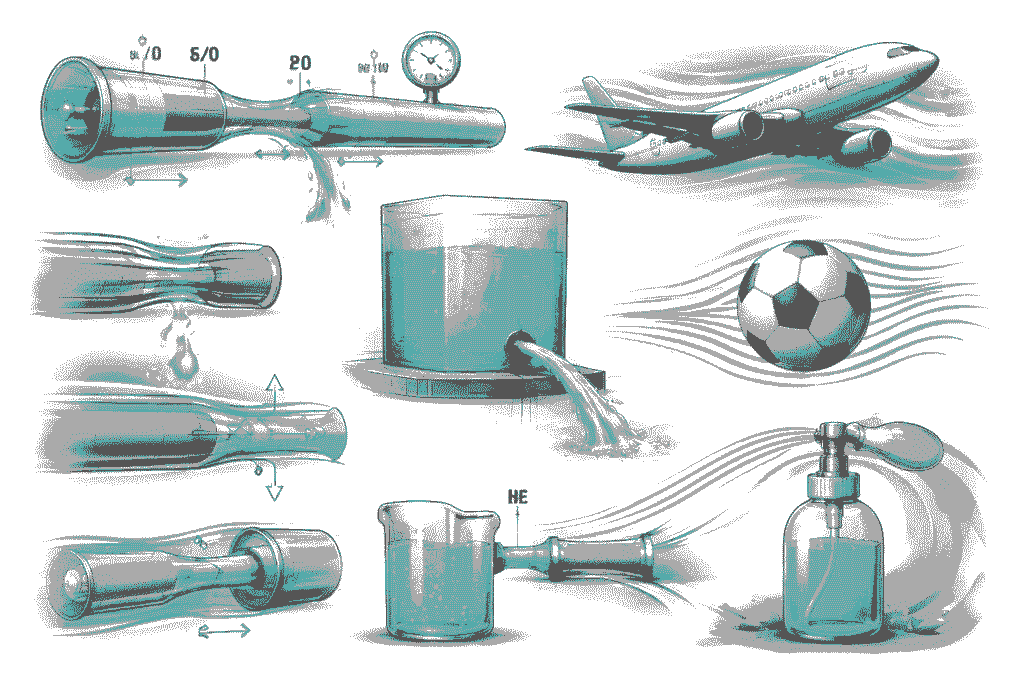
Fluid dynamics and aerodynamics MCQs based on fluid dynamics and aerodynamics are designed to test both conceptual clarity and numerical problem-solving skills. Key ideas such as Reynolds number, streamline and turbulent flow, Bernoulli’s principle, pressure–velocity relationships, continuity equation, and terminal velocity frequently appear in objective questions. These fluid dynamics and aerodynamics MCQs often connect theory with everyday phenomena—why airplanes generate lift, how perfume sprayers work, why blood pressure changes in narrowed arteries, or how a spinning football curves mid-air. Such fluid dynamics and aerodynamics mcqs questions require students not only to memorize formulas but also to interpret physical situations correctly.
Aerodynamics MCQs particularly emphasize pressure differences, airflow velocity, lift generation, and practical devices like venturi meters, carburetors, atomizers, and aerofoils. Meanwhile, fluid dynamics MCQs address flow behavior in pipes, viscosity, critical velocity, turbulence, and energy conservation. Together, these fluid dynamics and aerodynamics MCQs sharpen analytical thinking, improve time management, and prepare students for higher-level applications in mechanical engineering, aerospace studies, medical physics, and environmental science.
Fluid Dynamics and Aerodynamics MCQs :
1. The onset of turbulence in a liquid is determined by:
A. Pascal’s law
B. Magnus effect
C. Reynold’s number
D. Torricelli’s law
Correct Answer: C
2. A pure number which determines the type of flow of liquid through a pipe is known as:
A. Reynold’s number
B. Bernoulli’s number
C. Pascal’s number
D. Torricelli’s number
Correct Answer: A
3. The Reynold’s number for a liquid flow in a tube does NOT depend on:
A. Velocity of the liquid
B. Viscosity of the liquid
C. Length of the tube
D. Diameter of the tube
Correct Answer: C
4. Bernoulli’s principle is not involved in the working/explanation of:
A. Movement of spinning ball
B. Carburettors of automobile
C. Blades of a kitchen mixer
D. Heart attack
Correct Answer: C
5. Bernoulli’s theorem is a consequence of the law of conservation of:
A. Angular momentum
B. Mass
C. Energy
D. Momentum
Correct Answer: C
6. Aerofoils are so designed that the speed of air:
A. On top side is more than on lower side
B. On top side is less than on lower side
C. Is same on both sides
D. Is turbulent
Correct Answer: A
7. Which of the following cannot be explained on the basis of Bernoulli’s principle?
A. Lift on an aircraft’s wing
B. Ink filler
C. Swing of a cricket ball
D. Atomizer
Correct Answer: B
8. The lift of an airplane is based on:
A. Torricelli’s theorem
B. Bernoulli’s theorem
C. Law of gravitation
D. Conservation of linear momentum
Correct Answer: B
9. In old age arteries become narrow causing high blood pressure due to:
A. Pascal’s law
B. Stoke’s law
C. Bernoulli’s principle
D. Archimedes’ principle
Correct Answer: C
10. Scent sprayer is based on:
A. Bernoulli’s theorem
B. Archimedes’ principle
C. Charles’ law
D. Boyle’s law
Correct Answer: A
11. Two light balls suspended close together move closer when air flows between them because:
A. Distance may increase or decrease
B. Distance increases
C. Distance decreases
D. Distance remains same
Correct Answer: C
12. Liquid flowing through a truncated cone-shaped tube will have:
A. High speed at wider end
B. High speed at narrower end
C. Same speed at both ends
D. Uniform velocity
Correct Answer: B
13. Velocity of efflux of liquid through a hole does NOT depend on:
A. Size of the orifice
B. Height of liquid
C. Acceleration due to gravity
D. Density of liquid
Correct Answer: A
14. Banana kick in football is explained by:
A. Hooke’s law
B. Bernoulli’s law
C. Torricelli’s law
D. Newton’s law
Correct Answer: B
15. Match the columns correctly:
A. (A)III (B)IV (C)I (D)II
B. (A)I (B)II (C)III (D)IV
C. (A)II (B)I (C)IV (D)III
D. (A)III (B)IV (C)II (D)I
Correct Answer: A
16. Bernoulli’s principle is used in:
A. Hydroelectric power
B. Rocket propulsion
C. Aeroplane
D. Steam engine
Correct Answer: C
17. Which is NOT related to Bernoulli’s principle?
A. Capillary rise
B. Venturi meter
C. Lift of aeroplane
D. Propeller thrust
Correct Answer: A
18. Weight of an aeroplane in air is balanced by:
A. Vertical thrust
B. Reaction of gases
C. Upthrust of air
D. Pressure difference on wings
Correct Answer: D
19. Pressure is lowest in a flowing liquid where:
A. Velocity is highest
B. Velocity is lowest
C. Diameter is largest
D. Velocity is intermediate
Correct Answer: A
20. If a bucket with water falls freely, the water jet relative to bucket:
A. Moves straight
B. Moves parabolically
C. Stops flowing
D. Continues flowing
Correct Answer: D
Conclusion: Fluid Dynamics and Aerodynamics MCQs
In conclusion, Fluid Dynamics and Aerodynamics MCQs serve as a powerful learning tool for mastering one of the most conceptually rich areas of physics. Through well-structured objective questions, students gain clarity on how fluids transfer energy, momentum, and pressure, and how these principles govern both natural and engineered systems. Fluid dynamics and aerodynamics mcqs topics like Reynolds number determining flow regimes, Bernoulli’s principle explaining pressure variations, and aerodynamic lift enabling flight are repeatedly reinforced through fluid dynamics and aerodynamics MCQ practice, making abstract ideas more tangible and intuitive.
Regular practice of these fluid dynamics and aerodynamics MCQs helps students recognize patterns, avoid common conceptual errors, and apply principles quickly under exam conditions. Since many competitive exams prioritize accuracy and speed, exposure to a wide range of fluid dynamics and aerodynamics MCQs significantly boosts confidence and performance. These fluid dynamics and aerodynamics mcqs questions also bridge the gap between theoretical physics and real-life applications, encouraging learners to think beyond textbooks.
Moreover, mastering this fluid dynamics and aerodynamics mcqs topic strengthens interdisciplinary understanding, as fluid behavior is central to transport systems, biomedical flows, atmospheric science, and aeronautical engineering. A solid grasp of fluid dynamics and aerodynamics through fluid dynamics and aerodynamics MCQs lays the groundwork for advanced studies and practical innovation.