
- iamal
- January 9, 2026
Critical Thermal Radiation : Key Concepts and Real-World Impact
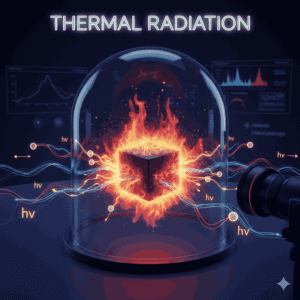
Thermal radiation is a fundamental mode of heat transfer in which energy is emitted in the form of electromagnetic waves due to the temperature of a body. Unlike conduction and convection, thermal radiation does not require any material medium, allowing heat to travel even through a vacuum. This unique property explains how the Sun transfers energy to Earth, how stars emit radiation, and how everyday objects lose heat to their surroundings.
The study of thermal radiation plays a crucial role in understanding black body radiation, emissive power, absorptivity, Kirchhoff’s law, Wien’s displacement law, Stefan–Boltzmann law, and Planck’s quantum theory. These thermal radiation concepts not only laid the foundation of modern quantum physics but are also heavily tested in competitive examinations such as NEET, JEE Main, JEE Advanced, CUET, and engineering entrance tests.
Thermal radiation concepts help explain real-world phenomena like why black objects cool faster, why blue stars are hotter than red stars, and why objects emit different wavelengths at different temperatures. A strong conceptual understanding of this thermal radiation topic enables aspirants to solve both theoretical and application-based MCQs with confidence.
28 Thermal Radiation MCQs
1. Let there be four identical cubes having colours blue, red, black and white. When they are heated together and allowed to cool under identical conditions, which cube will cool at the earliest?
A) White
B) Blue
C) Black
D) Grey
Answer: C) Black
2. Newton’s law of cooling is a special case of
A) Wien’s displacement law
B) Kirchhoff’s law
C) Stefan law
D) Planck’s law
Answer: C) Stefan law
3. Which of the following statement does not hold good for thermal radiation?
A) The wavelength changes when it travels from one medium to another
B) The frequency changes when it travels from one medium to another
C) The speed changes when it travels from one medium to another
D) They travel in straight line in a given medium
Answer: B) The frequency changes when it travels from one medium to another
4. The surface temperature is maximum for:
A) Blue star
B) Yellow star
C) Green star
D) Red star
Answer: A) Blue star
5. Heat travels through vacuum by:
A) Convection
B) Radiation
C) Conduction
D) All of these
Answer: B) Radiation
6. For amorphous substances, coefficient of transmission is
A) Equal to one
B) Less than one but greater than zero
C) Zero
D) Greater than one
Answer: B) Less than one but greater than zero
7. Kirchhoff’s law of radiation proves that a good emitter is a
A) Bad absorber of heat
B) Good absorber of heat
C) Good reflector of heat
D) Good transmitter of heat
Answer: B) Good absorber of heat
8. The unit of Wien’s constant b is
A) m²K⁴
B) mK⁻¹
C) Wm²
D) mK⁻¹K
Answer: D) mK⁻¹K
9. Absorption coefficient of an open window is:
A) 1
B) 0.25
C) 0
D) 0.5
Answer: A) 1
10. Understanding of black body radiation spectrum culminated into the discovery of
A) Wien’s law
B) Rayleigh Jeans law
C) Boltzmann law
D) Quantum law
Answer: D) Quantum law
11. The frequency of the most intense spectral component in the thermal radiation spectrum of a black body is given by
A) Stefan-Boltzmann’s law
B) Wien’s law
C) Kirchhoff’s law
D) Planck’s hypothesis
Answer: B) Wien’s law
12. A black body
A) Has an emissivity of zero
B) Is the most efficient absorber
C) Is the least efficient emitter
D) Has the same emission spectrum at all temperatures
Answer: B) Is the most efficient absorber
13. The means of energy transfer in vacuum is
A) Irradiation
B) Convection
C) Radiation
D) Conduction
Answer: C) Radiation
14. The temperature of the sun can be found out by using
A) Wien’s displacement law
B) Kepler’s law of motion
C) Stefan’s Boltzmann law
D) Planck’s law
Answer: C) Stefan’s Boltzmann law
15. In the case of black body energy distribution, Planck’s formula reduces to Rayleigh Jean’s formula for
A) Long wavelength region
B) Short wavelength region
C) Equal wavelength of radiation
D) Long frequency region
Answer: A) Long wavelength region
16. Evening Sun is not as hot as the mid day sun. What is the reason?
A) In the evening radiations travel slowly
B) In the evening the temperature of the sun decreases
C) Ozone in atmosphere absorbs more light in the evening
D) In the evening radiations travel a long distance through atmosphere
Answer: D) In the evening radiations travel a long distance through atmosphere
17. Which one among the following radiations carries maximum energy?
A) Ultraviolet rays
B) Gamma-rays
C) X-rays
D) Infra-red rays
Answer: B) Gamma-rays
18. Radiations coming from the Sun are mostly in the form of
A) Light only
B) Light and long wavelength infrared
C) Light and short wavelength infrared
D) Both short and long wavelength infrared
Answer: C) Light and short wavelength infrared
19. In which of the following phenomenon do heat waves travel along a straight line with the speed of light?
A) Thermal conduction
B) Thermal convection
C) Thermal radiation
D) Both thermal conduction and radiation
Answer: C) Thermal radiation
20. The source of unlimited thermal energy of stars is due to
A) Nuclear fission
B) Photo disintegration
C) Nuclear fusion
D) γ-ray disintegration
Answer: C) Nuclear fusion
21. The emissive power of a black body is proportional to (T = absolute temperature)
A) E ∝ T⁰
B) E ∝ T²
C) E ∝ T⁴
D) E ∝ T⁵
Answer: C) E ∝ T⁴
22. A body does not emit heat energy at
A) 0ºC
B) 0 K
C) 237ºC
D) 373ºC
Answer: B) 0 K
23. The rate of loss of heat of a body is directly proportional to the difference of temperature of the body and the surroundings. This statement is known as
A) Stefan’s Law
B) Newton’s law of cooling
C) Wien’s law
D) Kirchhoff’s law
Answer: B) Newton’s law of cooling
24. Newton’s law of cooling applies when a body is losing heat to its surroundings by
A) Conduction
B) Convection
C) Radiation
D) Conduction as well as radiation
Answer: B) Convection
25. The effect related to the emf developed when junctions of two different metals are kept at different temperatures is
A) Seebeck effect
B) Peltier effect
C) Thomson effect
D) Raman effect
Answer: A) Seebeck effect
26. As the temperature of hot junction increases, the thermo emf
A) Always increases
B) Always decreases
C) May increase or decrease
D) Always remains constant
Answer: C) May increase or decrease
27. In which of the following process, convection does not take place primarily?
A) Sea and land breeze
B) Boiling of water
C) Warming of glass of bulb due to filament
D) Heating air around furnace
Answer: C) Warming of glass of bulb due to filament
28. In which process, the rate of transfer of heat is maximum?
A) Conduction
B) Convection
C) Radiation
D) In all these, heat is transferred with the same speed
Answer: C) Radiation
Conclusion on Thermal Radiation
Thermal radiation provides deep insight into how energy is emitted, absorbed, and transferred by matter purely due to temperature. From the behavior of ideal black bodies to the laws governing spectral distribution and emissive power, this thermal radiation topic connects classical thermodynamics with quantum mechanics.
Understanding thermal radiation allows aspirants to accurately interpret cooling laws, radiation spectra, stellar temperatures, thermoelectric effects, and real-life heat transfer applications. Since many exam questions are conceptual rather than numerical, mastering the laws of thermal radiation and their physical meanings is essential for success in competitive physics examinations.
A solid grasp of thermal radiation not only strengthens exam performance but also builds appreciation for how fundamental physics governs both cosmic phenomena and everyday thermal processes.