
- Amal Augustine
- January 5, 2026
Mastering Temperature and Thermal Physics: Power Concepts that Guarantee Exam Success
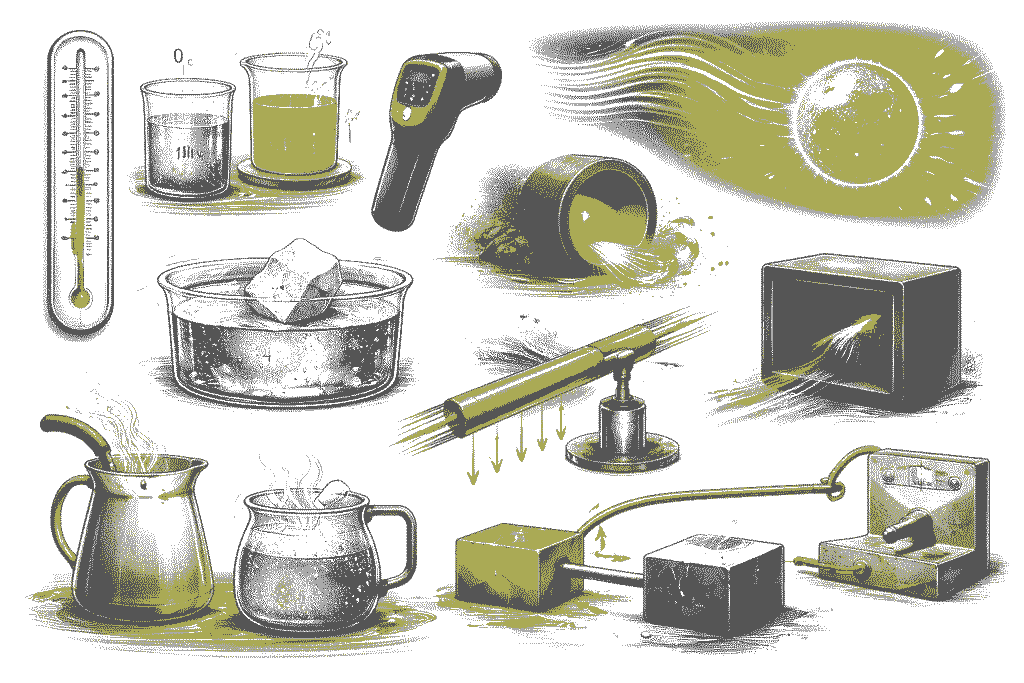
Temperature and Thermal Physics form the backbone of our understanding of heat, energy transfer, and the microscopic behavior of matter. These temperature and thermal physics concepts explain how substances respond to heating and cooling, how energy flows between systems, and how temperature governs physical changes at both macroscopic and atomic levels. In physics, temperature is not merely a measure of hotness or coldness; it is a fundamental thermodynamic parameter that reflects the average kinetic energy of particles within a system. Thermal physics extends this idea further by linking temperature to laws of thermodynamics, heat transfer mechanisms, thermal expansion, radiation, and phase transitions.
A major focus of Temperature and Thermal Physics MCQs is the interpretation of temperature scales such as Celsius, Fahrenheit, and Kelvin, along with precise conversions between them. These temperature and thermal physics questions often test conceptual clarity about absolute zero, triple point of water, anomalous expansion of water, and thermal equilibrium. Measurement of temperature using devices like mercury thermometers, resistance thermometers, thermocouples, and optical pyrometers also plays a vital role, especially in problems involving high-temperature sources such as stars and furnaces.
Thermal physics further explores how heat energy is transferred through conduction, convection, and radiation. Laws such as Wien’s displacement law, Stefan–Boltzmann law, and Kirchhoff’s law help explain black body radiation and thermal emission, which are essential for understanding stellar temperatures and real-world radiation detectors. Temperature and thermal physics MCQs frequently connect these laws to practical applications, including radiation pyrometers, thermopiles, and ideal black body approximations.
MCQs on Temperature and Thermal Physics :
1. On heating, the temperature at which water has minimum volume is
A. 0 °C
B. 4 °C
C. 4 K
D. 100 °C
Answer: B
2. Mercury boils at 367 °C. However, mercury thermometers can measure temperature up to 500 °C because of
A. Maintaining vacuum above mercury column
B. Filling nitrogen gas at high pressure above mercury column
C. Filling oxygen gas at high pressure above mercury column
D. Filling nitrogen gas at low pressure above mercury column
Answer: B
3. The door of an operating refrigerator is kept open. As a result, the temperature of the room
A. Remains unchanged
B. Increases
C. Decreases
D. Depends on contents inside the refrigerator
Answer: B
4. The triple point of water is
A. 273.16 °C
B. 273.15 K
C. 273.16 K
D. 0.15 K
Answer: B
5. The surface temperature of stars is determined using
A. Planck’s law
B. Wien’s displacement law
C. Rayleigh–Jeans law
D. Kirchhoff’s law
Answer: B
6. 30 °C temperature on the Fahrenheit scale is
A. 68 °F
B. 86 °F
C. 100 °F
D. 48.5 °F
Answer: B
7. The temperature of an object is 60 °C. Its value in Fahrenheit is
A. 120 °F
B. 130 °F
C. 140 °F
D. 110 °F
Answer: C
8. The color of a star indicates its
A. Velocity
B. Temperature
C. Size
D. Length
Answer: B
9. Absolute zero is the temperature at which
A. All substances become solid
B. Molecular motion ceases
C. Water freezes
D. None of these
Answer: B
10. A centigrade and Fahrenheit thermometer are dipped in boiling water. When the Fahrenheit thermometer reads 140°, the fall in centigrade reading is
A. 40°
B. 50°
C. 60°
D. 90°
Answer: A
11. The instrument used to measure temperature from thermal radiation is
A. Hygrometer
B. Barometer
C. Thermopile
D. Pyrometer
Answer: D
12. If the boiling point of water is 95 °F, the reduction on the Celsius scale is
A. 70 °C
B. 65 °C
C. 63 °C
D. 35 °C
Answer: D
13. The resistance of a metal increases with temperature because
A. Electron–electron collisions increase
B. Electron–lattice collisions increase
C. Number of conduction electrons decreases
D. Number of conduction electrons increases
Answer: B
14. In anomalous expansion of water, maximum density occurs at
A. 4 °C
B. < 4 °C
C. > 4 °C
D. 10 °C
Answer: A
15. Three bodies of masses m, m, and 3m at 40 °C, 60 °C, and 90 °C are mixed. Final temperature is
A. 45 °C
B. 54 °C
C. 52 °C
D. 48 °C
Answer: B
16. From the I–V characteristics of a metal wire at temperatures T₁ and T₂, it is concluded that
A. T₁ > T₂
B. T₁ < T₂
C. T₁ = T₂
D. T₁ ≠ T₂
Answer: B
17. A beaker filled with water at 40 °C will overflow
A. Only when cooled
B. Only when heated
C. When heated or cooled
D. Neither when heated nor cooled
Answer: C
18. A mercury thermometer inserted in hot water records
A. Average temperature of water
B. Surrounding temperature
C. Average temperature of water and thermometer
D. Temperature difference
Answer: A
19. Two similar heater coils take 10 minutes separately to boil water. If connected in series, time taken is
A. 15 min
B. 20 min
C. 7.5 min
D. 25 min
Answer: B
20. Which does not characterize the thermodynamic state of matter?
A. Temperature
B. Pressure
C. Work
D. Volume
Answer: C
21. Oxygen boils at –183 °C. This is approximately
A. 215 °F
B. –297 °F
C. 329 °F
D. 361 °F
t Answer: B
22. If water boils at 95 °C, its temperature in Fahrenheit is
A. 150 °F
B. 203 °F
C. 175 °F
D. 203 °F
Answer: D
23. Correct option for statements A and B is
A. Both true
B. Both false
C. A true, B false
D. A false, B true
Answer: D
24. Neutral temperature of a thermocouple is the temperature at which
A. EMF changes sign
B. EMF is maximum
C. EMF is minimum
D. EMF is zero
Answer: B
25. Mixing 50 g water at 10 °C with 50 g water at 100 °C gives final temperature
A. 80 °C
B. 55 °C
C. 52 °C
D. 45 °C
Answer: B
26. Device used to detect thermal radiation is
A. Thermopile
B. Liquid thermometer
C. Platinum resistance thermometer
D. Constant volume thermometer
Answer: A
27. A black body at 500 K emits energy proportional to
A. (500)³
B. (500)²
C. 500
D. (500)⁴
Answer: A
28. Which is closest to an ideal black body?
A. Black lamp
B. Cavity at constant temperature
C. Platinum black
D. Charcoal lamp
Answer: B
29. Mercury thermometer can measure temperature up to
A. 260 °C
B. 360 °C
C. 500 °C
D. 1000 °C
Answer: C
Conclusion: Importance of Temperature and Thermal Physics
A strong grasp of Temperature and Thermal Physics MCQs equips students with the ability to interpret thermal phenomena logically and quantitatively. These temperature and thermal physics questions test more than formula memorization—they demand clarity in concepts such as thermal expansion, heat flow, radiation laws, and temperature measurement techniques. By solving temperature and thermal physics MCQs related to black body radiation, thermodynamic states, and temperature-dependent properties of materials, learners develop a deeper understanding of how microscopic particle motion translates into observable thermal behavior.
Thermal physics also bridges classical mechanics and modern physics, offering insight into energy conservation, entropy, and equilibrium conditions. Repeated practice of temperature and thermal physics MCQs enhances speed, accuracy, and confidence, which is crucial in competitive examinations where time management is as important as conceptual strength. Moreover, these temperature and thermal physics concepts have strong real-world relevance, from climate science and engineering to astrophysics and medical instrumentation.
In essence, Temperature and Thermal Physics provide a unified framework for understanding heat and energy across scales. Consistent temperature and thermal physics MCQ practice transforms this foundational knowledge into exam-ready expertise, making it an indispensable part of physics preparation.

Amal Augustine is the founder of ExQuizMe, a dynamic learning and quiz platform built to make education engaging, competitive, and fun. A passionate learner and an academic achiever, Amal completed his schooling at Government HSS Manjapra, graduating with 92.5% in Computer Science. He later earned his degree from St. Stephen’s College, University of Delhi, one of India’s most prestigious arts and science institutions.
Currently, Amal is pursuing his Master’s degree at National Sun Yat-sen University, Taiwan, where he continues to deepen his interest in research and technology. Throughout his school and college years, he won 50+ national-level interschool and collegiate quiz competitions, was
Beyond academics, Amal Augustine is an avid reader of science journals, a dedicated research student, and a technology enthusiast who loves programming and exploring the world of Computer Science. Through ExQuizMe, he aims to make learning accessible, enjoyable, and empowering for students across the globe.