
- iamal
- January 15, 2026
The Brilliant Science Behind Vibrations of Strings
Understanding vibrations of strings and air columns is a cornerstone of wave motion and acoustics in physics.Vibrations of Strings questions based on sonometer wires, standing waves, overtones, harmonics, organ pipes, and resonance phenomena are extremely common in competitive examinations such as NEET, JEE, and state-level entrance tests. The vibration of strings MCQs listed above collectively test conceptual clarity, mathematical relations, and physical interpretation of sound and wave behavior.
At the most fundamental level, forces like tension in a string and friction originate from electromagnetic forces, as they arise due to interactions between atoms and molecules. This underlying vibrations of strings idea links mechanics with electromagnetism and forms the basis of wave propagation in strings.
Vibrations of Strings Stretched
When a string is fixed at both ends and set into vibration, it produces stationary (standing) transverse waves. The simplest mode is the fundamental frequency, followed by overtones or harmonics. In such systems:
-
The fundamental frequency is given by
f=v2Lf = \frac{v}{2L}
-
The first overtone corresponds to the second harmonic
-
The third overtone corresponds to the fourth harmonic
Vibrations of strings MCQs involving sonometer wires test the relationship between length, frequency, wave velocity, number of nodes, and antinodes. For example, a string vibrating in the third overtone has five loops, six nodes, and five antinodes, confirming the standing wave pattern.
Reflection of waves at a fixed end results in a phase change of π (180°), a vibrations of strings concept repeatedly tested in wave-pulse and reflection-based questions.
Stationary Waves and Node–Antinode Patterns
A stationary wave is formed by the superposition of two identical waves traveling in opposite directions. Important properties include:
-
Nodes: Points of zero displacement
-
Antinodes: Points of maximum displacement
-
Distance between successive nodes = λ/2
-
Length of one loop = λ/2
Questions asking about number of nodes and antinodes, or loop length, directly apply these principles.
Musical Instruments: Sitar and Organ Pipes
In instruments like the sitar, vibrations are stationary transverse waves on strings. In contrast, organ pipes involve stationary longitudinal waves in air columns.
Open Organ Pipes
-
Both ends are displacement antinodes
-
All harmonics are present
-
Frequencies: n,2n,3n,4n,…n, 2n, 3n, 4n, \dots
Closed Organ Pipes
-
One end node, one end antinode
-
Only odd harmonics are present
-
Frequencies: n,3n,5n,…n, 3n, 5n, \dots
Vibrations of strings MCQs often use frequency ratios like 1:3:5 to identify a closed organ pipe. Relationships between open and closed pipes, resonance conditions, and effects of temperature on frequency are also frequently examined.
MCQs on Vibrations of Strings:
1.
Force of friction and tension in a string are in origin
a) Gravitational forces
b) Electromagnetic forces
c) Nuclear forces
d) Weak nuclear forces
Answer-b
2.
An elastic string of length 2 m is fixed at one end. The string vibrates in the third overtone with a frequency 1200 Hz. The ratio of frequency of first overtone and fundamental is
a) 1 : 1
b) 2 : 1
c) 3 : 1
d) 4 : 1
Answer-c
3.
When a sonometer wire vibrates in the third overtone, there are
a) 6 nodes and 5 antinodes
b) 5 nodes and 4 antinodes
c) 4 nodes and 5 antinodes
d) 4 nodes and 3 antinodes
Answer-b
4.
A standing wave having 5 nodes and 4 antinodes is formed on a string of length 100 cm. Length of each loop is
a) 25 cm
b) 20 cm
c) 50 cm
d) 40 cm
Answer-a
5.
In a sitar, which type of vibration is produced?
a) Progressive longitudinal
b) Stationary longitudinal
c) Progressive transverse
d) Stationary transverse
Answer-d
6.
A wave reflected from a rigid support undergoes a phase change of
a) π/4
b) π/2
c) π
d) 2π
Answer-c
7.
A string of length 5 m has a fundamental frequency of 20 Hz. Frequency of the second overtone is
a) 40 Hz
b) 50 Hz
c) 60 Hz
d) 30 Hz
Answer-c
8.
A pulse reaching a fixed end of a string is reflected with
a) 180° phase change and reversed velocity
b) Same phase, no velocity reversal
c) 180° phase change, no velocity reversal
d) Same phase with reversed velocity
Answer-a
9.
A sonometer wire of length 100 cm has fundamental frequency 330 Hz. Wave velocity is
a) 300 m/s
b) 660 m/s
c) 115 m/s
d) 990 m/s
Answer-b
10.
For a stretched string of length L fixed at both ends, fundamental frequency is
a) v / 2L
b) v / L
c) v / 4L
d) v / 3L
Answer-a
11.
Maximum wavelength on a string of length 40 cm is
a) 20 cm
b) 40 cm
c) 120 cm
d) 80 cm
Answer-d
12.
A node is formed 10 cm from a fixed end for a 100 Hz wave. Wave speed is
a) 5 m/s
b) 10 m/s
c) 20 m/s
d) 40 m/s
Answer-c
13.
An open organ pipe of length 40 cm produces second harmonic of frequency
a) 900 Hz
b) 180 Hz
c) 450 Hz
d) 720 Hz
Answer-a
14.
Organ pipe with resonance frequencies in ratio 1:3:5 has length
a) 1 m
b) 1.5 m
c) 2 m
d) 0.5 m
Answer-a
15.
First overtone of an open pipe equals fundamental of a closed pipe of length 20 cm. Length of open pipe is
a) 60 cm
b) 80 cm
c) 120 cm
d) 70 cm
Answer-b
16.
A resonance air column of length 20 cm resonates at 250 Hz. Speed of sound is
a) 300 m/s
b) 200 m/s
c) 150 m/s
d) 75 m/s
Answer-b
17.
Closed organ pipe with 2 nodes and 2 antinodes vibrates in
a) Fundamental
b) 2nd overtone
c) 3rd overtone
d) 1st overtone
Answer-d
18.
A pipe open at both ends of length 1 m cannot resonate at
a) 510 Hz
b) 170 Hz
c) 85 Hz
d) 340 Hz
Answer-c
19.
Organ pipe producing 240 Hz, 720 Hz, and 1200 Hz is
a) Closed at one end
b) Open at both ends
c) Closed at both ends
d) Flute
Answer-a
20.
For beats, two notes must have
a) Different amplitudes and frequencies
b) Nearly equal frequencies and equal amplitudes
c) Exactly equal frequencies
d) Exactly equal amplitudes
Answer-b
21.
Water poured into a long closed organ pipe causes fundamental frequency to
a) Increase continuously
b) Increase then remain constant
c) Decrease continuously
d) Decrease then remain constant
Answer-d
22.
With increase in temperature, organ pipe frequency
a) Increases
b) Decreases
c) Remains same
d) Cannot be predicted
Answer-a
23.
Waves in a closed organ pipe are
a) Longitudinal progressive
b) Transverse progressive
c) Transverse stationary
d) Longitudinal stationary
Answer-d
24.
Closed pipe fundamental is 100 Hz. Open pipe frequencies are
a) 100, 200, 300…
b) 100, 300, 500…
c) 200, 400, 500…
d) 200, 400, 600, 800…
Answer-d
25.
Correct statement about stationary waves is
a) Closed pipe has all harmonics
b) Open pipe has only even harmonics
c) Distance between nodes equals λ
d) First overtone = second harmonic
Answer-d
26.
If fundamental frequency of open pipe is n, other frequencies are
a) n, 2n, 3n, 4n
b) n, 3n, 5n
c) n, 2n, 4n, 8n
d) None
Answer-a
27.
Pipe producing 100 Hz, 300 Hz, 500 Hz is
a) Open at both ends
b) Closed at both ends
c) One end closed
d) None
Answer-c
28.
Harmonics present in a pipe open at one end are
a) Odd harmonics
b) Even harmonics
c) Both
d) None
Answer-a
29.
System with resonances at 100 Hz, 300 Hz, 500 Hz is
a) Pipe closed at one end
b) Pipe open at both ends
c) Pipe closed at both ends
d) None
Answer-a
30.
If fundamental of closed pipe equals second harmonic of open pipe, ratio of lengths is
a) 1 : 2
b) 1 : 4
c) 1 : 8
d) 1 : 16
Answer-b
Conclusion on Vibrations of Strings
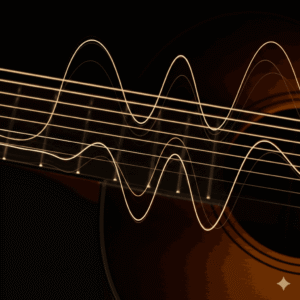
The study of vibrations of strings forms a crucial part of wave mechanics and helps in understanding how sound and mechanical energy are produced, transmitted, and sustained in physical systems. When a string is stretched between two fixed points and set into vibration, it does not oscillate randomly. Instead, it produces well-defined stationary (standing) waves governed by the principles of superposition, boundary conditions, and elasticity.
In vibrations of strings, the formation of nodes and antinodes clearly demonstrates how energy remains localized while the wave pattern appears stationary. The fundamental mode and higher harmonics depend on key physical parameters such as the length of the string, tension applied, and linear mass density. These relationships explain why increasing tension raises pitch, while increasing length or mass lowers it—vibrations of strings concepts that are essential in understanding musical instruments like the sitar, violin, and guitar.
Another important outcome of vibrations of strings is the presence of harmonics and overtones, which give rise to the richness and quality (timbre) of sound. The fundamental frequency determines the pitch, while overtones shape the character of the sound produced. This vibrations of strings principle finds applications not only in acoustics but also in engineering fields such as signal processing and mechanical design.
In conclusion, vibrations of strings provide a practical and theoretical framework for studying wave behavior. They bridge the gap between abstract wave equations and real-world applications, making them an indispensable topic in physics education. Mastery of this vibrations of strings topic strengthens the foundation for advanced studies in acoustics, wave optics, and modern physics.