
- iamal
- January 6, 2026
Boost Your Score: Ultimate Thermodynamic Processes and Laws MCQs for NEET,JEE & CUET
Thermodynamics forms one of the most conceptually rich and application-oriented chapters in physics, bridging microscopic molecular behavior with macroscopic physical laws. A strong understanding of thermodynamic processes and laws MCQs is essential for students preparing for competitive examinations such as NEET, JEE, and senior secondary board exams, where questions frequently test both conceptual clarity and analytical reasoning. These Thermodynamic processes and laws MCQs are not limited to formula substitution; instead, they demand a clear grasp of physical principles, sign conventions, and logical interpretation of thermodynamic behavior.
At the foundation of thermodynamics lie its laws—the Zeroth, First, Second, and Third Laws—which define temperature, energy conservation, direction of natural processes, and absolute zero. Among these, the Zeroth and First Laws play a dominant role in thermodynamics processes and laws MCQ-based examinations. The Zeroth Law introduces the concept of thermal equilibrium and temperature measurement, while the First Law establishes the relationship between heat, work, and internal energy. Most thermodynamic processes and laws MCQs revolve around identifying correct energy balances, recognizing state functions, and interpreting physical meaning rather than performing lengthy calculations.
Equally important are thermodynamic processes and laws mcqs, such as isothermal, adiabatic, isochoric, isobaric, and cyclic processes. Each process has distinct characteristics regarding heat exchange, work done, and internal energy change.Thermodynamic processes and laws MCQs based on these processes often test whether students can correctly apply conditions like ΔQ = 0, ΔW = 0, or ΔU = 0 under specific constraints.
30 Thermodynamic Processes and Laws MCQs-
1.
If Q, E and W denote respectively the heat added, change in internal energy and the work done in a closed cycle process, then
A. Q = 0
B. W = 0
C. E = 0
D. Q = W = 0
Answer: C
2.
Consider the following two statements:
A: If heat is added to a system, its temperature must always increase.
B: If positive work is done by a system, its volume must increase.
A. Both A and B are correct
B. A is correct, but B is wrong
C. B is correct, but A is wrong
D. Both A and B are wrong
Answer: C
3.
A: Neutral temperature does not depend on cold junction temperature.
B: Inversion temperature does not depend on cold junction temperature.
A. A wrong, B correct
B. A correct, B wrong
C. Both correct
D. Both wrong
Answer: B
4.
First law of thermodynamics states that
A. System can do work
B. System has temperature
C. System has pressure
D. Heat is a form of energy
Answer: D
5.
Degrees of freedom of a triatomic gas molecule are
A. 2
B. 4
C. 6
D. 8
Answer: C
6.
A gas in an airtight container is heated from 25°C to 90°C. The density will
A. Increase slightly
B. Remain the same
C. Increase considerably
D. Decrease slightly
Answer: B
7.
Two ice blocks join when pressed together because
A. Heat is produced
B. Cold is produced
C. Melting point decreases with pressure
D. Melting point increases with pressure
Answer: C
8.
Which does NOT characterize the thermodynamic state of matter?
A. Temperature
B. Pressure
C. Work
D. Volume
Answer: C
9.
When a flask filled with liquid is heated, the level
A. Rises immediately
B. Initially falls then rises
C. Rises abruptly
D. Falls abruptly
Answer: B
10.
Latent heat of vaporization of water is 2250 J/kg. If work done in vaporising 1 kg is 168 J, increase in internal energy is
A. 1984 J
B. 2250 J
C. 3202 J
D. 2082 J
Answer: D
11.
Which is correct?
A. Heat & work are intrinsic
B. Neither heat nor work is intrinsic
C. Heat intrinsic, work not
D. Work intrinsic, heat not
Answer: B
12.
A cycle tyre bursts suddenly. The process is
A. Isothermal
B. Adiabatic
C. Isochoric
D. Isobaric
Answer: B
13.
When gas temperature increases
A. Kinetic energy increases
B. Total energy constant
C. Potential energy increases
D. Only potential energy increases
Answer: A
14.
Which is a state function?
A. dQ
B. dW
C. dU
D. dQ and dW
Answer: C
15.
If R/Cv = 0.67, the gas is
A. Monoatomic
B. Diatomic
C. Polyatomic
D. Mixture
Answer: A
16.
A heated copper disc with a central hole will have hole diameter
A. Increase
B. Decrease
C. First decrease then increase
D. Unchanged
Answer: A
17.
Change in internal energy in one complete cyclic process is
A. Path dependent
B. Always positive
C. Always zero
D. Always negative
Answer: C
18.
During melting of ice at 273 K
A. Work done by system
B. Work done on system by atmosphere
C. Internal energy decreases
D. None
Answer: B
19.
Isochoric process with ΔU increase and heat expelled ΔQ. Ratio ΔU : ΔQ is
A. −1
B. −0.5
C. 2
D. −2
Answer: C
20.
Which is NOT a thermodynamic function?
A. Enthalpy
B. Work
C. Gibbs energy
D. Internal energy
Answer: B
21.
Which process is reversible?
A. Radiation
B. Electrical heating
C. Conduction
D. Isothermal compression
Answer: D
22.
Ice blocks join on pressing because
A. Melting point lowers with pressure
B. Melting point increases
C. No change in melting point
D. Ice melts at 0°C
Answer: A
23.
Incorrect statement is
A. Adiabatic → Q = 0
B. Isochoric → Volume variable
C. Isobaric → Pressure constant
D. Cyclic → Returns to initial state
Answer: B
24.
For isothermal process
A. ΔT = 0
B. ΔP = 0
C. ΔV = 0
D. ΔQ = 0
Answer: A
25.
No work is done in
A. Isothermal
B. Adiabatic
C. Cyclic
D. Isochoric
Answer: D
26.
Entropy in reversible adiabatic process
A. Remains constant
B. Increases
C. Decreases
D. May vary
Answer: A
27.
In an indicator diagram, negative work indicates
A. Compression
B. Expansion
C. No work
D. Infinite work
Answer: A
28.
First law of thermodynamics mathematically is
A. dU = dQ − dW
B. dQ = dU − dW
C. dW = dQ + dU
D. dU = dQ + dW
Answer: A
29.
Thermodynamic equilibrium between systems implies equality of
A. Heat
B. Pressure
C. Temperature
D. Energy
Answer: C
30.
The process in which ΔQ < 0 and ΔW = 0 for ideal gas causes
A. Temperature decrease
B. Pressure constant
C. Volume increase
D. Temperature increase
Answer: A
Conclusion on Thermodynamic Processes and Laws MCQs
In conclusion, mastering thermodynamic processes and laws MCQs is not merely about memorizing equations but about developing a coherent understanding of how energy flows, transforms, and conserves in physical systems. Thermodynamics demands precision in reasoning, clarity in definitions, and careful attention to conditions under which different laws and processes apply. Thermodynamic processes and laws MCQs in this topic are designed to assess these very skills, making systematic practice indispensable.
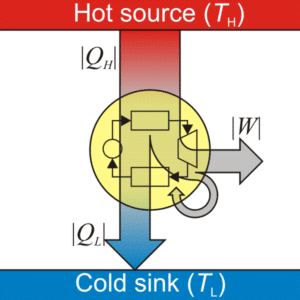
A thorough command over thermodynamic processes and laws mcqs enables students to confidently analyze heat and work interactions, recognize cyclic behavior where net internal energy change is zero, and correctly interpret real-world phenomena such as engine cycles, refrigeration, and phase changes. Similarly, fluency in thermodynamic processes and laws MCQs allows learners to quickly classify problems based on constraints like constant temperature, volume, or entropy, which significantly reduces error rates in objective examinations.
Consistent exposure to thermodynamic processes and laws MCQs enhances conceptual retention and sharpens problem-solving speed—both crucial in time-bound competitive tests. It also helps students internalize fundamental principles, such as the conservation of energy and the directionality imposed by natural laws, which remain relevant across multiple chapters of physics.
Ultimately, a strong foundation in thermodynamic processes and laws MCQs empowers students to approach advanced topics with confidence, connect theory with practical applications, and perform reliably under exam pressure. With focused thermodynamic processes and laws MCQs practice and conceptual clarity, thermodynamics transforms from a challenging topic into a scoring and intellectually rewarding area of physics.