
- iamal
- January 5, 2026
The Ultimate Guide to Thermal Expansion and temperature Measurement :Smart MCQs that builds Strong Basics
Understanding thermal expansion and temperature measurement heat transfer is fundamental to mastering thermal physics. These thermal expansion and temperature measurement concepts explain why metals expand on heating, how thermometers work, why bimetallic strips bend, and how energy transfer occurs without mechanical work. From gas thermometers and thermocouples to expansion of solids, liquids, and cavities, thermal physics connects microscopic molecular motion with observable macroscopic behavior.
Thermal Expansion and Temperature Measurement MCQs are designed to strengthen conceptual clarity and numerical reasoning. They cover a wide range of exam-relevant topics such as coefficients of expansion, heat capacity, thermoelectric effects, phase change, and material behavior under temperature variation.
MCQs on Thermal Expansion and Temperature Measurement :
1. For a constant volume gas thermometer, the gas should be filled at
A. High temperature and low pressure
B. High temperature and high pressure
C. Low temperature and low pressure
D. Low temperature and high pressure
Answer: B
2. Which denotes the smallest temperature?
A. 1° Celsius
B. 1 Kelvin
C. 1° Fahrenheit
D. 1° Reaumur
Answer: B
3. The surface temperature of the Sun is nearly
A. 2000 K
B. 4000 K
C. 6000 K
D. 8000 K
Answer: C
4. Which statement about heat is correct?
A. Energy transfer without temperature difference is not heat
B. Energy transfer always needs temperature difference
C. Length and volume remain same on heating
D. Heat is the only mode of energy transfer
Answer: A
5. An ideal thermometer should have
A. Small heat capacity
B. Large heat capacity
C. Medium heat capacity
D. Variable heat capacity
Answer: A
6. A solid metal ball with a concentric cavity is heated. The cavity volume will
A. Increase
B. Decrease
C. Remain unchanged
D. Collapse
Answer: A
7. When a body is heated, the maximum increase occurs in
A. Length
B. Area
C. Volume
D. Density
Answer: C
8. If the coefficient of cubical expansion of metal is less than water, the apparent weight of metal in water on heating
A. Increases
B. Decreases
C. Remains same
D. Becomes zero
Answer: B
9. On heating an iron sphere, its
A. Density decreases
B. Density increases
C. Radius decreases
D. Mass decreases
Answer: A
10. Percentage change is maximum in
A. Radius
B. Volume
C. Density
D. Mass
Answer: B
11. A bimetallic strip bends because
A. One metal has more density
B. One metal has higher specific heat
C. Metals melt differently
D. Coefficients of expansion differ
Answer: D
12. A rotating metallic rod heated uniformly will have angular speed
A. Increased
B. Unchanged
C. Decreased
D. Zero
Answer: C
13. Thermo-emf in thermocouples connected in series
A. Decreases
B. Increases
C. Becomes zero
D. Remains same
Answer: B
14. If tensile force is suddenly removed from a stretched wire, its temperature
A. Decreases
B. Increases
C. Remains constant
D. Becomes zero
Answer: B
15. A hole in a heated copper plate will
A. Increase in size
B. Decrease
C. Remain same
D. Close
Answer: A
16. Heating coil time doubles when two identical coils are connected in series because
A. Resistance halves
B. Power decreases
C. Voltage doubles
D. Heat capacity increases
Answer: D
17. Peltier effect is the reverse of
A. Thomson effect
B. Joule effect
C. Fleming’s rule
D. Seebeck effect
Answer: D
18. If coefficient of cubical expansion is X times superficial expansion, X equals
A. 0.5
B. 1
C. 1.5
D. 4
Answer: C
19. Pipes burst in winter because
A. Water expands on freezing
B. Metal contracts more
C. Pressure decreases
D. Water density increases
Answer: A
20. Thermal capacity depends on
A. Mass
B. Shape
C. Density
D. Temperature only
Answer: A
21. During vaporization
A. Temperature remains constant
B. Liquid and vapor coexist
C. Change of state occurs
D. All of the above
Answer: D
22. Copper is used in calorimeters because
A. Zero specific heat
B. Low specific heat
C. High conductivity
D. No expansion
Answer: B
23. Direct solid-to-gas conversion is called
A. Sublimation
B. Condensation
C. Vaporization
D. Boiling
Answer: A
24. Interference is observed in
A. Transverse waves
B. Longitudinal waves
C. Both
D. None
Answer: C
25. Fringe width increases when slit separation
A. Increases
B. Decreases
C. Remains same
D. Becomes zero
Answer: A
26. Neutral temperature of a thermocouple is the temperature at which
A. Thermo-emf is zero
B. Thermo-emf changes sign
C. Thermo-emf is maximum
D. Thermo-emf is minimum
Answer: C
27. When equal masses of water at different temperatures are mixed, the final temperature depends on
A. Initial temperatures only
B. Mass only
C. Specific heat only
D. Mass and initial temperatures
Answer: D
28. The resistance of a metal increases with temperature because
A. Electron density decreases
B. Lattice vibrations increase
C. Atomic spacing decreases
D. Drift velocity increases
Answer: B
29. Which thermometer is most suitable for measuring very high temperatures?
A. Mercury thermometer
B. Alcohol thermometer
C. Platinum resistance thermometer
D. Optical pyrometer
Answer: D
30. The Stefan–Boltzmann law states that radiant energy emitted is proportional to
A. T
B. T²
C. T³
D. T⁴
Answer: D
31. An ideal black body is one which
A. Reflects all radiation
B. Emits maximum radiation
C. Absorbs maximum radiation
D. Emits and absorbs no radiation
Answer: C
32. Which of the following remains constant during a change of phase?
A. Temperature
B. Volume
C. Density
D. Pressure
Answer: A
33. The anomalous expansion of water occurs between
A. 0°C to 100°C
B. 0°C to 4°C
C. 4°C to 100°C
D. Below 0°C
Answer: B
34. A constant volume gas thermometer is preferred because
A. It is cheap
B. It is independent of gas used
C. It gives linear response
D. It is highly sensitive
Answer: B
35. Which quantity does NOT depend on temperature?
A. Resistance of metals
B. Density of liquids
C. Mass of a body
D. Volume of solids
Answer: C
Conclusion : Thermal Expansion and Temperature Measurement
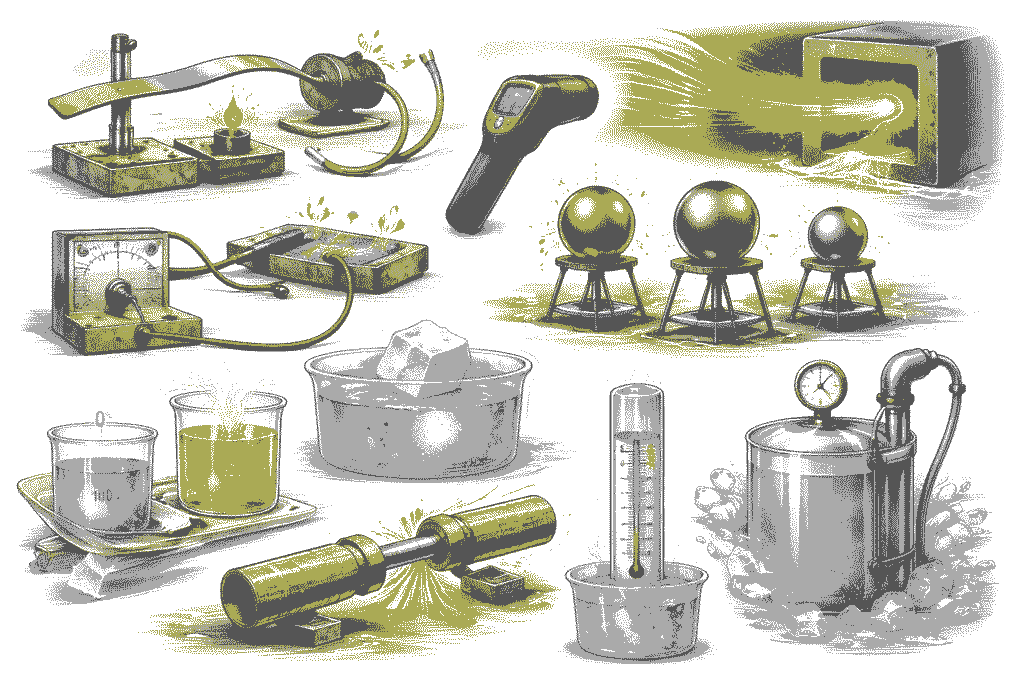
In conclusion, thermal expansion and temperature measurement together form a crucial foundation in thermal physics, explaining how matter responds to changes in heat and how those changes are quantified accurately. Thermal expansion reveals the microscopic behavior of particles as temperature varies, helping us understand real-world phenomena such as expansion of solids, liquids, and gases, bending of bimetallic strips, stress development in constrained materials, and the need for expansion joints in engineering structures. At the same time, accurate temperature measurement allows these changes to be observed, analyzed, and compared using standardized scales and reliable instruments.
These Thermal Expansion and Temperature Measurement MCQs comprehensively cover how materials respond to heat, how temperature is measured accurately, and how thermal energy governs physical transformations. By practicing such thermal expansion and temperature measurement concept-oriented questions, learners develop strong intuition about real-world thermal behavior, from bending bimetallic strips to designing thermometers and preventing structural damage due to expansion.
Moreover, combining thermal expansion and temperature measurement strengthens conceptual clarity in problem-solving and experimentation. Many thermal expansion and temperature measurement practical situations—such as thermometer corrections, apparent expansion of liquids, stress in rails, and behavior of cavities in heated solids—require simultaneous application of both ideas. Mastery of these thermal expansion and temperature measurement topics enables students to confidently analyze numerical problems, interpret experimental data, and avoid common misconceptions, especially in competitive examinations.
Overall, a solid grasp of thermal expansion and temperature measurement transforms abstract thermal concepts into tangible physical understanding. Regular practice of thermal expansion and temperature measurement related questions not only enhances accuracy and speed but also builds confidence in applying thermal principles across physics, engineering, and everyday technology, making these thermal expansion and temperature measurement topics essential for academic and practical success.