
- iamal
- January 5, 2026
Avoid Mistakes in Thermal Energy and Heat Transfer MCQs : Proven Concepts for NEET,JEE & CUET
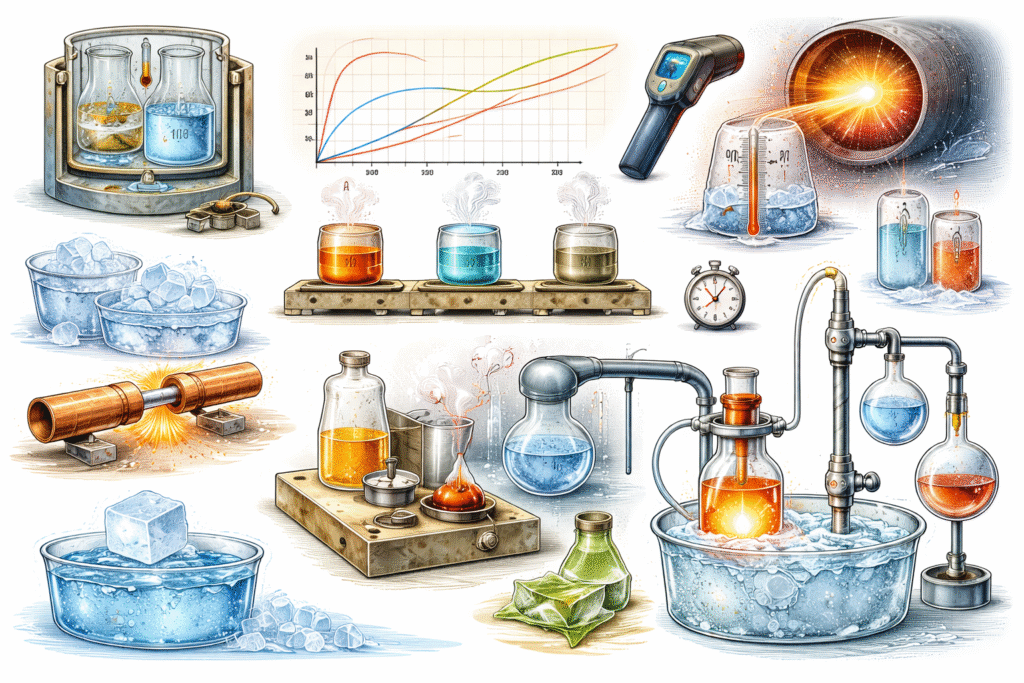
Thermal energy and heat transfer form a foundational pillar of physics, connecting microscopic molecular motion with observable macroscopic phenomena. Thermal Energy and heat transfer concepts such as temperature, heat, specific heat capacity, latent heat, thermal expansion, and modes of heat transfer are essential for understanding how energy flows within and between systems. For students preparing for board examinations and competitive tests like JEE and NEET, mastering these ideas through Thermal Energy and Heat Transfer MCQs is one of the most effective learning strategies.
Multiple-choice questions on thermal energy and heat transfer play a critical role in strengthening conceptual clarity because they test not only factual recall but also analytical reasoning and application skills. Thermal Energy and heat transfer MCQs on thermal energy often integrate real-life situations—such as phase changes of matter, cooling curves, radiation from hot bodies, and efficiency of heat engines—requiring students to interpret physical principles rather than rely on memorization alone. Thermal Energy and heat transfer topics like specific heat capacity explain why water is an effective coolant, while latent heat concepts clarify why temperature remains constant during melting and boiling processes.
Heat transfer mechanisms—conduction, convection, and radiation—bridge physics with everyday experiences, from cooking food to understanding atmospheric circulation. Thermal energy and heat transfer questions involving black body radiation, Wien’s displacement law, and Stefan–Boltzmann law further extend thermal physics into astrophysics and modern technology. Practicing thermal energy and heat transfer MCQs enables learners to recognize subtle distinctions, avoid common misconceptions, and develop speed and accuracy under exam conditions.Moreover, Thermal Energy and Heat Transfer MCQs encourage interdisciplinary thinking by linking thermodynamics with material science, meteorology, and engineering applications.
MCQs on Thermal Energy and Heat Transfer :
1. A quantity of heat required to change the unit mass of a solid substance to its liquid state, while the temperature remains constant, is known as
A. Latent heat of vaporization
B. Latent heat of fusion
C. Heat of condensation
D. Specific heat
Answer: B
2. The SI unit of specific heat capacity is:
A. J K⁻¹
B. J kg⁻¹
C. J mol⁻¹ K⁻¹
D. J kg⁻¹ K⁻¹
Answer: D
3. A piece of blue glass heated to a high temperature and a piece of red glass at room temperature are taken inside a dimly lit room. Then:
A. Blue looks blue, red looks usual
B. Red looks brighter, blue ordinary
C. Blue shines brighter red than red glass
D. Both look equally red
Answer: C
4. Water is used as a coolant in automobile radiators owing to its high:
A. Viscosity
B. Surface tension
C. Latent heat
D. Specific heat capacity
Answer: D
5. Consider boiling water converting into steam. Under this condition, the specific heat of water is:
A. Less than zero
B. Zero
C. Slightly greater than zero
D. Infinite
Answer: D
6. Copper and silicon are cooled from 300 K to 60 K. The specific resistance:
A. Decreases in copper but increases in silicon
B. Increases in copper but decreases in silicon
C. Increases in both
D. Decreases in both
Answer: A
7. An electric fan is switched on in a closed room. The air in the room is:
A. Cooled
B. Heated
C. Maintains same temperature
D. Depends on atmospheric pressure
Answer: B
8. The specific heat capacity of a body depends on:
A. Temperature
B. Heat supplied
C. Amount of body
D. Material of the body
Answer: D
9. The mechanical equivalent of heat:
A. Has same dimension as heat
B. Has same dimension as work
C. Has same dimension as energy
D. Is dimensionless
Answer: D
10. If the heat capacity of a body is infinite, then the body:
A. Gives out heat
B. Takes in heat
C. Shows no change in temperature
D. All of these
Answer: C
11. Heat required to melt 1 g of ice is 80 cal. A man melts 60 g of ice by chewing in one minute. His power is:
A. 4800 W
B. 336 W
C. 1.33 W
D. 0.75 W
Answer: B
12. Match the following is correctly given by:
A. (i–C), (ii–D), (iii–B), (iv–A)
B. (i–A), (ii–C), (iii–D), (iv–B)
C. (i–D), (ii–B), (iii–A), (iv–C)
D. (i–D), (ii–B), (iii–A), (iv–C)
Answer: A
13. Water and turpentine oil are heated to the same temperature and allowed to cool. The cooling curves of water and oil respectively are represented by:
A. A and B
B. B and A
C. Same curves
D. None
Answer: A
14. Which statement is NOT true?
A. Specific heat depends on nature, not quantity
B. Specific heat depends on temperature
C. Specific heat of water does not vary
D. SI unit is J kg⁻¹ K⁻¹
Answer: C
15. A beaker filled with water at 4°C. Identify incorrect statement:
A. Overflows when heated above 4°C
B. Overflows when cooled below 4°C
C. Overflows when heated or cooled
D. Will not overflow when cooled below 4°C
Answer: D
16. Which substance has the least heat capacity if heated equally?
A. A
B. B
C. C
D. Cannot be determined
Answer: A
17. Specific heat of aluminium = 24.4 J/mol-K. Its value in J/kg-K is:
A. 500
B. 600
C. 900
D. 1200
Answer: C
18. Specific heat of solids at constant volume Cv:
A. Independent of temperature
B. Increases with temperature, differs for solids
C. Increases with temperature and becomes zero
D. None
Answer: C
19. Which process depends on gravity?
A. Radiation
B. Convection
C. Conduction
D. None
Answer: B
20. Wien’s displacement law relates:
A. λmax and absolute temperature
B. Energy and wavelength
C. Emissive power and temperature
D. Colour and temperature
Answer: A
21. A black body at 727°C radiates energy proportional to:
A. (727)⁴
B. (1000)⁴
C. (727)²
D. (1000)²
Answer: B
22. Radiation emitted by human body:
A. Seasonal
B. Ultraviolet
C. Invisible
D. Only daytime
Answer: C
23. Colour change of heated iron is explained by:
A. Stefan’s law
B. Wien’s displacement law
C. Kirchhoff’s law
D. Newton’s cooling law
Answer: B
24. Largest specific heat:
A. Mercury
B. Water
C. Iron
D. Diamond
Answer: B
25. 20 g ice + 20 g hot water → final temp = 0°C. Hot water temp was:
A. 40°C
B. 72°C
C. 80°C
D. 96°C
Answer: C
26. Boiling water at 100°C mixed with cold water in ratio 1:3 gives 37°C. Cold water temp =
A. 4°C
B. 9°C
C. 12°C
D. 16°C
Answer: D
27. When ice melts, the system undergoes:
A. Entropy ↑, internal energy ↑
B. Entropy ↓, internal energy ↓
C. Entropy ↓, internal energy ↑
D. Entropy ↑, internal energy ↓
Answer: A
28. Boiling point is the temperature at which:
A. Dew point occurs
B. Vapour pressure equals atmospheric pressure
C. Internal energy equals zero
D. None
Answer: B
29. Ice line in P–T diagram has:
A. Positive slope
B. Negative slope
C. Parallel to pressure axis
D. Parallel to temperature axis
Answer: B
30. A man with dark skin experiences:
A. Less heat, less cold
B. Less heat, more cold
C. More heat, more cold
D. More heat, less cold
Answer: C
31. Latent heat is represented in graph by:
A. AB and BC
B. BC and DE
C. CD and DC
D. DE and AB
Answer: B
32. Heat needed to change liquid to gas at constant temperature is:
A. Specific heat
B. Mechanical equivalent
C. Latent heat of vaporization
D. Quenching
Answer: C
33. Correct statement about specific heat:
A. Depends on mass and shape
B. Independent of mass and shape
C. Depends only on temperature
D. None
Answer: B
34. Correct statements about latent heat:
A. Fixed at given temperature
B. Depends on temperature and volume
C. Independent of temperature and volume
D. Depends on temperature only
Answer: B
35. Two beakers at 4°C heated and cooled respectively. Result:
A. Level in B decreases
B. Overflows in A only
C. Overflows in both
D. Level in A decreases
Answer: C
36. Heat required to raise temperature of a body by 1°C is called:
A. Water equivalent
B. Thermal capacity
C. Specific heat
D. Temperature gradient
Answer: B
Conclusion on Thermal Energy and Heat Transfer
In conclusion, Thermal Energy and Heat Transfer MCQs serve as a powerful tool for consolidating theoretical knowledge and sharpening exam readiness. The study of thermal physics is not limited to equations and definitions; it demands a deep understanding of how energy behaves during heating, cooling, expansion, phase transitions, and radiation. Thermal energy and heat transfer MCQs help students revisit these concepts repeatedly in varied contexts, reinforcing learning through active recall and critical thinking.
By practicing thermal energy and heat transfer MCQs on specific heat, latent heat, calorimetry, thermal expansion, and radiation laws, learners develop a strong conceptual framework that allows them to tackle unfamiliar problems with confidence. These thermal energy and heat transfer questions also highlight the interconnected nature of thermal phenomena, such as the relationship between temperature and molecular motion or the dependence of radiation on absolute temperature.
Ultimately, mastering thermal physics through MCQs prepares students not only for exams but also for advanced studies in physics, engineering, and applied sciences. A systematic approach to Thermal Energy and Heat Transfer MCQs transforms complex concepts into manageable knowledge, fostering both academic success and a deeper appreciation of the physical world.