
- iamal
- January 2, 2026
Surface Tension and Capillarity MCQs: Master Fluid Surface Phenomena for Physics Exams
Understanding the behavior of liquids at their surfaces is a crucial part of physics, especially in topics related to surface tension, capillary action, molecular forces, and thermal effects. Surface tension and Capillarity MCQs based on these concepts frequently appear in board exams, JEE, NEET, and other competitive tests, as they combine theory, reasoning, and real-life applications.
Surface tension and capillarity are closely related phenomena that arise due to intermolecular forces acting within liquids and at their surfaces, and together they explain many observable behaviors of fluids in nature and everyday life. Surface tension refers to the tendency of a liquid surface to behave like a stretched elastic membrane, caused by unbalanced cohesive forces acting on molecules at the surface. While molecules inside a liquid experience equal attraction from all directions, surface molecules are pulled inward, giving the surface higher potential energy and causing it to minimize its area.
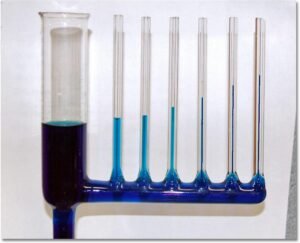
Capillarity, on the other hand, is the phenomenon by which a liquid rises or falls in a narrow tube or porous material due to the combined effects of surface tension, adhesive forces between the liquid and the solid surface, and cohesive forces within the liquid itself.Surface tension and capillarity MCQs help students understand how intermolecular forces govern liquid surfaces, droplet formation, and the rise or fall of liquids in narrow tubes.
Surface Tension and Capillarity MCQs
1. The potential energy of a molecule on the surface of a liquid compared to one inside the liquid is
A. Zero
B. Lesser
C. Equal
D. Greater
Answer: D
2. Oil spreads over the surface of water whereas water does not spread over the surface of oil due to
A. Surface tension of water is very high
B. Surface tension of oil is high
C. Viscosity of water is high
D. Viscosity of oil is high
Answer: A
3. At which of the following temperatures is the surface tension of water minimum?
A. 4°C
B. 25°C
C. 50°C
D. 75°C
Answer: D
4. An iron needle floats on the surface of water because of
A. Buoyancy
B. Viscosity
C. Gravitational force
D. Surface tension
Answer: D
5. A piece of ice floating in water melts completely. The water level will
A. Go up
B. Not change
C. Go down
D. Fluctuate
Answer: B
6. The working principle of a ballpoint pen is
A. Bernoulli’s theorem
B. Surface tension
C. Gravity
D. Viscosity
Answer: B
7. Vapour pressure, surface tension, and viscosity can be explained by
A. Vapour pressure only
B. Surface tension only
C. Viscosity only
D. (I), (II), and (III)
Answer: D
8. With the addition of impurities, surface tension of a liquid
A. Increases
B. Decreases
C. Remains constant
D. May increase or decrease
Answer: D
9. The free surface of a liquid tends to have minimum area due to
A. Viscosity
B. Surface tension
C. Pressure
D. Diffusion
Answer: B
10. Hairs of a shaving brush cling together when taken out of water due to
A. Attraction between hairs
B. Surface tension
C. Velocity of water
D. Nature of hairs
Answer: B
11. The INCORRECT statement is
A. A liquid is compressible and has a free surface
B. A gas is compressible and occupies all space
C. Pressure is same at same height in fluid
D. Water surface in capillary is concave
Answer: A
12. In a tug of war, two teams pull with 20 kN each. Tension in the rope is
A. 0 kN
B. 20 kN
C. 40 kN
D. 15 kN
Answer: B
13. On increasing temperature, surface tension of a liquid
A. Decreases
B. Increases
C. Remains constant
D. Depends on viscosity
Answer: A
14. Neglecting gravity, surface molecules of a liquid have potential energy
A. Greater than inside
B. Less than inside
C. Equal
D. Variable
Answer: A
15. Soldering of two metals is possible due to
A. Viscosity
B. Surface tension
C. Osmosis
D. Cohesion
Answer: D
16. Surface energy of a liquid film on a ring of area 0.15 m² is
A. 0.75 J
B. 1.5 J
C. 2.25 J
D. 3.0 J
Answer: B
17. With increase in temperature
A. Surface tension increases
B. Viscosity of gases decreases
C. Viscosity of liquids increases
D. Both increase
Answer: B
18. When oil floats on water, surface tension of water
A. Vanishes
B. Decreases
C. Increases
D. Remains unchanged
Answer: B
19. Surface tension of liquids is mainly
A. Electromagnetic in nature
B. Nuclear force
C. Viscous force
D. Magnetic force
Answer: A
20. Sprinkling water cools a room due to
A. Lower water temperature
B. High specific heat
C. Large latent heat of vaporisation
D. Poor conductivity
Answer: C
21. Water rises in a glass capillary due to
A. Surface tension
B. Cohesive force of glass
C. Temperature
D. Adhesive force
Answer: A
22. With increase in temperature, angle of contact
A. Decreases
B. Increases
C. Remains constant
D. Varies randomly
Answer: A
23. A liquid rises in a capillary if angle of contact is
A. Acute
B. Obtuse
C. 90°
D. Zero
Answer: A
24. WRONG statement about angle of contact is
A. θ > 90° for water–glass
B. θ not constant for solid–liquid
C. θ < 90° for kerosene–glass
D. θ > 90° for mercury–glass
Answer: B
25. A towel becomes wet completely due to
A. Viscosity
B. Capillary action
C. Gravity
D. Evaporation
Answer: B
26. Kerosene rises in a lantern wick due to
A. Diffusion
B. Capillary action
C. Buoyancy
D. Gravity
Answer: B
27. Water rises more in a capillary of
A. Larger diameter
B. Smaller diameter
C. Same diameter
D. Independent of diameter
Answer: B
28. Meniscus of mercury in glass capillary is
A. Concave
B. Plane
C. Cylindrical
D. Convex
Answer: D
29. If capillary length is less than rise height, liquid will
A. Not rise
B. Rise and ooze out
C. Rise and stay at top
D. Rise and remain at top
Answer: D
30. Relation between capillary rise (h) and radius (r) is best shown by graph
A. 1
B. 2
C. 3
D. 4
Answer: C
Conclusion on Surface Tension and Capillarity MCQs
Both surface tension and capillarity are governed by molecular interactions and energy considerations, making them essential topics in fluid mechanics. Understanding these surface tension and capillarity mcqs concepts allows students to interpret pressure differences across curved surfaces, analyze capillary rise equations, and apply theoretical principles to practical situations. In competitive examinations, questions on surface tension and capillarity mcqs often test conceptual clarity, graphical interpretation, unit conversions, and real-world reasoning, requiring a strong grasp of the underlying physics rather than mere memorization. Together, surface tension and capillarity mcqs form a fundamental framework for explaining fluid surface phenomena and demonstrate how microscopic molecular forces give rise to macroscopic physical behavior.
Overall, practicing surface tension and capillarity MCQs strengthens understanding of molecular forces, fluid stability, and energy considerations. These surface tension and capillarity mcqs concepts are not only theoretical but also deeply connected to everyday observations, making them both intuitive and highly examinable.By practicing surface tension and capillarity MCQs, learners gain clarity on concepts such as cohesive and adhesive forces, angle of contact, surface energy, and capillary rise.
These surface tension and capillarity MCQs connect microscopic molecular interactions with macroscopic phenomena like floating needles, meniscus formation, wicks absorbing oil, and water rising in capillaries.Surface tension and capillarity MCQs also strengthen problem-solving skills by applying formulas to real-world situations involving temperature variation, impurities, and liquid–solid interactions.Regular practice of surface tension and capillarity MCQs builds strong conceptual foundations required for competitive exams, ensuring accuracy, speed, and confidence in fluid-related physics questions.