
- iamal
- December 31, 2025
Mastering Viscosity and Surface Tension MCQs: Essential Conceptual & Numerical Practice for Physics Exams
Viscosity and Surface Tension MCQs form a crucial part of physics examinations because they test how well aspirants understand the microscopic behavior of liquids and their macroscopic effects. These viscosity and Surface tension topics explain why liquids resist flow, why droplets become spherical, why soap cleans better, and how objects interact with liquid surfaces. Viscosity and Surface tension questions in this area combine theory with real-world applications such as capillary rise, terminal velocity, Reynolds number, and molecular forces. Practicing MCQs on viscosity and surface tension helps students sharpen conceptual clarity, strengthen numerical problem-solving skills, and prepare effectively for competitive exams like JEE, NEET, and board examinations.
A Concept Overview on Viscosity and Surface Tension MCQs
Viscosity describes the internal resistance offered by a fluid when its layers move relative to each other. It plays a key role in determining whether fluid motion is smooth or turbulent and directly influences quantities such as terminal velocity and Reynolds number. Surface tension, on the other hand, arises due to unbalanced cohesive forces acting on molecules at the liquid surface, causing liquids to minimize surface area.
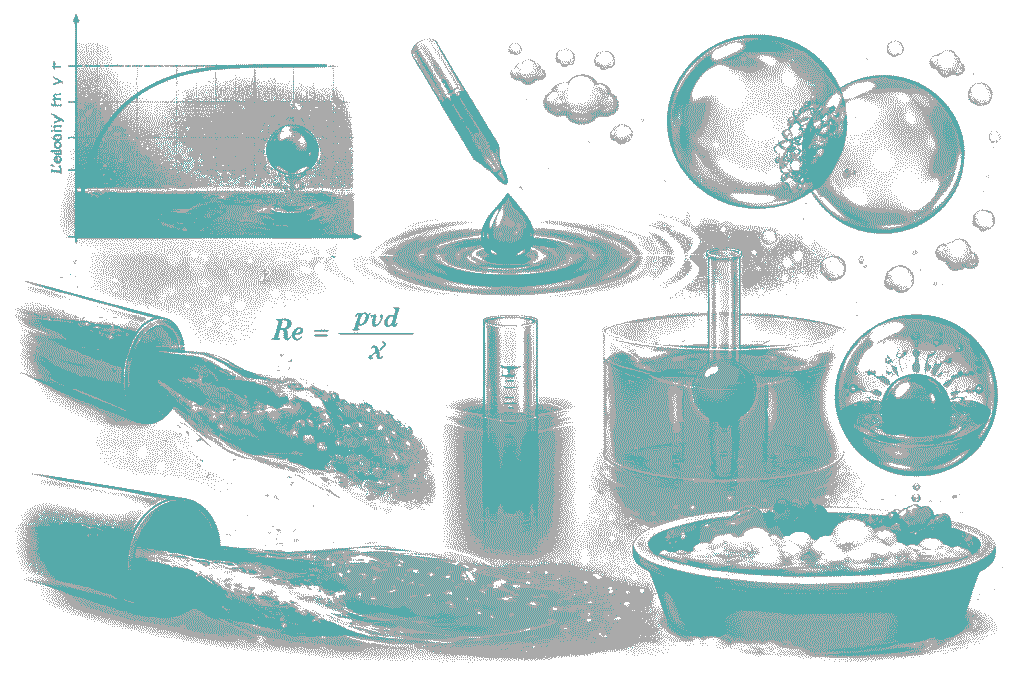
Together, these concepts explain a wide range of natural phenomena, including spherical rain droplets, soap bubble formation, capillary action, wetting behavior, and the effectiveness of detergents. MCQs from this chapter often involve graphical interpretation, dimensional analysis, and reasoning based on molecular interactions.
MCQs on Viscocity and Surface Tension:
1.
A spherical ball is dropped in a long column of a highly viscous liquid. The curve that represents the speed of the ball (v) as a function of time (t) is
A. A
B. B
C. C
D. D
Answer: D
2.
If ρ is the density and η is the coefficient of viscosity of a fluid flowing with speed v in a pipe of diameter d, the Reynolds number is
A. Re = d / v
B. Re = v / d
C. Re = ρvd / η
D. Re = ηvd / ρ
Answer: C
3.
The velocity of the upper layer of water in a river is 36 km h⁻¹. The shearing stress between layers is 10⁻³ N m⁻². The depth of the river is (η = 10⁻² Pa·s)
A. 10 m
B. 100 m
C. 50 m
D. 65 m
Answer: B
4.
Viscosity is
A. Adhesive force
B. Cohesive force
C. Long-range force
D. Pressure
Answer: B
5.
The potential energy of a molecule on the surface of a liquid compared to one inside the liquid is
A. Lesser
B. Equal
C. Zero
D. Greater
Answer: D
6.
A 1.0 cm long wire is placed horizontally on water and pulled upward with a force of 2 × 10⁻² N. The surface tension of water is
A. 0.1 N/m
B. 0.2 N/m
C. 0.01 N/m
D. 0.002 N/m
Answer: A
7.
A drop of oil spreads over the surface of water because
A. Oil is lighter than water
B. Surface tension of water is greater than oil
C. Oil repels water
D. Both have equal surface tension
Answer: B
8.
If the surface tension of a liquid is 70 dyne/cm, its value in SI units is
A. 7 × 10⁻² N/m
B. 7 × 10⁻³ N/m
C. 7 × 10⁻⁴ N/m
D. 70 N/m
Answer: C
9.
Surface tension vanishes at
A. Absolute zero
B. Transition temperature
C. Critical temperature
D. Room temperature
Answer: C
10.
The force required to lift a ring of radius R from the water surface (surface tension = T, mass = m) is
A. mg + 2πTR
B. 2mg + πR
C. 3mg + 2πTR
D. mg + 4πTR
Answer: D
11.
The work done in blowing a soap bubble of radius 0.2 m (T = 60 × 10⁻³ N/m) is
A. 24 × 10⁻⁴ J
B. 24 × 10⁻³ J
C. 96 × 10⁻⁴ J
D. 1.92 × 10⁻³ J
Answer: D
12.
Rain drops are spherical due to
A. Surface tension
B. Viscosity
C. Pressure
D. Dust particles
Answer: A
13.
Soap solution cleans clothes because it
A. Increases viscosity
B. Increases surface tension
C. Decreases surface tension
D. Decreases temperature
Answer: C
14.
If detergent is dissolved in water, the surface tension
A. Decreases
B. Becomes zero
C. Remains constant
D. Increases
Answer: A
15.
The SI unit of surface tension is
A. N/m²
B. N/m³
C. N/m
D. kg/m
Answer: C
16.
Two soap bubbles have radii in the ratio 4 : 3. The ratio of work done is
A. 3 : 2
B. 4 : 3
C. 8 : 3
D. 16 : 9
Answer: D
17.
Pressure on the concave side of a curved liquid surface is
A. Greater than convex side
B. Less than convex side
C. Equal to convex side
D. Atmospheric
Answer: B
18.
Surface energy is defined as
A. Work done per unit length
B. Work done per unit force
C. Work done per unit area
D. Energy per unit mass
Answer: C
19.
A molecule at the surface of a liquid experiences a net
A. Upward adhesive force
B. Downward adhesive force
C. Upward cohesive force
D. Downward cohesive force
Answer: D
20.
For a liquid rising in a capillary tube, the angle of contact is
A. Obtuse
B. 180°
C. Acute
D. 90°
Answer: C
21.
Surface tension decreases with increase in temperature because
A. Molecular attraction increases
B. Kinetic energy of molecules increases
C. Density increases
D. Viscosity increases
Answer: B
22.
The wettability of a surface depends mainly on
A. Viscosity
B. Density
C. Surface tension
D. Angle of contact
Answer: D
23.
If the surface of a liquid is plane, the angle of contact is
A. Acute
B. Obtuse
C. 90°
D. 0°
Answer: C
24.
Angle of contact depends on
A. Solid only
B. Liquid only
C. Both solid and liquid
D. Orientation of surface
Answer: C
25.
Two glass plates with water between them cannot be separated easily due to
A. Viscosity
B. Atmospheric pressure
C. Surface tension
D. Adhesion
Answer: C
26.
A waterproofing agent changes the angle of contact
A. From acute to 90°
B. From obtuse to 90°
C. From acute to obtuse
D. From obtuse to acute
Answer: C
27.
The coefficient of viscosity of an ideal fluid is
A. One
B. Zero
C. Infinite
D. Very large
Answer: B
28.
Streamline flow is more likely for liquids with
A. Low density and low viscosity
B. High density and low viscosity
C. Low density and high viscosity
D. High density and high viscosity
Answer: D
29.
Kinematic viscosity is defined as the ratio of
A. Viscosity to density
B. Density to viscosity
C. Surface tension to viscosity
D. Pressure to density
Answer: A
30.
Archimedes’ principle will not exist if
A. Density is zero
B. Pressure is zero
C. Gravity is absent
D. Viscosity is zero
Answer: C
Conclusion on Viscosity and Surface Tension :
Viscosity and Surface Tension MCQs are essential for mastering the physics of liquids and understanding how microscopic forces influence macroscopic behavior. These viscosity and tension surface questions not only test memory of formulas but also challenge students to apply concepts logically in real-life situations. Regular practice of these viscosity and Surface tension MCQs enhances accuracy, speed, and confidence, all of which are critical for success in competitive examinations. A strong grasp of these viscosity and Surface tension topics lays a solid foundation for advanced studies in fluid behavior, material science, and applied physics.