
- iamal
- January 7, 2026
Master Thermodynamics Laws MCQs : Zeroth, First & Second Law Explained
Thermodynamics forms the backbone of many physical systems, from engines and refrigerators to biological and atmospheric processes. For aspirants preparing for competitive examinations, practicing thermodynamics laws MCQs is essential to mastering this chapter. Questions based on the Zeroth, First, and Second Laws of Thermodynamics frequently appear in NEET, JEE, and higher-secondary physics examinations.
These thermodynamics laws mcqs define how heat, work, and internal energy interact and impose fundamental restrictions on physical processes. While the mathematical expressions are straightforward, conceptual understanding is crucial for solving MCQs correctly. Many exam questions test whether students can distinguish between state functions and path functions, identify valid thermodynamic processes, and apply energy conservation logically.
This presents a focused approach to thermodynamics laws MCQs, helping learners connect theory with application. By practicing these thermodynamics laws mcqs questions, aspirants can improve conceptual clarity, avoid common pitfalls, and develop confidence in handling thermodynamics-based problems efficiently.
Thermodynamics is one of the most concept-driven chapters in physics, and mastering it requires consistent practice through thermodynamics laws MCQs. These thermodynamic laws mcqs questions test not only formula knowledge but also a student’s ability to interpret physical processes involving heat, work, internal energy, and entropy. In competitive exams such as NEET, JEE, and state board assessments, questions from the Zeroth, First, and Second Thermodynamics laws mcqs appear regularly in both direct and application-based formats.
Practicing thermodynamics laws MCQs helps aspirants understand how energy conservation governs real and ideal systems, including cyclic processes, adiabatic changes, and isothermal transformations. Many MCQs are designed to check conceptual clarity—such as distinguishing state variables from path variables, identifying valid thermodynamic processes, and interpreting energy transfer using sign conventions correctly.
Thermodynamics Laws MCQs-
1. The process in which volume remains constant is called an isochoric process. We know that W=P dVW = P\,dV. If ΔV=0\Delta V = 0, then
A. ΔU = ΔQ
B. ΔQ = ΔW
C. ΔU = ΔW
D. None of these
Answer: A. ΔU = ΔQ
2. Heating of water at atmospheric pressure is covered under the thermodynamic process known as
A. Isobaric
B. Isochoric
C. Isentropic
D. Isothermal
Answer: A. Isobaric
3. In a cyclic process, the amount of heat given to a system is equal to
A. Net heat increase in internal energy
B. Net work done by the system
C. Net decrease in internal energy
D. Net change in volume
Answer: B. Net work done by the system
4. In the V–T diagram shown, what is the relation between pressures P1P_1 and P2P_2?
A. P1=P2P_1 = P_2
B. P2<P1P_2 < P_1
C. P2>P1P_2 > P_1
D. Insufficient data
Answer: B. P2<P1P_2 < P_1
5. In which process is the PV indicator diagram a straight line parallel to the volume axis?
A. Isothermal
B. Isobaric
C. Adiabatic
D. Irreversible
Answer: B. Isobaric
6. A thermodynamic system is taken from D to E by a linear process and then from E to F by an isobaric process. The total work done by the gas is
A. 450 J
B. 900 J
C. 1350 J
D. Zero
Answer: B. 900 J
7. A sample of gas expands from volume V1V_1 to V2V_2. The work done is greatest when the expansion is
A. Adiabatic
B. Isobaric
C. Isothermal
D. Same in all cases
Answer: B. Isobaric
8. In a Carnot engine, when heat is taken from the source, the temperature of the source
A. Remains constant
B. Does not remain constant
C. Decreases
D. Increases
Answer: A. Remains constant
9. In an isochoric process
A. ΔW = 0
B. ΔU = 0
C. ΔQ = 0
D. ΔT = 0
Answer: A. ΔW = 0
10. A process in which the supplied heat goes fully into changing internal energy and temperature is
A. Adiabatic process
B. Cyclic process
C. Isobaric process
D. Isothermal process
Answer: Isochoric process
11. The volume of 1 m³ of gas is doubled at atmospheric pressure. The work done is
A. 10510^5 J
B. 10610^6 J
C. 10710^7 J
D. 10810^8 J
Answer: C. 10710^7 J
12. In an isochoric process, if heat is supplied to a gas, the pressure will
A. Increase
B. Decrease
C. Remain constant
D. Vary exponentially
Answer: A. Increase
13. A gas performs minimum work (in magnitude) during
A. Adiabatic process
B. Isothermal process
C. Isobaric process
D. Isochoric process
Answer: D. Isochoric process
14. Heat is given to an ideal gas in an isothermal process. Then
A. Internal energy decreases
B. Internal energy increases
C. Internal energy remains constant
D. Gas does positive work
Answer: C. Internal energy remains constant
15. Which PV diagram best represents an isothermal process?
A. A
B. B
C. C
D. D
Answer: B
16. The condition dQ=dWdQ = dW holds good in
A. Adiabatic process
B. Isothermal process
C. Isobaric process
D. Isochoric process
Answer: B. Isothermal process
17. The first operation in a Carnot cycle is
A. Isothermal expansion
B. Adiabatic expansion
C. Isothermal compression
D. Adiabatic compression
Answer: A. Isothermal expansion
18. In the equation PVγ=constantPV^\gamma = \text{constant}, if γ=1\gamma = 1, the process is
A. Isothermal
B. Adiabatic
C. Isobaric
D. Irreversible
Answer: A. Isothermal
19. A gas is compressed isothermally. The RMS velocity of its molecules
A. Increases
B. Decreases
C. First increases then decreases
D. Remains the same
Answer: D. Remains the same
20. In an isothermal change of an ideal gas
A. PV=constantPV = \text{constant}
B. (PV)γ=constant(PV)^\gamma = \text{constant}
C. PVγ=constantPV^\gamma = \text{constant}
D. None
Answer: A. PV=constantPV = \text{constant}
21. Which of the following is a slow process?
A. Isothermal
B. Adiabatic
C. Isobaric
D. None
Answer: A. Isothermal
22. Boyle’s law is applicable in which process?
A. Adiabatic
B. Isochoric
C. Isobaric
D. Isothermal
Answer: D. Isothermal
23. The internal energy of an ideal diatomic gas doubled isothermally
A. Doubles
B. Halves
C. Quadruples
D. Remains unchanged
Answer: D. Remains unchanged
24. In an isothermal process, which statement is NOT true?
A. Temperature remains constant
B. Internal energy remains constant
C. No heat enters or leaves the system
D. None of the above
Answer: C
25. Slope of an isothermal curve is always
A. Equal to adiabatic curve
B. Greater than adiabatic curve
C. Less than adiabatic curve
D. Cannot be determined
Answer: C
26. Which process is reversible?
A. Radiation
B. Electrical heating
C. Conduction
D. Isothermal compression
Answer: D
27. Isothermal process graph is plotted between
A. Pressure and Temperature
B. Pressure and Volume
C. Volume and Temperature
D. P, V and T
Answer: B
28. Match the following
A. (A) iv, (B) ii, (C) i, (D) iii
B. (A) iv, (B) i, (C) ii, (D) iii
C. (A) ii, (B) iii, (C) iv, (D) i
D. (A) ii, (B) i, (C) iv, (D) iii
Answer: D
29. In general, which thermodynamic process is slow?
A. Isothermal
B. Adiabatic
C. Isobaric
D. Isochoric
Answer: A
30. In which thermodynamic process does the pressure of a gas remain constant throughout the process?
A. Isothermal process
B. Isochoric process
C. Isobaric process
D. Adiabatic process
Answer: C. Isobaric process
Conclusion on Thermodynamics Laws MCQs
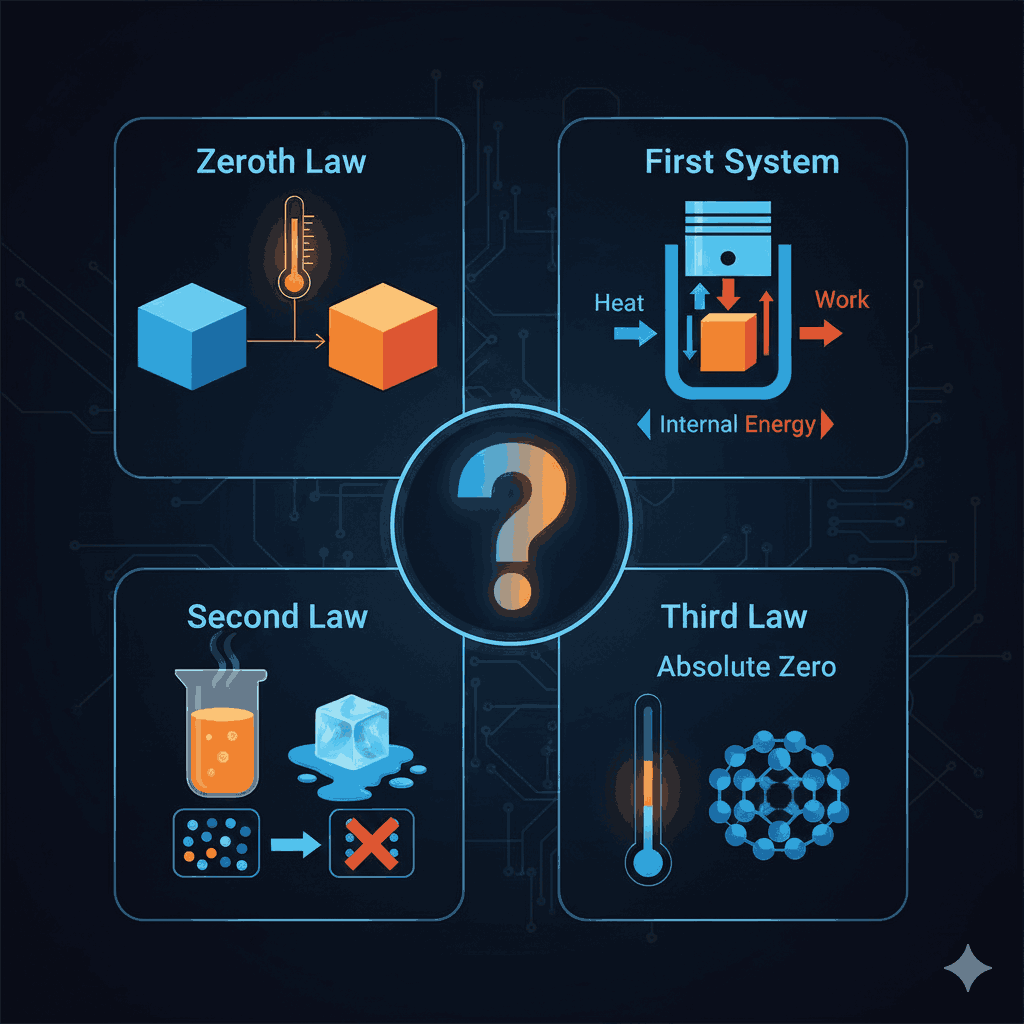
A strong grasp of thermodynamics laws MCQs with answers enables students to understand how energy transformations occur in real and ideal systems. The Zeroth Law establishes thermal equilibrium, the First Law formalizes energy conservation, and the Second Law explains the direction and feasibility of physical processes.
Solving thermodynamics laws MCQs based on these laws strengthens analytical thinking and helps aspirants quickly identify correct options without lengthy calculations. Regular thermodynamics laws mcqs practice also clarifies subtle ideas such as internal energy as a state function, work and heat as path-dependent quantities, and the physical meaning of cyclic and adiabatic processes.
By consistently working through thermodynamics laws MCQs with answers, learners can convert a conceptually heavy chapter into a high-scoring one. With clear fundamentals and repeated MCQ practice, thermodynamics becomes both intuitive and exam-friendly.
A strong command over thermodynamics laws MCQs also improves problem-solving speed, as these questions often rely on logical elimination rather than lengthy calculations. By repeatedly solving thermodynamics laws MCQs based on thermodynamic laws, learners develop the confidence to tackle tricky conceptual questions, avoid common misconceptions, and score consistently higher in examinations.