
- iamal
- December 29, 2025
Master Satellite Orbits and Space Physics MCQs: Period, Escape Velocity, Rockets & Black Holes
Satellite orbits and space physics mcqs form one of the most concept-rich and scoring areas of classical physics, especially in competitive exams and senior-secondary curricula. This satellite orbits and space physics mcqs topic connects fundamental laws of gravitation with real astronomical phenomena such as planetary motion, satellite dynamics, escape velocity, and orbital energy. Understanding how satellites revolve around planets, why geostationary satellites remain fixed over Earth, and how escape velocity determines whether an object stays bound or travels into deep space is crucial for mastering orbital mechanics.
Satellite Orbits and Space Physics MCQs test not only formula recall but also conceptual clarity in Kepler’s laws, gravitational potential and kinetic energy, conservation of angular momentum, and orbital time periods. These satellite orbits and space physics mcqs questions frequently combine mathematics with physical reasoning, making them ideal for strengthening problem-solving skills. Practicing such satellite orbits and space physics MCQs helps aspirants visualize motion in space, interpret real satellite behavior, and confidently tackle numerical as well as assertion-reason questions in physics examinations.
Satellite Orbits and Space Physics MCQs are one of the fastest ways to master orbital time periods, Kepler’s laws, and the logic behind escape velocity. These Satellite orbits and space physics mcqs questions connect multiple ideas—gravity as the centripetal force, how orbital radius controls period, why geostationary satellites “hover,” and what happens if a satellite suddenly loses gravitational pull. It also see how rocket exhaust produces thrust, why Hubble’s law supports an expanding universe, and the mass threshold ideas behind neutron stars and black holes.
Satellite Orbits and Space Physics MCQs :
1) The period of revolution of a satellite is
A. independent of mass of a satellite
B. independent of radius of planet
C. independent of height of the satellite from the planet
D. dependent on the mass of a satellite
Answer: A
2) Two satellites of masses mm and 4m4m in the same orbit: correct statement
A. same kinetic energy
B. same potential energy
C. periods ratio 1:4
D. same period
Answer: D
3) If Earth suddenly contracts to 1/101/10 of its radius (mass same), new day duration
A. 24 hr
B. n 24\sqrt{n}\,24 hr
C. n2 24n^2\,24 hr
D. n2 24n^2\,24 hr
Answer: C (as given)
4) Rocket mass 100 kg burns 0.1 kg/s, exhaust speed 1 km/s. Acceleration
A. 100 m/s²
B. 1000 m/s²
C. 10 m/s²
D. 1 m/s²
Answer: D
5) If recession velocity vv and distance rr:
A. v∝rv\propto r
B. v∝1/rv\propto 1/r
C. v∝r2v\propto r^2
D. v∝1/r2v\propto 1/r^2
Answer: A
6) Star mass > 5 times solar mass becomes after death
A. nebula
B. black hole
C. neutron star
D. red giant
Answer: B
7) Satellite orbiting Earth at height hh. If hh increases, time period
A. decreases
B. increases
C. unaffected
D. becomes zero
Answer: B
8) Kepler relation between period TT and distance rr (as listed)
A. T2∝rT^2\propto r
B. T∝r3T\propto r^3
C. T3=T^3= constant
D. T2∝r1/3T^2\propto r^{1/3}
Answer: B (as given)
9) Ball released from satellite at 1200 km height (no air friction)
A. falls vertically
B. goes far into space
C. falls in spiral
D. follows the satellite
Answer: D
10) Metal weighed in orbit while suspended in water (density 8× water). Reading
A. 14g
B. −2g
C. zero
D. 2g
Answer: C
11) Two equal-mass stars orbit circle radius RR. Time period proportional to
A. R3/2R^{3/2}
B. RR
C. R2R^2
D. R1/2R^{1/2}
Answer: A
12) Escape speed vertically is 11 km/s. At 45° with vertical, escape speed
A. 11 km/s
B. 11211\sqrt2 km/s
C. 11/2 km/s
D. 22 km/s
Answer: A
13) If projectile speed > escape speed, trajectory is
A. elliptic
B. hyperbolic
C. vertical straight
D. parabolic
Answer: B
14) If gravity suddenly disappears, satellite will
A. continue in original orbit
B. move tangentially with speed vv
C. fall down
D. come to rest on orbit
Answer: B
15) Minimum speed from moon so it doesn’t fall back
A. 2.3 km/hr
B. 3.2 km/hr
C. 1.2 km/s
D. 2.3 km/s
Answer: D
16) If total energy of Earth’s satellite is zero, it means
A. bound to Earth
B. may no longer be bound
C. moves away along parabolic path
D. escapes in hyperbolic path
Answer: C
17) Geostationary satellite orbital period
A. 2 h
B. 5 h
C. 24 h
D. 12 h
Answer: C
18) Geostationary period depends on:
(i) mass of satellite (ii) mass of Earth (iii) radius of orbit (iv) height from surface
A. (i) only
B. (i) and (ii)
C. (i), (ii) and (iii)
D. (ii), (iii) and (iv)
Answer: D
19) Planet mass 8×10248\times10^{24} kg, radius 6×1066\times10^6 m: escape velocity close to
A. 1 km/s
B. 4.6 km/s
C. 16 km/s
D. 12.6 km/s
Answer: D
20) Planet in circular orbit: angular velocity proportional to
A. velocity
B. square of velocity
C. cube of velocity
D. none
Answer: C
21) Satellite rotation W→E same period as Earth, relative velocity
A. half
B. double
C. same
D. zero
Answer: D
22) Satellite time period 7 h. Radius becomes 3×. New period
A. 40 h
B. 36 h
C. 30 h
D. 25 h
Answer: B
23) Equator satellite period 1.5 h (W→E). Time between overhead sightings
A. 1.5 h
B. 1.6 h
C. 22.5 h
D. 25.5 h
Answer: B
24) Moon to escape Earth forever needs speed
A. 11.2 km/s
B. less than 11.2 km/s
C. slightly more than 11.2 km/s
D. 22.4 km/s
Answer: B
25) Spy satellite few hundred km above surface: approximate period
A. 1 h
B. 2 h
C. 8 h
D. 4 h
Answer: B
26) Two satellites m1>m2m_1>m_2, radii r1>r2r_1>r_2. Speeds v1,v2v_1, v_2
A. v1=v2v_1=v_2
B. v1>v2v_1>v_2
C. v2>v1v_2>v_1
D. v1f=v2fv_1f=v_2f
Answer: C
27) Escape speed is 11 km/s. Launched at 60° with vertical → escape speed
A. 11 km/s
B. 13 km/s
C. 11 km/s
D. 33 km/s
Answer: A
28) Ball dropped from satellite at 120 km height will
A. move straight tangential line
B. move along original orbit of satellite
C. fall gradually
D. go far away
Answer: B
29) Satellite S in elliptical orbit (mass negligible vs Earth). True statement
A. acceleration always toward Earth’s center
B. angular momentum direction changes but magnitude constant
C. total mechanical energy varies periodically
D. linear momentum magnitude constant
Answer: A
30) Seconds pendulum in a rocket: period decreases when rocket
A. comes down with uniform acceleration
B. moves in geostationary orbit
C. moves up with uniform velocity
D. moves up with uniform acceleration
Answer: D
31) Mass required for black hole formation compared to Sun
A. 2
B. 6
C. 8
D. 10
Answer: B
32) Escape velocities on two planets (same radius), masses m1,m2m_1, m_2:
A. v1=m2m1v2v_1=\dfrac{m_2}{m_1}v_2
B. v1=m1m2v2v_1=\dfrac{m_1}{m_2}v_2
C. v1=(m2m1)2v2v_1=\left(\dfrac{m_2}{m_1}\right)^2 v_2
D. v1=m2m1v2v_1=\dfrac{m_2}{\sqrt{m_1}}v_2
Answer: B
33) Light energy from Sun can be spread by
A. shower of raindrops
B. plane mirror
C. convex lens
D. combination lens
Answer: A
34) Condition for uniform spherical mass (radius r) to be a black hole
A. 2Gmr≥c\dfrac{2Gm}{r}\ge c
B. 2gmr=c\dfrac{2gm}{r}=c
C. 2Gmr≥c2\dfrac{2Gm}{r}\ge c^2
D. gm≥r2cgm\ge r^2c
Answer: C
35) Hubble’s law is related with
A. planetary motion
B. speed of galaxy
C. galaxy motion
D. comet motion
Answer: B
36) Toy car mass 80 g, radius 0.8 m, centripetal force 10 N. Speed v
A. 1
B. 5
C. 100
D. 10
Answer: B
Conclusion on Satellite orbits and space physics mcqs :
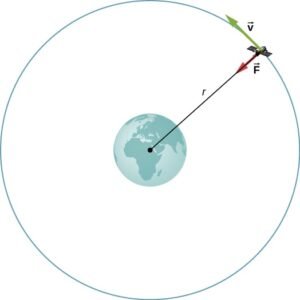
These Satellite Orbits and Space Physics MCQs reinforce the big exam ideas: orbital period is set by orbital radius and the central mass, not the satellite’s own mass; escape velocity is direction-independent (it’s about total energy); and when gravity provides centripetal force, removing it makes motion tangential instantly. Satellite orbits and space physics mcqs questions on Hubble’s law and black holes expand the same gravity logic into cosmology—showing how gravity controls both orbits of satellites and the fate of massive stars.
Satellite Orbits and Space Physics MCQs provide a powerful way to reinforce the fundamental principles of gravitation, orbital motion, and energy conservation in space. By solving these satellite orbits and space physics mcqs questions, learners develop a deeper understanding of how satellites remain in orbit, why escape velocity is independent of direction, and how Kepler’s laws govern planetary motion. Regular practice of such satellite orbits and space physics MCQs sharpens numerical accuracy and strengthens conceptual thinking, which is essential for competitive examinations. Mastery of these satellite orbits and space physics mcqs problems not only improves exam performance but also builds a strong foundation for advanced studies in astrophysics, aerospace science, and space technology.