
- iamal
- February 11, 2026
Power-Packed Free Energy and Cell Voltage Relationship MCQs for Top Scores
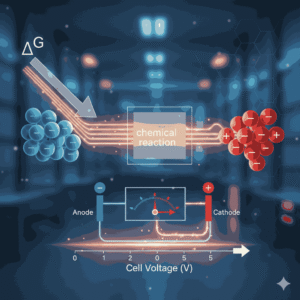
Free energy and cell voltage relationship MCQs is one of the most important conceptual areas in electrochemistry for Class 12 aspirants. The connection between thermodynamics and electrochemistry becomes clear when we relate Gibbs free energy change (ΔG) with cell potential (E). Understanding this link helps aspirants solve numerical problems accurately and interpret spontaneity correctly. When preparing for Free energy and cell voltage relationship MCQs, it is essential to master the equation that connects these two quantities.
The fundamental equation that governs this relationship is:
ΔG = –nFE
Here, n is the number of moles of electrons transferred, F is Faraday’s constant (96500 C mol⁻¹), and E is the cell potential. In Free energy and cell voltage relationship MCQs, aspirants are often required to determine whether a reaction is spontaneous by analyzing the sign of E° or ΔG°. If E° is positive, ΔG° becomes negative, meaning the reaction is spontaneous under standard conditions.
Free energy and cell voltage relationship MCQs frequently test the standard form of the equation:
ΔG° = –nFE°
This equation clearly shows that a higher positive standard cell potential corresponds to a larger negative standard free energy change. Therefore, in Free energy and cell voltage relationship MCQs, a reaction with a large E° value will have a strong thermodynamic driving force.
Another important aspect in Free energy and cell voltage relationship MCQs is the connection between cell potential and equilibrium constant. By combining thermodynamics with electrochemistry, we obtain:
ΔG° = –RT ln K
and
E° = (0.059/n) log K at 298 K
This relationship is central to solving Free energy and cell voltage relationship MCQs involving equilibrium constant calculations. When K > 1, ΔG° is negative and E° is positive. When K < 1, ΔG° becomes positive and E° turns negative.
In Free energy and cell voltage relationship MCQs, aspirants must also understand how temperature affects these quantities. Although E° is temperature dependent, most board-level problems assume 298 K. The numerical conversion between joules and volts is another common area tested in Free energy and cell voltage relationship MCQs, especially when calculating maximum work done by the cell.
Maximum electrical work obtainable from an electrochemical cell is equal to –ΔG. Therefore, in Free energy and cell voltage relationship MCQs, if ΔG° is –200 kJ mol⁻¹, it means the maximum work the cell can perform is 200 kJ per mole of reaction. This concept bridges physical chemistry and thermodynamics.
Free energy and cell voltage relationship MCQs also emphasize sign conventions. A positive E° means the reaction proceeds spontaneously in the forward direction. A negative E° indicates non-spontaneity under standard conditions. Aspirants often lose marks in Free energy and cell voltage relationship MCQs due to confusion in sign interpretation.
Another common scenario in Free energy and cell voltage relationship MCQs involves calculating ΔG from E when n is given. Since Faraday’s constant is large, even a moderate E value can correspond to a significant free energy change. This is why even small differences in electrode potentials can result in noticeable thermodynamic effects.
Free energy and cell voltage relationship MCQs may also include problems where ΔG is given and E must be calculated. In such cases, rearranging ΔG = –nFE correctly is essential. Accuracy in units is critical while solving Free energy and cell voltage relationship MCQs, especially converting kJ to J.
The conceptual clarity required for Free energy and cell voltage relationship MCQs includes understanding that ΔG = 0 corresponds to E = 0, which represents equilibrium. At equilibrium, no net work can be extracted from the cell. This equilibrium condition frequently appears in Free energy and cell voltage relationship MCQs.
Free Energy and Cell Voltage Relationship MCQs
1.
The standard free energy change of a reaction is ΔG° = -115 kJ at 298 K. Calculate the equilibrium constant Kₚ in log Kₚ (R = 8.314 JK⁻¹mol⁻¹)
A) 20.16
B) 2.303
C) 13.83
D) 2.016
Answer: A
2.
The emf of the Daniel Cell Zn | ZnSO₄ (0.01M) || CuSO₄ (1M) | Cu at 298 K is E₁. When the concentration of ZnSO₄ is changed to 1M and that of CuSO₄ is changed to 0.01M, the emf changed to E₂. Then find the relationship between E₁ and E₂
A) E₁ > E₂
B) E₁ < E₂
C) E₂ = 0 ≠ E₁
D) E₂ = E₁
Answer: A
3.
Calculate the maximum work that can be obtained from the cell, Zn | Zn²⁺ (1M) || Ag⁺ (1M) | Ag
E°Zn²⁺/Zn = -0.76 V and E°Ag⁺/Ag = 0.80 V
A) 212.80 kJ
B) 201.80 kJ
C) -201.80 kJ
D) -301.080 kJ
Answer: D
4.
For a cell reaction involving a two electron change, the standard emf is 0.295 V at 25°C. The equilibrium constant is
A) 1 × 10¹⁰
B) 2.95 × 10¹⁰
C) 1 × 10⁻¹⁰
D) 2.95 × 10⁻²
Answer: A
5.
Given data for AgI system, log Ksp for AgI is
A) 8.12
B) -8.12
C) 8.612
D) -37.83
Answer: B
6.
Potential for the cell Cr | Cr³⁺ (0.01M) || Fe²⁺ (0.01M) | Fe is
A) -0.26 V
B) 0.399 V
C) -0.399 V
D) 0.26 V
Answer: D
7.
Standard reaction enthalpy ΔrH° at 300 K is
A) -412.8 kJ mol⁻¹
B) -384 kJ mol⁻¹
C) 260.4 kJ mol⁻¹
D) 192 kJ mol⁻¹
Answer: A
8.
Standard cell potential expression is
A) x + 2y – 3z
B) x – y
C) x + y – z
D) x – z
Answer: A
9.
Standard Gibbs energy (Zn + Cu²⁺ → Zn²⁺ + Cu) is
A) 384
B) 192
C) -384
D) -192
Answer: C
10.
Ratio [Sn²⁺]/[Pb²⁺] at equilibrium is
A) 1.1644
B) 4
C) 3
D) 2.1544
Answer: D
11.
E°cell value (×10⁻² V) is
A) 6
B) -6
C) 3
D) -3
Answer: B
12.
ΔG negative if
A) C₁ = 2C₂
B) C₂ = √2C₁
C) C₁ = C₂
D) C₁ < C₂
Answer: B
13.
E° Cu²⁺/Cu⁺ is
A) 0.158 V
B) 0.182 V
C) -0.182 V
D) -0.158 V
Answer: A
14.
ΔrG°m magnitude is
A) -45
B) 90
C) 45
D) -90
Answer: C
15.
Value of x in emf expression is
A) 1.4715
B) 2.4715
C) 1.5572
D) 3
Answer: A
16.
Value of x for oxidising power change is
A) 3776
B) 4283
C) 3376
D) 2776
Answer: A
17.
Gibbs energy change is
A) 96500
B) 2 × 96500
C) 4 × 96500
D) None
Answer: A
18.
ln K value is
A) 144
B) 12
C) 11
D) 121
Answer: A
19.
Cell constant x value is
A) 26
B) 23
C) 4
D) 24
Answer: A
20.
Reaction spontaneous when
A) ΔG° positive
B) ΔG° zero
C) E° negative
D) E° positive
Answer: D
21.
Cell constant value is
A) 0.219
B) 0.291
C) 0.301
D) 0.194
Answer: A
22.
Standard free energy change is
A) 115.8 kJ
B) -115.8 kJ
C) 231.6 kJ
D) -231.6 kJ
Answer: D
23.
Not used in cell constant determination
A) 10⁻¹ M KCl
B) 10⁻² M KCl
C) 1 M KCl
D) Saturated KCl
Answer: D
24.
Standard Gibbs energy is
A) -89.0 kJ
B) -98.0 kJ
C) -4.5 kJ
D) -9.8 kJ
Answer: A
25.
Minimum potential required is
A) 4.5 V
B) 3.0 V
C) 2.5 V
D) 5.0 V
Answer: C
26.
Correct relationship is
A) ΔG° > 0; K < 1
B) ΔG° > 0; K > 1
C) ΔG° < 0; K > 1
D) ΔG° < 0; K < 1
Answer: A
27.
A hypothetical electrochemical cell is shown below:
A | A⁺ (x M) || B⁺ (y M) | B
The emf measured is +0.20V. The cell reaction is:
A) B + A⁺ → B⁺ + A
B) A⁺ + e⁻ → A
C) Cannot predict
D) A + B⁺ → A⁺ + B
Answer: D
28.
Standard electrode potential for Sn⁴+/Sn²⁺ couple is 0.15 V and that for the Cr³⁺/Cr couple is -0.74 V. These two couples in their standard state are connected to make a cell. The cell potential will be
A) 0.59 V
B) 0.18 V
C) 0.89 V
D) 0.82 V
Answer: C
29.
A button cell used in watches functions as follows:
Zn(s) + Ag₂O(s) + H₂O(l) ⇌ Zn²⁺ (aq) + 2Ag (s) + 2OH⁻(aq)
If half-cell potentials are
Zn²⁺ + 2e⁻ → Zn (E° = -0.76V) and Ag₂O + H₂O + 2e⁻ → 2Ag + 2OH⁻ (E° = 0.34V), the cell potential is:
A) 0.84 V
B) 1.34 V
C) 0.42 V
D) 1.10 V
Answer: D
30.
Assertion (A): The cell potential of mercury cell is 1.35 V, which remains constant.
Reason (R): In mercury cell, the electrolyte is paste of KOH and ZnO.
A) Both correct & explanation correct
B) Both correct but explanation not correct
C) Assertion correct, Reason incorrect
D) Both incorrect
Answer: B
Conclusion on Free Energy and Cell Voltage Relationship MCQs
Ultimately, mastering Free energy and cell voltage relationship MCQs strengthens an aspirant’s ability to connect thermodynamics, equilibrium, and electrochemistry into one unified framework. By repeatedly practicing Free energy and cell voltage relationship MCQs, aspirants develop numerical accuracy, conceptual clarity, and confidence in solving higher-level electrochemical problems.