
- iamal
- January 9, 2026
Best Ultimate Entropy and Heat Transfer MCQs for Concept-Clearing Practice ( NEET,JEE & CUET)
Entropy and Heat Transfer MCQs form a crucial part of physics examinations because they test both conceptual understanding and real-world application of thermodynamics. Thermodynamics is not merely about formulas; it explains why heat flows in one direction, why engines have efficiency limits, and why natural processes tend to move toward disorder. Among all thermodynamic ideas, entropy and modes of heat transfer—conduction, convection, and radiation—play a defining role in understanding physical systems.
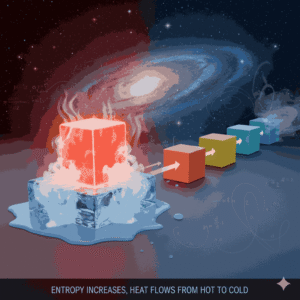
Entropy represents the degree of disorder or randomness in a system and is directly linked to the second law of thermodynamics, which states that the entropy of the universe always increases for any spontaneous process. This entropy and heat transfer mcqs concept explains why heat naturally flows from a hotter body to a colder one and why no heat engine can convert all absorbed heat into work. Entropy and heat transfer MCQs based on entropy often examine reversible and irreversible processes, adiabatic changes, phase transitions, and cyclic processes.
Similarly, heat transfer mechanisms are essential for explaining everyday phenomena such as why metals feel colder than wood, how refrigerators work, or why black bodies emit radiation. Conduction dominates in solids, convection depends on gravity and fluid motion, and radiation occurs through electromagnetic waves without requiring a medium. These principles frequently appear in Entropy and Heat Transfer MCQs, testing students’ understanding of thermal conductivity, black body radiation, thermocouples, and refrigeration systems.
A strong grasp of these ideas allows aspirants to logically approach entropy and heat transfer MCQs rather than relying on memorization, making thermodynamics a scoring topic in competitive exams.
Entropy and Heat Transfer MCQs 30 Questions
1. For which of the following processes is the entropy change zero?
A. Isobaric
B. Isothermal
C. Adiabatic
D. Isochoric
Answer: C
2. The theory of refrigerator is based on
A. Joule–Thomson effect
B. Newton’s particle theory
C. Joule’s effect
D. None of the above
Answer: D
3. When you make ice cubes, the entropy of water
A. Does not change
B. Increases
C. Decreases
D. May either increase or decrease depending on the process
Answer: C
4. A measure of degree of disorder of a system is known as
A. Isobaric
B. Isotropy
C. Entropy
D. Enthalpy
Answer: C
5. Entropy of the universe tends to
A. Zero
B. Maximum
C. Minimum
D. Constant
Answer: B
6. No process is possible whose sole result is the transfer of heat from a colder object to a hotter object. This is the
A. Zeroth law of thermodynamics
B. First law of thermodynamics
C. Second law of thermodynamics
D. Cantor’s theorem
Answer: C
7. Clausius’s statement primarily concerns which thermodynamic variable?
A. Pressure
B. Internal energy
C. Volume
D. Temperature
Answer: B
8. The second law of thermodynamics is concerned with the
A. Conservation of energy
B. Conservation of number of holes
C. Conversion of heat energy into work
D. Transformation of temperature
Answer: C
9. The entropy remains constant in
A. A cyclic process
B. An isobaric process
C. An isothermal process
D. An adiabatic process
Answer: D
10. A long silver teaspoon placed in hot tea becomes hot at the exposed end mainly due to
A. Conduction
B. Reflection
C. Radiation
D. Thermal expansion
Answer: A
11. Which combination is most desirable for a cooking pot?
A. High specific heat & low conductivity
B. Low specific heat & high conductivity
C. High specific heat & high conductivity
D. Low specific heat & low conductivity
Answer: B
12. Which is the best conductor of heat?
A. Iron
B. Copper
C. Wood
D. Aluminium
Answer: B
13. A metal surface feels colder than wood because metal has
A. Low thermal conductivity
B. High thermal conductivity
C. High specific heat
D. Low specific heat
Answer: B
14. The requirement for heat conduction in a solid is
A. Density gradient
B. Uniform density
C. Temperature gradient
D. Uniform temperature
Answer: C
15. If temperature difference across a wall doubles, its thermal conductivity
A. Remains unchanged
B. Is doubled
C. Is halved
D. Becomes four times
Answer: A
16. The temperature at which thermo emf is maximum is called
A. Neutral temperature
B. Temperature of inversion
C. Transitional temperature
D. Null temperature
Answer: A
17. A brass block fitted in an iron block can be loosened by
A. Heating and then cooling
B. Cooling and then heating
C. Heating
D. Cooling
Answer: C
18. Correct order of thermal conductivities is
A. Copper > Glass > Water > Steel
B. Steel > Copper > Glass > Water
C. Copper > Steel > Glass > Water
D. Water > Glass > Steel > Copper
Answer: C
19. Two copper rods of same length but different diameters receive equal heat. Which expands more?
A. Thin rod
B. Thick rod
C. Both equally
D. Thin rod for large heat
Answer: B
20. Which statement is NOT correct?
A. Conduction is dominant in solids
B. Convection involves moving particles
C. Radiation uses electromagnetic waves
D. Melting temperature is called boiling point
Answer: D
21. Which statement is NOT correct?
A. Molecules vibrate during conduction
B. Specific heat is heat needed to raise temperature
C. Liquids transfer heat by convection
D. Radiation needs no medium
Answer: B
22. Net charge in a current-carrying conductor is
A. Always positive
B. Always negative
C. Zero
D. Either positive or negative
Answer: C
23. Heat transfer by molecular collisions is called
A. Convection
B. Conduction
C. Radiation
D. Ionization
Answer: B
24. Which heat transfer process depends on gravity?
A. Conduction
B. Convection
C. Radiation
D. None
Answer: B
25. Freezer is placed at top of refrigerator to allow
A. Fast cooling by convection
B. Motor protection
C. High heat absorption
D. Low heat absorption
Answer: A
26. Trade winds are caused by
A. Conduction
B. Convection
C. Radiation
D. None
Answer: B
27. A perfectly black body has
A. Infinite absorptive power
B. Zero absorptive power
C. Zero emissive power
D. Absorptive power = 1
Answer: D
28. Which object glows brightest at same temperature?
A. White
B. Black
C. All equal
D. Grey
Answer: B
29. Radiation from a black body is proportional to
A. Temperature
B. Fourth root of temperature
C. Fourth power of temperature
D. Square of temperature
Answer: C
30. Wavelength of radiation emitted depends on
A. Nature of surface
B. Area of surface
C. Temperature of surface
D. All of the above
Answer: C
Conclusion on Entropy and Heat Transfer MCQs-
In conclusion, Entropy and Heat Transfer MCQs provide an effective way to evaluate an aspirant’s depth of understanding of thermodynamic laws and their applications. These entropy and heat transfer mcqs connect abstract theoretical principles with observable physical behavior, reinforcing the importance of conceptual clarity. Entropy explains the natural direction of processes and the limitations of energy conversion, while heat transfer mechanisms explain how energy moves across systems in different forms.
In this Entropy and heat transfer mcqs ,understanding entropy helps aspirants analyze why reversible processes are idealized, why adiabatic processes can be isentropic, and why real-world systems always involve losses. Heat transfer concepts, on the other hand, explain practical technologies such as refrigerators, cooking utensils, thermal insulation, and radiation-based heating. When aspirants master these entropy and heat transfer mcqs concepts, they can easily interpret questions involving thermal equilibrium, black body radiation, and the efficiency of heat engines.
From an exam perspective, practicing Entropy and Heat Transfer MCQs strengthens analytical thinking and helps identify common traps set by conceptual options. Instead of guessing answers, aspirants learn to apply physical reasoning, dimensional understanding, and thermodynamic laws systematically.
Overall, entropy and heat transfer mcqs re foundational pillars of thermodynamics. A clear understanding of these topics not only boosts exam performance but also builds a strong base for advanced studies in physics, engineering, and energy sciences. Consistent practice of entropy and heat transfer MCQs rooted in these concepts ensures long-term retention and confidence in problem-solving.