
- iamal
- January 17, 2026
The Powerful Doppler Effect in Sound for NEET, JEE and CUET
The Doppler effect in sound is a well-known phenomenon related to sound waves that explains the apparent change in frequency or pitch of a sound when there is relative motion between the source of sound and the observer. It was first observed by the Austrian physicist Christian Doppler and is commonly experienced in everyday life. The Doppler effect in sound not because the sound itself changes, but because the distance between successive sound wavefronts changes due to motion.
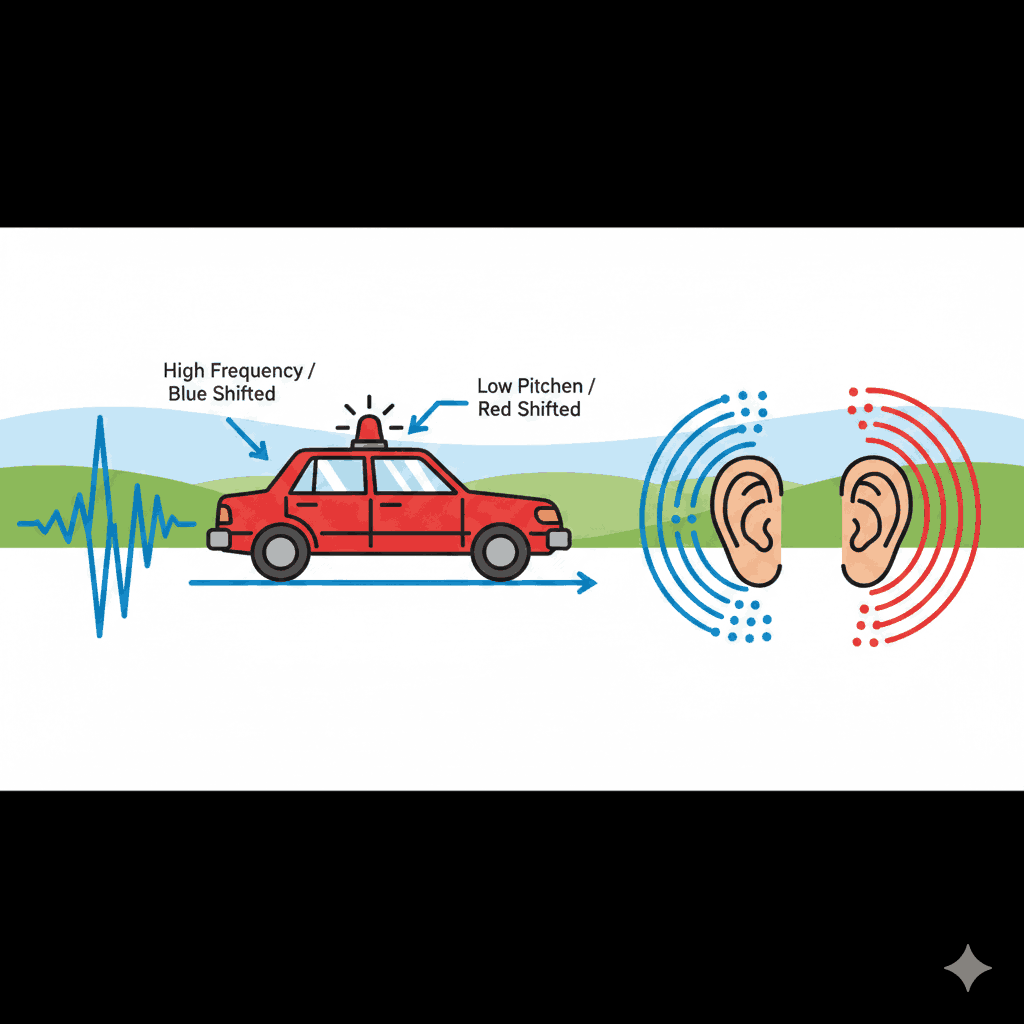
When a sound source moves towards an observer, the sound waves in front of the source get compressed, resulting in a higher frequency and a shriller (higher-pitched) sound. Conversely, when the source moves away from the observer, the sound waves get stretched, leading to a lower frequency and a deeper (lower-pitched) sound. The same effect can also occur if the observer moves while the source remains stationary.
A common real-life example of the Doppler effect in sound is the sound of an ambulance or police siren. As the vehicle approaches an observer, the siren sounds sharper and higher in pitch. Once it passes and moves away, the pitch suddenly drops and sounds lower. This noticeable change in pitch happens even though the siren produces sound at a constant frequency.
The Doppler effect in sound is applicable only when there is relative motion along the line joining the source and the observer. If both are stationary or moving together at the same speed, no Doppler effect in sound is observed. This phenomenon is especially important in physics because it helps explain how motion affects wave behavior and has wide applications in science, medicine, astronomy, and technology.
30 MCQs on Doppler Effect in Sound:
1. If T is the reverberation time of an auditorium of volume V, then:
a) T ∝ V²
b) T ∝ V
c) T ∝ 1/V
d) T ∝ 1/V²
Answer: b
2. A man X can hear up to 10 kHz and another man Y up to 20 kHz. A note of frequency 500 Hz is produced; both will hear sounds of:
a) Different pitch but same quality
b) Same pitch but different quality
c) Same pitch and same quality
d) Different pitch and different quality
Answer: b
3. Sound waves in air cannot be polarized because:
a) Their speed is small
b) They require a medium
c) They are longitudinal
d) Their speed is temperature dependent
Answer: c
4. The speed of sound waves in a gas:
a) Does not depend upon density
b) Does not depend upon pressure
c) Does not depend upon temperature
d) Depends upon density of the gas
Answer: d
5. Choose the correct statement:
a) Beats are due to destructive interference
b) Maximum beat frequency audible is 20
c) Beats are a result of Doppler effect
d) Beats are due to superposition of two waves of nearly equal frequencies
Answer: d
6. The phenomenon of sound propagation in air is:
a) Isothermal
b) Adiabatic
c) Isobaric
d) None of these
Answer: c
7. Intensity of sound is reduced by 10% through one slab. Reduction through three slabs is:
a) 30%
b) 27.10%
c) 20%
d) 36%
Answer: b
8. The sound wave produced in a gas is always:
a) Longitudinal
b) Transverse
c) Stationary
d) Electromagnetic
Answer: a
9. Source and observer are at rest. If speed of sound changes, frequency heard is:
a) Increased
b) Decreased
c) Unchanged
d) Decreasing exponentially
Answer: c
10. A tuning fork (500 Hz) resonates at 17 cm and 52 cm. Velocity of sound is:
a) 175 m/s
b) 350 m/s
c) 525 m/s
d) 700 m/s
Answer: b
11. Beats are the result of:
a) Diffraction
b) Destructive interference
c) Constructive and destructive interference
d) Superposition of two waves of nearly equal frequencies
Answer: d
12. In a sonometer wire, waves produced are:
a) Longitudinal
b) Transverse, stationary and unpolarized
c) Transverse, stationary and polarized
d) Transverse, progressive and polarized
Answer: c
13. When sound travels from one medium to another, which remains unchanged?
a) Amplitude
b) Wavelength
c) Velocity
d) Pitch
Answer: d
14. During sound propagation, medium particles:
a) Are displaced permanently
b) Make a conventional current
c) Have no net displacement
d) Jump from one position to another
Answer: c
15. Interference of sound waves with nearly equal frequencies causes:
a) Diffraction
b) Resonance
c) Beats
d) Refraction
Answer: c
16. Which quantity is transmitted in longitudinal waves?
a) Dispersion
b) Energy
c) Matter
d) Frequency
Answer: b
17. Intensity of sound varies with time in:
a) Doppler effect
b) Beats
c) Transverse waves
d) Longitudinal waves
Answer: b
18. In compressions and rarefactions:
a) Density varies
b) Density remains constant
c) Heat transfer occurs
d) Boyle’s law is obeyed
Answer: a
19. Reverberation time does not depend on:
a) Temperature
b) Volume of room
c) Size of window
d) Carpet and curtain
Answer: d
20. Velocity of sound is affected by:
a) Temperature
b) Medium
c) Pressure
d) Both (a) and (b)
Answer: d
21. Which statement is wrong?
a) Sound travels in straight line
b) Sound is a form of energy
c) Sound travels as waves
d) Sound travels faster in vacuum
Answer: d
22. A bomb explodes on the Moon. Sound will be heard on Earth after:
a) 3.7 min
b) 10 min
c) 138 min
d) Sound will never be heard
Answer: d
23. Speed of sound 332 m/s equals:
a) 1.1952 km/h
b) 11.952 km/h
c) 119.52 km/h
d) 1195.2 km/h
Answer: d
24. Sonometer works on:
a) Hooke’s law
b) Elasticity
c) Resonance
d) Newton’s law
Answer: c
25. Electrical sound waves are not transmitted directly because:
a) Speed is low
b) Frequency varies
c) Heavily absorbed by atmosphere
d) Antenna height increases
Correct answer: c
26. Beats can occur for:
a) Longitudinal waves only
b) Transverse waves only
c) Sound waves only
d) Both longitudinal and transverse waves
Answer: d
27. Beats heard change when one tuning fork is loaded:
a) Increases
b) Decreases
c) Remains constant
d) May increase or decrease
Answer: d
28. We identify a sound source from:
a) Overtones present
b) Wavelength
c) Amplitude
d) Intensity
Answer: a
29. When sound travels from air to water, what remains constant?
a) Time period
b) Frequency
c) Velocity
d) Wavelength
Answer: b
30. Velocity of sound in air is not affected by:
a) Moisture
b) Temperature
c) Atmospheric pressure
d) Composition of air
Answer: c
Conclusion: Importance and Applications of Doppler Effect in Sound
The Doppler effect in sound is a fundamental concept that clearly demonstrates how motion influences wave properties, particularly frequency and pitch. In this Doppler effect in sound it helps us understand why sounds from moving objects appear different even though the source itself does not change its frequency. By analyzing whether the source or observer is moving toward or away from each other, we can predict whether the perceived pitch will increase or decrease.
Beyond everyday experiences like passing vehicles, the Doppler effect in sound has significant practical applications. In medical science, Doppler ultrasound is used to measure blood flow in arteries and veins, helping doctors detect blockages and heart conditions. In meteorology, Doppler radar is used to study wind speed, storms, and cyclones. The Doppler effect in sound concept is also used in sonar systems to detect underwater objects and in traffic monitoring devices to measure vehicle speed.
Understanding the Doppler effect in sound also builds a strong foundation for advanced topics in physics, including wave motion and acoustics. In Doppler effect in sound it highlights the relationship between speed, frequency, and wavelength, reinforcing the idea that waves behave differently depending on the observer’s frame of reference.
In conclusion, the Doppler effect in sound is not just a theoretical concept but a phenomenon deeply connected to real life. Its simplicity, clear observations, and wide-ranging applications make it an essential topic in physics, helping aspirants appreciate how scientific principles explain everyday experiences and modern technologies alike.