
- Amal Augustine
- November 26, 2025
Dimensional Analysis Mastery for NEET ,JEE &CUET:Advanced MCQs Guide(Units & Measurements)
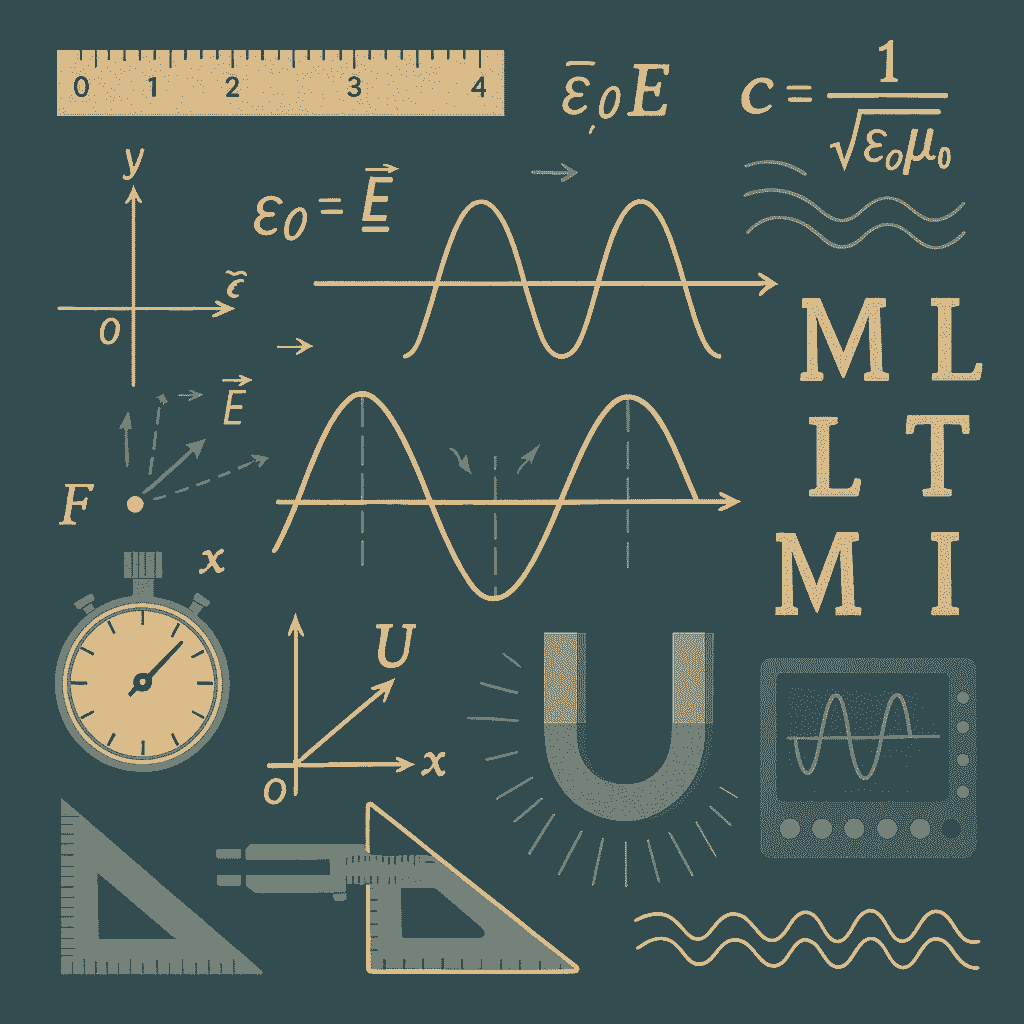
A detailed physics-themed digital illustration featuring rulers, vectors, electromagnetic fields, waves, formulas, dimensional symbols, and measurement tools — without any written text.
Introduction: Why Dimensional Analysis Matters for CUET, NEET & JEE Aspirants
Dimensional Analysis is one of the most scoring and conceptually rich chapters in NCERT Class 11 Units & Measurements. Whether you are preparing for CUET Physics, the NEET UG exam, or JEE Main/Advanced, understanding dimensions, units, and the mathematical relationships between physical quantities is absolutely essential.
This chapter offers high-yield marks because:
-
Questions are direct and formula-based
-
No heavy calculation is required
-
Units, dimensions & derived quantities appear across all physics chapters
-
CUET specifically asks multi-concept MCQs with dimensional reasoning
This blog includes:
-
Comprehensive conceptual explanations
-
SEO-rich long-tail keywords such as:
CUET physics dimensional analysis,
units and measurements NEET questions,
JEE main important MCQs,
NCERT class 11 chapter 1 solved MCQs,
dimension formula trick for competitive exams,
CUET physics practice questions chapter-wise,
NEET physics units and dimensional analysis numericals, etc. -
A massive MCQ Practice Section with answers included immediately after each question
Let’s begin mastering one of the most foundational topics of physics.
Understanding Dimensions: A Quick Refresher
Every physical quantity—whether force, pressure, energy, power, or angular momentum—can be represented in terms of the fundamental dimensions:
-
Mass (M)
-
Length (L)
-
Time (T)
-
Electric Current (A)
-
Temperature (K)
-
Amount of Substance (mol)
-
Luminous Intensity (cd)
Derived quantities are expressed using combinations of these base units.
Dimensional analysis allows us to:
✔ Check the correctness of equations
✔ Derive formulas
✔ Convert units
✔ Understand which physical quantities are comparable
✔ Solve CUET, JEE, and NEET MCQs quickly
Why CUET, NEET & JEE Love Dimensional Questions
Dimensional Analysis questions test your understanding of:
-
How physical formulas are structured
-
Whether two quantities can be added or compared
-
Which constants have dimensions
-
How to derive new relations
CUET especially asks MATCH-LIST and assertion–reason type dimensional questions.
CUET/JEE/NEET PRACTICE SECTION — MCQs WITH OPTIONS + ANSWERS
(1) The dimension of E²/μ₀ in mass (M), length (L) and time (T) is (E = electric field, μ₀ = permeability of free space)
a) [M2L3T−2A−2][M²L³T^{-2}A^{-2}]
b) [MLT−4][MLT^{-4}]
c) [ML3T−2][ML³T^{-2}]
d) [ML4T−4][ML⁴T^{-4}]
✔ Answer: b
(2) The dimension of angular momentum in mass (M), length (L) and time (T) is
a) [MLT−1][MLT^{-1}]
b) [ML−1T−1][ML^{-1}T^{-1}]
c) [ML2T−1][ML²T^{-1}]
d) [ML−1T−2][ML^{-1}T^{-2}]
✔ Answer: c
(3) If E and E₀ represent energies, τ and t₀ represent times, which relation is dimensionally correct?
a) E=E0etE = E₀e^t
b) E=E0t0e−t/t0E = E₀ t₀ e^{-t/t₀}
c) E=E0t0e−t2E = E₀ t₀ e^{-t^2}
d) E=E0e−t/t0E = E₀ e^{-t/t₀}
✔ Answer: d
(4) If E = energy and G = gravitational constant, E/G has dimensions:
a) [M2L−1T0][M^2L^{-1}T^0]
b) [ML−1T−1][ML^{-1}T^{-1}]
c) [ML0T0][ML^0T^0]
d) [M2L−2T−1][M^2L^{-2}T^{-1}]
✔ Answer: a
(5) Dimensions of ε0dϕEdt\varepsilon_0 \frac{d\phi_E}{dt} are same as:
a) Potential
b) Current
c) Charge
d) Capacitance
✔ Answer: b
(6) Quantity with neither units nor dimensions:
a) Relative velocity
b) Relative density
c) Angle
d) Energy
✔ Answer: b
(7) If momentum (P), area (A), time (T) are fundamental quantities, dimensional formula for power is:
a) P1/2AT−1P^{1/2}AT^{-1}
b) P2AT−2P^{2}AT^{-2}
c) PA1/2T−2PA^{1/2}T^{-2}
d) PA1T−2PA^{1}T^{-2}
✔ Answer: c
(8) Dimensions of σb4\sigma b^4 (Stefan’s constant × Wien’s constant):
a) [M0L0T0][M^0L^0T^0]
b) [ML4T−3][ML^4T^{-3}]
c) [ML−2T][ML^{-2}T]
d) [ML4T−2][ML^4T^{-2}]
✔ Answer: b
(9) Dimensional formula of ε0μ0\varepsilon_0 \mu_0:
a) [M0L−2T2][M^0L^{-2}T^{2}]
b) [M0L2T−2][M^0L^2T^{-2}]
c) [M0LT−1][M^0LT^{-1}]
d) [M0L−1T][M^0L^{-1}T]
✔ Answer: a
(10) For P = P₀e^{-at²}, dimension of constant a is
a) dimensionless
b) [T−2][T^{-2}]
c) [T2][T^{2}]
d) same as P
✔ Answer: b
(11) Which pair has same dimensions?
a) Force & surface tension
b) Frequency & velocity gradient
c) Angular speed & solid angle
d) Stefan constant & Planck constant
✔ Answer: b
(12) Dimensional formula of AD/B from F = A cos Bx + C sin Dt:
a) [M0LT−1][M^0LT^{-1}]
b) [ML2T−3][ML^2T^{-3}]
c) [MLT−2][MLT^{-2}]
d) [M2L2T−3][M^2L^2T^{-3}]
✔ Answer: b
(13) In P = a – t² / bx (P = pressure), dimension of a/b is:
a) [LT2][LT^2]
b) [MT−2][MT^{-2}]
c) [ML2T−4][ML^2T^{-4}]
d) [M2LT−2][M^2LT^{-2}]
✔ Answer: b
(14) Dimensions of stopping potential:
a) [ML−1T−2A3][ML^{-1}T^{-2}A^3]
b) [M−1L−2T3A2][M^{-1}L^{-2}T^3A^2]
c) [M−2LT−3A−1][M^{-2}LT^{-3}A^{-1}]
d) [ML2T−3A−1][ML^2T^{-3}A^{-1}]
✔ Answer: d
(15) Not dimensionless:
a) Relative permeability
b) Power factor
c) Permeability of free space
d) Quality factor
✔ Answer: c
(16) With F, L, T as fundamental quantities, dimension of density is:
a) FL−4T2FL^{-4}T^2
b) FL−3T2FL^{-3}T^2
c) FL−5T2FL^{-5}T^2
d) FL−3T3FL^{-3}T^3
✔ Answer: a
(17) If (Energy × speed) = [MaLbTc][M^aL^bT^c], values of a, b, c are:
a) (1, 3, –3)
b) (1, 2, 3)
c) (1, 2, 3)
d) (1, 3, –2)
✔ Answer: a
(18) Dimensions of Angle × Force × Length:
a) (1, 1, –1)
b) (1, 2, –2)
c) (1, 1, 1)
d) (1, 2, 2)
✔ Answer: b
(19) Dimensional formula of emissivity:
a) [ML0T−3][ML^0T^{-3}]
b) [ML2T−3][ML^2T^{-3}]
c) [M0L0T0][M^0L^0T^0]
d) [ML2T−2][ML^2T^{-2}]
✔ Answer: c
(20) Same dimensions:
a) Electric displacement & surface charge density
b) Displacement current & electric field
c) Current density & surface charge density
d) Electric potential & energy
✔ Answer: a
(21) Dimensional formula of viscosity using P, A, T:
a) PA−1T0PA^{-1}T^0
b) PAT−2PAT^{-2}
c) PA−1TPA^{-1}T
d) PA−1T−1PA^{-1}T^{-1}
✔ Answer: a
(22) Same dimensions:
a) Velocity gradient & decay constant
b) Wien constant & Stefan constant
c) Angular frequency & angular momentum
d) Wave number & Avogadro number
✔ Answer: a
(23) Pair with different dimensions:
a) Wave number & Rydberg constant
b) Stress & coefficient of elasticity
c) Coercivity & magnetization
d) Specific heat capacity & latent heat
✔ Answer: d
(24) Dimension of mutual inductance:
a) [ML2T−2A−1][ML^2T^{-2}A^{-1}]
b) [ML2T−3A−1][ML^2T^{-3}A^{-1}]
c) [ML2T−2A−2][ML^2T^{-2}A^{-2}]
d) [ML2T−3A−2][ML^2T^{-3}A^{-2}]
✔ Answer: c
(25) Dimensions of B2/μ0B^2/\mu_0:
a) [ML2T−2][ML^2T^{-2}]
b) [MLT−2][MLT^{-2}]
c) [ML−1T−2][ML^{-1}T^{-2}]
d) [ML2T−2A−1][ML^2T^{-2}A^{-1}]
✔ Answer: c
(26) Dimension of density in system of C, G, h is:
a) C3G−2h−1C^3G^{-2}h^{-1}
b) C5G−2h−1C^5G^{-2}h^{-1}
c) C−3/2G−1/2h1/2C^{-3/2}G^{-1/2}h^{1/2}
d) C9/2G−1/2h−1/2C^{9/2}G^{-1/2}h^{-1/2}
✔ Answer: b
(27) Dimensional formula for power of a lens:
a) [L−1M0T0][L^{-1}M^0T^0]
b) [L0M−1T0][L^0M^{-1}T^0]
c) [L0M0T−1][L^0M^0T^{-1}]
d) [L0M0T0][L^0M^0T^0]
✔ Answer: a
(28) Dimensional formula of electric flux:
a) [ML−3T3A−1][ML^{-3}T^3A^{-1}]
b) [ML3T3A−1][ML^3T^3A^{-1}]
c) [ML−3T−3A−1][ML^{-3}T^{-3}A^{-1}]
d) [M−1L3T−3A−1][M^{-1}L^3T^{-3}A^{-1}]
✔ Answer: c
(29) Dimensions of Boltzmann constant:
a) [ML2T−2Θ−1][ML^2T^{-2}\Theta^{-1}]
b) [ML2T−2Θ][ML^2T^{-2}\Theta]
c) [M2LT−2Θ−1][M^2LT^{-2}\Theta^{-1}]
d) [ML0T−2Θ−1][ML^0T^{-2}\Theta^{-1}]
✔ Answer: a
(30) Dimension of angular momentum:
a) [M0L1T−1][M^0L^1T^{-1}]
b) [ML2T−2][ML^2T^{-2}]
c) [ML2T−1][ML^2T^{-1}]
d) [M2L1T−2][M^2L^1T^{-2}]
✔ Answer: c
Conclusion
This long-form article combines all major dimensional analysis concepts, includes exam-level MCQs, and integrates CUET, NEET, and JEE targeted keywords. Solving these questions builds confidence and ensures you can handle both direct and tricky dimensional problems in competitive exams.

Amal Augustine is the founder of ExQuizMe, a dynamic learning and quiz platform built to make education engaging, competitive, and fun. A passionate learner and an academic achiever, Amal completed his schooling at Government HSS Manjapra, graduating with 92.5% in Computer Science. He later earned his degree from St. Stephen’s College, University of Delhi, one of India’s most prestigious arts and science institutions.
Currently, Amal is pursuing his Master’s degree at National Sun Yat-sen University, Taiwan, where he continues to deepen his interest in research and technology. Throughout his school and college years, he won 50+ national-level interschool and collegiate quiz competitions, was
Beyond academics, Amal Augustine is an avid reader of science journals, a dedicated research student, and a technology enthusiast who loves programming and exploring the world of Computer Science. Through ExQuizMe, he aims to make learning accessible, enjoyable, and empowering for students across the globe.