
- iamal
- February 9, 2026
Master Daniell Cell Numerical MCQs Class 12 – High -Scoring Electrochemistry Practice
The Daniell cell is one of the most important electrochemical cells studied in senior secondary chemistry, especially when aspirants begin solving numerical problems based on electrochemical principles. Understanding the concepts behind Daniell cell numerical mcqs class 12 helps learners connect theory with calculation-based applications.
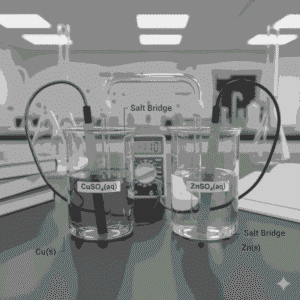
At its core, the Daniell cell consists of a zinc electrode immersed in zinc sulphate solution and a copper electrode immersed in copper sulphate solution. The separation of oxidation and reduction reactions in this setup forms the conceptual backbone of Daniell cell numerical mcqs class 12, where aspirants are expected to calculate EMF values accurately.
One of the first numerical ideas associated with the Daniell cell is the calculation of standard cell potential using standard electrode potentials. In many Daniell cell numerical mcqs class 12, learners apply the relation Ecell∘=Ecathode∘−Eanode∘E^\circ_{cell} = E^\circ_{cathode} – E^\circ_{anode} to determine feasibility of reactions.
Another crucial numerical aspect involves the Nernst equation. Real-world Daniell cells rarely operate under standard conditions, so concentration-based corrections are essential. Mastery of Daniell cell numerical mcqs class 12 depends on the correct use of logarithmic terms in the Nernst equation.
Aspirants also encounter Gibbs free energy calculations linked with EMF values. The relation ΔG=−nFE\Delta G = -nFE frequently appears in Daniell cell numerical mcqs class 12, reinforcing the connection between thermodynamics and electrochemistry.
Reaction quotient calculations form another layer of complexity. In many problems related to Daniell cell numerical mcqs class 12, learners must correctly identify ionic concentrations and substitute them into the reaction quotient expression before applying the Nernst equation.
Understanding spontaneity is essential when solving Daniell cell problems. A positive EMF indicates a spontaneous reaction, a concept repeatedly emphasized in Daniell cell numerical mcqs class 12, especially when comparing different electrochemical setups.
Equilibrium constant calculations are also common. Using the relationship between EMF and equilibrium constant helps aspirants evaluate reaction extent, which is a recurring theme in Daniell cell numerical mcqs class 12 at competitive exam level.
Another important numerical focus is the effect of dilution. Changing the concentration of zinc or copper ions directly influences EMF, and such changes are systematically tested in Daniell cell numerical mcqs class 12 problems.
The role of salt bridge does not involve direct calculation, but its influence on maintaining electrical neutrality is conceptually important. This understanding indirectly supports accuracy in Daniell cell numerical mcqs class 12 by preventing conceptual errors.
Aspirants are also expected to identify anode and cathode correctly before performing any calculations. Misidentification often leads to sign errors in Daniell cell numerical mcqs class 12, making conceptual clarity essential.
Temperature dependence of EMF is another advanced numerical idea. Though often simplified at 298 K, some Daniell cell numerical mcqs class 12 involve temperature corrections using modified Nernst equations.
Linking Daniell cell numericals with corrosion and electroplating concepts strengthens applied understanding. These interdisciplinary links enhance problem-solving ability in Daniell cell numerical mcqs class 12.
Exam-oriented preparation emphasizes unit consistency. Errors in Faraday constant units or logarithmic bases can significantly affect answers in Daniell cell numerical mcqs class 12, so precision is vital.
Repeated practice improves speed and accuracy. Exposure to diverse variations of Daniell cell numerical mcqs class 12 helps aspirants recognize patterns and avoid common traps.
Conceptual visualization of electron flow—from zinc to copper—is essential. This mental model simplifies calculations and improves confidence in Daniell cell numerical mcqs class 12.
Ultimately, numerical mastery of the Daniell cell reflects a aspirant’s overall grasp of electrochemistry. Strong fundamentals ensure consistent performance across Daniell cell numerical mcqs class 12 in board and competitive examinations.
Daniell Cell Numerical MCQs Class 12 :
1.
The reduction potential of hydrogen half-cell will be negative if:
a) PH2=1P_{H_2} = 1 atm and [H+]=2.0[H^+] = 2.0 M
b) PH2=1P_{H_2} = 1 atm and [H+]=1.0[H^+] = 1.0 M
c) PH2=2P_{H_2} = 2 atm and [H+]=1.0[H^+] = 1.0 M
d) PH2=2P_{H_2} = 2 atm and [H+]=2.0[H^+] = 2.0 M
Answer: c
2.
Which one of the following will increase the voltage of the cell at 298 K?
Sn(s) + 2Ag⁺(aq) → Sn²⁺(aq) + 2Ag(s)
a) Increase in the size of silver rod
b) Increasing the size of plate
c) Increase in the concentration of Ag⁺ ions
d) Increase in the concentration of Sn²⁺ ions
Answer: c
3.
The emf of a cell with 1 M solutions of reactants and products measured at 25°C is called:
a) Half-cell potential
b) Standard emf
c) Single electrode potential
d) Redox potential
Answer: b
4.
For the reaction
3Sn²⁺ + 2Au³⁺ → 3Sn⁴⁺ + 2Au,
the value of Ecell0E^0_{cell} is:
a) 1.38 V
b) 2.55 V
c) 1.35 V
d) –2.55 V
Answer: c
5.
Which of the following relations for EMF of a cell are correct?
a) (i) and (ii)
b) (ii) and (iii)
c) (iii) and (iv)
d) (ii) and (iv)
Answer: d
6.
The order of reducing power of A, B and C having Ered0E^0_{red} values 0.68 V, –2.54 V and –0.50 V is:
a) A > B > C
b) B > C > A
c) A > C > B
d) C > B > A
Answer: b
7.
The E° value for OCl⁻/½Cl₂ will be:
a) 2.20 V
b) 0.42 V
c) –2.20 V
d) –0.42 V
Answer: d
8.
The potential for the reaction
Sn(s) + 2Fe³⁺ → 2Fe²⁺ + Sn²⁺ is:
a) 1.68 V
b) 1.40 V
c) 0.91 V
d) 0.63 V
Answer: c
9.
During electrolysis of CuSO₄ using copper electrodes, the reaction at the anode is:
a) H⁺ + e⁻ → H
b) SO₄²⁻ → SO₄ + 2e⁻
c) Cu²⁺ + 2e⁻ → Cu
d) Cu(s) → Cu²⁺ + 2e⁻
Answer: d
10.
The minimum potential difference needed for electrolytic reduction of Al₂O₃ at 500°C is:
a) 4.5 V
b) 3.0 V
c) 2.5 V
d) 5.0 V
Answer: c
11.
Reduction potential of Fe³⁺/Fe²⁺ electrode at given concentrations is:
a) 0.653 V
b) 0.683 V
c) 0.489 V
d) 2.771 V
Answer: a
12.
The emf of the cell
Ni | Ni²⁺ || Au³⁺ | Au is:
a) 1.75 V
b) 1.25 V
c) –1.25 V
d) 2.00 V
Answer: a
13.
Time required to deposit 1 g of chromium at 1.25 A current is:
a) 1.24 h
b) 124 s
c) 12 min
d) None of these
Answer: a
14.
For a cell involving 3 moles of electrons and E° = 0.59 V, the equilibrium constant is:
a) 10¹⁵
b) 10⁵
c) 10³⁰
d) 10¹⁰
Answer: c
15.
During electrolysis of acidified CuSO₄ using Pt electrodes, the anode reaction is:
a) Cu → Cu²⁺ + 2e⁻
b) Cu²⁺ + 2e⁻ → Cu
c) 2H₂O → 4H⁺ + O₂ + 4e⁻
d) None of the above
Answer: c
16.
On diluting CuSO₄ solution 100 times, the change in reduction potential is:
a) –59.0 mV
b) 29.5 mV
c) –90.0 mV
d) 59.0 mV
Answer: d
17.
Electrode potential of Ni²⁺(0.1 M) | Ni at 25°C is:
a) 0.28 V
b) –0.28 V
c) 0.34 V
d) –0.82 V
Answer: b
18.
Which statement is not correct for electrolytic preparation of H₂O₂?
a) Lead is used as cathode
b) 50% H₂SO₄ is used
c) Hydrogen is liberated at anode
d) Sulphuric acid undergoes oxidation
Answer: c
19.
Volume of 1 M acetic acid needed to neutralize NaOH formed is:
a) 100 cm³
b) 200 cm³
c) 10 cm³
d) 2000 cm³
Answer: a
20.
The emf of the cell
Fe²⁺ + Zn → Zn²⁺ + Fe is:
a) 0.32 V
b) –1.20 V
c) –0.32 V
d) 1.20 V
Answer: a
21.
The Ecell0E^0_{cell} for
Mg + Cu²⁺ → Mg²⁺ + Cu is:
a) 2.03 V
b) –2.03 V
c) –2.7 V
d) 2.7 V
Answer: d
22.
The electrode potential for
Cu⁺ + e⁻ → Cu is:
a) 0.30 V
b) 0.38 V
c) 0.98 V
d) 0.52 V
Answer: d
23.
Which statement is correct?
a) Zn oxidizes Fe
b) Zn reduces Mg²⁺
c) Mg oxidizes Fe
d) Zn oxidizes Fe²⁺
Answer: d
24.
Reaction at the anode during electrolysis is:
a) Reduction
b) Oxidation
c) Hydrolysis
d) Redox reaction
Answer: b
25.
During charging of a lead-acid battery, the cathode reaction is:
a) Formation of PbSO₄
b) Reduction of Pb²⁺ to Pb
c) Formation of PbO₂
d) Oxidation of Pb to Pb²⁺
Answer: c
26.
Which electrolyte gives the highest boiling point?
a) Glucose
b) BaCl₂
c) KCl
d) K₄[Fe(CN)₆]
Answer: d
27.
In a Daniell cell, anode and cathode are:
a) Zn | Zn²⁺ and Cu²⁺ | Cu
b) Cu | Cu²⁺ and Zn²⁺ | Zn
c) Fe | Fe²⁺ and Cu²⁺ | Cu
d) Cu | Cu²⁺ and Fe²⁺ | Fe
Answer: a
28.
Which metal will displace P from its solution?
a) Q
b) Q and R
c) R
d) P
Answer: d
29.
Maximum flocculation value for Fe(OH)₃ sol is shown by:
a) NaCl
b) Na₂S
c) (NH₄)₃PO₄
d) K₂SO₄
Answer: a
30.
Kohlrausch’s law states that at infinite dilution:
a) Each ion contributes to conductance irrespective of other ions
b) Each ion contributes to equivalent conductance irrespective of other ions
c) Each ion contributes at finite dilution
d) Contribution depends on nature of other ions
Answer: b
Conclusion
In summary, consistent practice and conceptual clarity are essential for mastering daniell cell numerical mcqs class 12. These numericals strengthen understanding of electrode potentials, EMF, and spontaneity. By applying formulas carefully and interpreting electrochemical data correctly, aspirants can confidently solve daniell cell numerical mcqs class 12. Strong fundamentals ultimately ensure better performance in board exams and competitive tests focused on daniell cell numerical mcqs class 12.