
- iamal
- December 5, 2025
Class 11 Motion in One Dimension MCQs With Answers -A Fully Solved Guide
Important Class 11 Motion in One Dimension MCQs are essential for building a strong foundation in kinematics. These Class 11 Motion in One Dimension MCQs will help students strengthen core concepts like displacement, velocity, acceleration, distance–time graphs, and average speed. Each question is carefully curated to build exam confidence for CBSE Class 11, NEET, JEE, and CUET aspirants. Practising these problems regularly ensures conceptual accuracy and strong numerical problem-solving skills.
Motion in One Dimension MCQs —also known as rectilinear motion—is one of the most important foundations in physics. It helps students understand how bodies move along a straight line under the influence of velocity, acceleration, and time. Although the concepts seem simple at first, mastering them builds the confidence needed for tackling more advanced topics like projectile motion, laws of motion, circular motion, and kinetics.
For students preparing for NEET, JEE, CUET, or Class 11 exams, understanding Motion in One-Dimension MCQs is not just helpful—it’s essential. This chapter strengthens your ability to read distance-time graphs, interpret velocity-time graphs, calculate average speed, and analyse acceleration, all of which frequently appear in competitive exams.
These Class 11 Motion in One Dimension MCQs help you to strengthen your concepts,learn faster, and avoid common mistakes.Each solved questions bluids your confidence and improves your understanding pg straight-line motion.
MCQs on Class 11 Motion in One Dimension MCQs (With Answers)
1. Weight of a body of mass m in its free fall above the surface of the earth is
A) mg
B) zero
C) infinity
D) m√g
Answer: B
2. A cyclist starts from rest, accelerates uniformly, and covers 120 m in 10 s. His acceleration is
A) 5
B) 1.5
C) 2.4
D) 3
Answer: C
3. A car covers AB distance in three equal parts with speeds v₁, v₂, and v₃ where v₃ = 3v₁, v₂ = 2v₁, v₁ = 11 m/s. Average velocity is
A) 20 m/s
B) 12 m/s
C) 18 m/s
D) 22 m/s
Answer: C
4. When a body starts from rest and moves with constant acceleration, the velocity–time graph is
A) Graph a
B) Graph b
C) Graph c
D) Graph d
Answer: A
5. Stopping distance of a moving vehicle is proportional to
A) initial velocity
B) cube of initial velocity
C) square of initial velocity
D) square root of initial velocity
Answer: C
6. The displacement of a particle is s = 9t² – 2t³. Time when velocity becomes zero is
A) 8 s
B) 6 s
C) 4 s
D) 3 s
Answer: D
7. The slope of a velocity–time graph for uniform velocity equals
A) Initial velocity
B) Final velocity
C) Zero
D) Constant velocity
Answer: C
8. For x = 8t² + 18t, the average acceleration between t = 2 and t = 4 is
A) 18 m/s²
B) 32 m/s²
C) 20 m/s²
D) 16 m/s²
Answer: B
9. A train travels from A to B at 18 m/s and returns at 36 m/s. Average speed is
A) √(5/2) m/s
B) 36 m/s
C) √(3/2) m/s
D) 36 m/s
Answer: C
10. A vehicle at 36 km/h stops in 200 m. Retardation is
A) 0.25 m/s²
B) 0.20 m/s²
C) 0.15 m/s²
D) 0.10 m/s²
Answer: A
11. Incorrect statements for variable velocity motion
A) (i), (ii), (iii)
B) (i), (ii)
C) (ii), (iii)
D) (i) & (iii)
Answer: D
12. For 3s = 9t + 5t², acceleration is
A) 5/3
B) 14/3
C) 10/3
D) 19/3
Answer: C
13. A particle at x = 0 moves with v = 5x. Its acceleration is
A) 8.5 m/s²
B) 12.5 m/s²
C) 10.5 m/s²
D) 11.5 m/s²
Answer: B
14. What decreases when a body moves with constant retardation?
A) Speed
B) Acceleration
C) Distance
D) All of these
Answer: A
15. If a = λv and v(0) = 0, then velocity as a function of time is
A) 4/3 λ²t²
B) 4/1 λ²t²
C) 2/1 λ²t²
D) 3/4 λ²t²
Answer: C
16. A body starting from rest travels distance x in first n seconds and y in next n seconds. Then
A) x = y
B) x = 3y
C) x = y
D) x = 2y
Answer: A
17. Distances in three equal intervals for uniform acceleration (from rest) are in the ratio
A) 1:2:3
B) 1:3:5
C) 1:2:3²
D) 1:3²:5²
Answer: B
18. For s = 3t³ + t² + 3t + 8, acceleration at t = 1 is
A) 32
B) 10
C) 16
D) 23
Answer: A
19. For x = α + βt², average velocity between t = 2 and t = 4 is 12 m/s. β =
A) 0.5
B) 2
C) 4
D) 5
Answer: B
20. A body covers C/4 distance along a circle radius r. Displacement is
A) r
B) r√2
C) 2r
D) 2r√2
Answer: B
21. For a given straight-line motion graph, the correct interpretation is
A) Increasing velocity then constant
B) Uniform increase
C) Average velocity zero
D) Impossible graph
Answer: C
22. A 20 kg body moving at 15 m/s faces 100 N retarding force. Time to stop is
A) 3 s
B) 6 s
C) 1.5 s
D) 9 s
Answer: A
23. A body with constant momentum has constant
A) Acceleration
B) Force
C) Velocity
D) Mass
Answer: C
24. A bomb dropped from 720 km/h at altitude 980 m hits ground in
A) 1 s
B) 7.2 s
C) 14.15 s
D) 0.15 s
Answer: C
25. A car goes 50 km south and returns to Bengaluru in 2 hours. Average velocity magnitude is
A) 0
B) 50 km/h
C) 25 km/h
D) Cannot be calculated
Answer: A
26. Object at u = 5 m/s accelerates at 2 m/s² for 6 s. Distance traveled is
A) 60 m
B) 25 m
C) 36 m
D) 66 m
Answer: D
27. Deceleration needed for 10 m/s to stop in 100 m is
A) 20 m/s²
B) 10 m/s²
C) 2 m/s²
D) 0.5 m/s²
Answer: D
28. A 175 m train at 72 km/h meets a bird at 18 km/h opposite. Time to cross is
A) 35 s
B) 27 s
C) 11.6 s
D) 7 s
Answer: D
29. For v = u + at, the v–t graph is a line
A) Through origin
B) With x-intercept u
C) With y-intercept u
D) With slope u
Answer: C
30. Acceleration-time graph shows a body starting from rest. Maximum speed is at
A) Point 1
B) Point 2
C) Point 3
D) Point 4
Answer: B
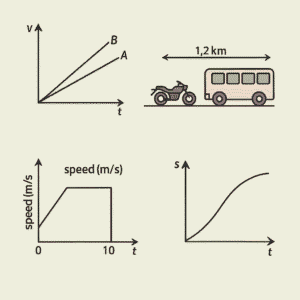
Conclusion
These Class 11 Motion in One Dimension MCQs help students build a strong conceptual base in kinematics. By practising a mix of numerical, graphical, and theoretical questions, learners develop precision and speed—skills essential for scoring well in JEE, NEET, CUET, and school examinations. Consistent revision of these problems strengthens understanding of displacement, velocity, and acceleration, ensuring long-term mastery of straight-line motion. Mastering Class 11 motion in One Dimension MCQs ensures strong conceptual clarity and improves accuracy in competitive exams. These collection of Class 11 Motion in One Dimension MCQs provides details understanding of distance, displacement, speed, velocity, and acceleration.The Class 11 Motion in One Dimension MCQs presented in this guide act as a valuable resource for concept reinforcement.