
- iamal
- January 12, 2026
Effective Conceptual MCQs on Simple Harmonic Motion, Oscillations, and Wave Phenomena
Simple Harmonic Motion (SHM) and oscillatory motion form a crucial foundation in classical physics, appearing extensively in school boards, JEE, NEET, and university-level examinations. The questions discussed in this set revolve around restoring force, periodic motion, energy variation, damping, resonance, standing waves, and electromagnetic effects like eddy currents, all of which are interconnected through fundamental physical principles.
Many natural and artificial systems exhibit simple harmonic motion, such as a mass attached to a spring, oscillations of a pendulum for small angular displacements, vibrations of atoms in solids, and electrical oscillations in LC circuits. In Simple Harmonic Motion, physical quantities like displacement, velocity, and acceleration vary periodically with time, while the motion itself can be represented using sine or cosine functions. The governing differential equation of Simple Harmonic Motion highlights the importance of angular frequency, which determines how fast the system oscillates.
One of the key features of simple harmonic motion is the continuous exchange between kinetic energy and potential energy. At the mean position, the particle possesses maximum kinetic energy and zero potential energy, whereas at the extreme positions, kinetic energy becomes zero and potential energy reaches its maximum value. However, the total mechanical energy of an ideal Simple Harmonic Motion system remains constant, provided no damping forces such as friction or air resistance are present.
Motion in Simple Harmonic Motion and Restoring Forces
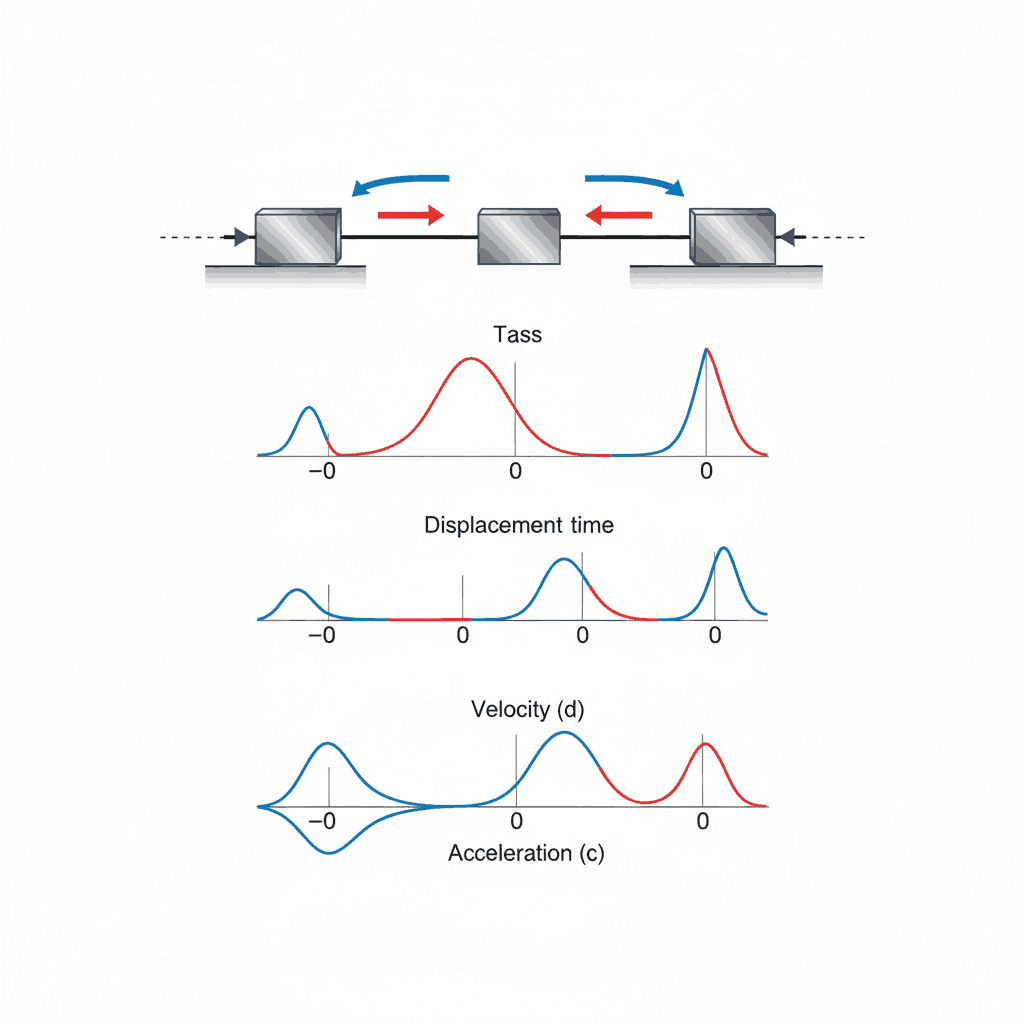
In linear Simple Harmonic Motion, the defining condition is that the restoring force is directly proportional to displacement and always directed towards the equilibrium position. This leads to acceleration being maximum at the extreme positions and zero at the mean position. Consequently, the velocity is maximum at the mean position, a concept repeatedly tested through graphical and numerical MCQs.
The differential equation
d2xdt2+ω2x=0\frac{d^2x}{dt^2} + \omega^2 x = 0
clearly shows that ω2\omega^2 represents the restoring force per unit displacement, which determines the angular frequency of oscillation.
Energy in Simple Harmonic Motion
The total mechanical energy of an Simple Harmonic Motion system remains constant and is directly proportional to the square of the amplitude. While displacement, velocity, and acceleration vary periodically, total energy does not—making it a non-periodic quantity in Simple Harmonic Motion.
When amplitude changes, energy changes significantly:
-
Doubling amplitude → Maximum velocity doubles
-
Energy increases by a factor of four
Average velocity over a complete oscillation is zero, but average speed depends on amplitude and frequency, a subtle but important distinction frequently tested.
Pendulum, Swing, and Oscillation-Based Systems
Changes in configuration affect the time period:
-
Sitting on a swing lowers the center of mass → time period decreases
-
Standing up raises the center of mass → time period decreases further
The kinetic energy oscillates with frequency 2f, while displacement oscillates with frequency f. This explains why energy-related MCQs often involve doubled frequencies.
MCQs on Simple Harmonic Motion with Answers:
1.
A bar magnet is released from rest along the axis of a very long vertical copper tube. After some time, the magnet will
A. Move down with almost constant speed
B. Oscillate inside the tube
C. Move down with an acceleration greater than g
D. Move down with an acceleration equal to g
Answer: A
2.
In a linear SHM:
(A) Restoring force ∝ displacement
(B) Acceleration and displacement are opposite
(C) Velocity is maximum at mean position
(D) Acceleration is minimum at extreme points
Choose the correct option.
A. (A), (B), and (C) only
B. (C) and (D) only
C. (A), (B), and (D) only
D. (A), (C), and (D) only
Answer: A
3.
A particle executes SHM with amplitude 8 cm and time period 6 s. Time taken to move from extreme position to half amplitude is
A. 1 s
B. 2 s
C. 3 s
D. 6 s
Answer: A
4.
A particle executes two perpendicular SHMs of different amplitudes with phase difference 2π. The path will be
A. Circular
B. Straight line
C. Parabolic
D. Elliptical
Answer: D
5.
A pendulum undergoes SHM with frequency f. The frequency of its kinetic energy is
A. f/2
B. 2f
C. f
D. 4f
Answer: B
6.
Total energy of a simple harmonic oscillator is proportional to
A. Square of amplitude
B. Frequency
C. Amplitude
D. Velocity
Answer: A
7.
In the SHM equation d²x/dt² + ω²x = 0, ω² represents
A. Restoring force per unit mass
B. Restoring force per unit displacement
C. Restoring force per unit velocity
D. Acceleration per unit mass per unit displacement
Answer: B
8.
The acceleration of a particle executing SHM is
A. Always zero
B. Always constant
C. Maximum at extreme position
D. Maximum at equilibrium position
Answer: C
9.
Motion described by y = A sin(ωt) + B has amplitude
A. A
B. B
C. A + B
D. √(A + B)
Answer: A
10.
Which function represents periodic motion?
A. e^ωt
B. log(e^ωt)
C. sinωt + cosωt
D. e^–ωt
Answer: C
11.
If a boy oscillating on a swing board sits down, the time period will
A. Increase
B. Decrease
C. Remain unchanged
D. Depend on body weight
Answer: B
12.
If a child stands up on a swing instead of sitting, the time period will
A. Remain same
B. Increase if tall, decrease if short
C. Increase
D. Decrease
Answer: D
13.
Which quantity does not vary periodically in SHM?
A. Velocity
B. Total energy
C. Acceleration
D. Displacement
Answer: B
14.
Distance travelled in one complete SHM oscillation of amplitude A is
A. 2A
B. 4A
C. A
D. A/2
Answer: B
15.
Average velocity of a particle executing SHM over one complete cycle is
A. Aω
B. 2Aω²
C. Zero
D. 2Aω
Answer: C
16.
Average speed over one SHM oscillation (amplitude = a, frequency = n) is
A. 2an
B. 4an
C. 6an
D. 8an
Answer: B
17.
When forced vibration frequency equals natural frequency, the phenomenon is
A. Resonance
B. Beats
C. Forced vibration
D. Damping
Answer: A
18.
Naturally oscillating systems undergo
A. SHM
B. Circular motion
C. Accelerated motion
D. Continuous motion
Answer: A
19.
A system that returns to equilibrium fastest without oscillation is
A. Overdamped
B. Critically damped
C. Underdamped
D. Undamped
Answer: B
20.
In an acceleration–time graph of SHM, speed is maximum at
A. t = 4 s
B. t = 4 s
C. t = 2 s
D. t = 3 s
Answer: B
21.
Time period of the second’s hand of a watch is
A. 1 hour
B. 1 second
C. 12 hours
D. 1 minute
Answer: D
22.
Which of the following is SHM?
A. Earth around Sun
B. Earth about axis
C. Revolving top
D. Steel ball in viscous medium
E. None
Answer: E
23.
For x = a sin(2πt), position at t = 1/8 s is
A. a
B. a/2
C. a/√2
D. a/4
Answer: C
24.
At mean position in SHM, velocity is
A. Zero
B. Minimum
C. Maximum
D. Infinite
Answer: C
25.
At 3 cm from mean position, acceleration is 12 cm/s². Time period is
A. 0.5 s
B. 1 s
C. 2 s
D. 3.14 s
Answer: D
26.
Which expression represents SHM?
A. a + bx − cx²
B. bx²
C. a − bx + cx²
D. −bx
Answer: D
27.
In stationary waves, particles between two nodes pass mean position
A. At different times with different velocities
B. At different times with same velocity
C. Same time with unequal velocity
D. Same time with different velocities
Answer: D
28.
If amplitude of SHM doubles, what happens?
A. Max PE doubles
B. Max KE doubles
C. Total energy doubles
D. Max velocity doubles
Answer: D
29.
A standing wave with 3 nodes and 2 antinodes between atoms separated by 1.21 Å has wavelength
A. 1.21 Å
B. 1.42 Å
C. 6.05 Å
D. 3.63 Å
Answer: A
Conclusion on Simple Harmonic Motion
In conclusion, simple harmonic motion represents a perfect balance between mathematical simplicity and physical applicability. Its defining characteristic—the proportional restoring force—leads to predictable, periodic behavior that can be analyzed precisely using equations and graphs. By studying Simple Harmonic Motion, learners gain deep insight into how oscillatory systems behave under ideal conditions.
The importance of Simple Harmonic Motion extends far beyond textbook problems. It provides a conceptual bridge between mechanics, waves, acoustics, and even quantum physics. Real-world systems rarely perform perfect simple harmonic motion, but Simple Harmonic Motion serves as an excellent approximation for small oscillations and forms the starting point for understanding damping, resonance, and energy dissipation. The study of Simple Harmonic Motion also enhances problem-solving skills by strengthening the ability to interpret motion graphs, apply energy principles, and relate physical quantities logically.