
- iamal
- December 15, 2025
Mastering Curvilinear and Rotational Motion MCQs : Power Practice for Competitive Exams
Curvilinear and rotational motion mcqs forms a crucial bridge between linear kinematics and advanced mechanics. Curvilinear and rotational motion mcqs questions from this topic frequently appear in Class 11 Physics, NEET, JEE Main, and other competitive exams, testing both conceptual understanding and numerical accuracy.
This post compiles high-quality MCQs on Curvilinear and rotational motion mcqs, covering banking of roads, centripetal acceleration, circular dynamics, and combined projectile–circular motion scenarios. Each curvilinear and rotational motion mcqs question includes multiple options followed immediately by the correct answer, making it ideal for revision, mock tests, and last-minute preparation.
Curvilinear and Rotational Motion MCQs (With Answers)
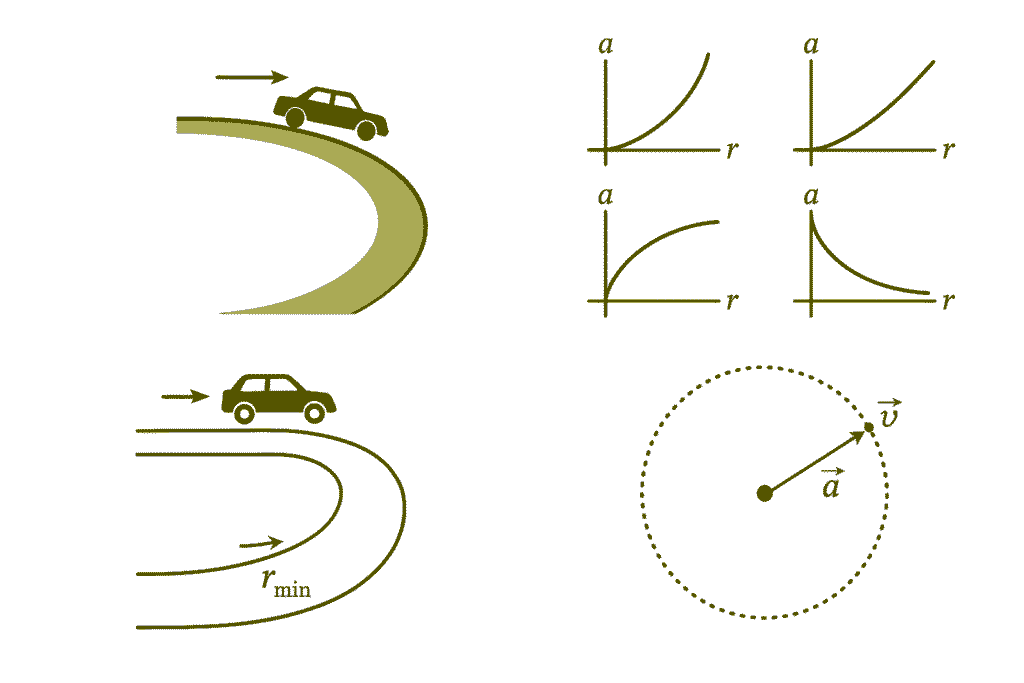
1. A circular freeway entrance is banked for 14 m/s. To design a similar ramp for 28 m/s, one should
A. Increase the radius by factor 2
B. Increase the radius by factor 4
C. Decrease the radius by factor 4
D. Decrease the radius by factor 2
Answer: B
2. If a body moves in a circular path with constant speed 10 m/s, the relation between acceleration and radius is shown by
A. Graph A
B. Graph B
C. Graph C
D. Graph D
Answer: C
3. A car turns on a slippery road at 10 m/s with coefficient of friction 0.5. Minimum radius is
A. 20 m
B. 10 m
C. 5 m
D. 4 m
Answer: A
4. On a railway curve, the outer rail is raised so that the resultant force on wheels
A. Is vertical
B. Decreases
C. Increases
D. Has a horizontal inward component
Answer: D
5. Centripetal acceleration of mass m moving with speed v in radius r is
A. v²/r towards centre
B. v²/r away from centre
C. m²/r away from centre
D. m²/r towards centre
Answer: A
6. In uniformly accelerated circular motion
A. Velocity is radial
B. Velocity is tangential; acceleration has radial & tangential parts
C. Velocity is radial; acceleration tangential
D. Velocity tangential; acceleration radial only
Answer: B
7. At the highest point of projectile motion, acceleration is always vertical for angle
A. 90°
B. 0°
C. 60°
D. 45°
Answer: B
8. Electron moving in a circle of radius 2 m at 4 m/s has acceleration
A. 0.8 m/s²
B. 4 m/s²
C. 16 m/s²
D. 10 m/s²
Answer: A
9. Work done by centripetal force over half a circle is
A. Zero
B. 2mv²
C. πrmv²
D. rmv²
Answer: A
10. Net force on a particle tied to a string moving in a circle is
A. T
B. T − mv²/l
C. T + mv²/l
D. Zero
Answer: A
11. If radius doubles keeping speed constant, centripetal force becomes
A. Double
B. Half
C. One-fourth
D. Same
Answer: B
12. Centrifugal force on 1 g pellet moving at 1 rad/s in 1 m radius is
A. 0.1 dyne
B. 1 dyne
C. 10 dyne
D. 100 dyne
Answer: D
13. Motion that requires radial force
is
A. Uniform circular motion
B. Elliptical motion
C. Projectile motion
D. Uniform straight motion
Answer: A
14. If ar ≠ 0 and at = 0, motion is
A. Linear
B. Purely tangential
C. Uniform circular motion
D. Oscillatory
Answer: C
15. Wrong statement in uniform circular motion is
A. Work done in one cycle is zero
B. Centripetal force acts inward
C. Angular velocity constant
D. Tangential velocity constant
Answer: D
16. Circular motion with constant speed is
A. SHM but not periodic
B. Periodic and SHM
C. Neither periodic nor SHM
D. Periodic but not SHM
Answer: D
17. Cream separates during churning due to
A. Centripetal force
B. Centrifugal force
C. Friction
D. Gravity
Answer: B
18. False statement for particle moving in a circle with constant angular speed
A. Velocity tangent
B. Acceleration tangent
C. Acceleration towards centre
D. Velocity ⟂ acceleration
Answer: B
19. Motion with constant centripetal force magnitude implies
A. Constant velocity
B. Constant speed only
C. Variable speed, constant velocity
D. Constant speed, variable velocity
Answer: D
20. Period of swing decreases when a girl stands up because
A. Moment of inertia decreases
B. Mass increases
C. Torque increases
D. Gravity increases
Answer: A
21. A particle moves in a circle of radius 40 cm with constant speed 8 m/s. Its centripetal acceleration is
A. 320 m/s²
B. 120 m/s²
C. 160 m/s²
D. 80 m/s²
Answer: C
22. A particle moving in a circular path has velocity v and acceleration a at an instant. The angle between velocity and acceleration is
A. 0°
B. 45°
C. 90°
D. 180°
Answer: C
23. A body moving with constant speed along a circular path
A. Has zero acceleration
B. Experiences no force
C. Has inward radial acceleration
D. Has constant velocity
Answer: C
24. A stone tied to a string is rotated in a circular path. If the string suddenly breaks, the stone moves
A. Towards the centre
B. Perpendicular to the radius
C. Along radius outward
D. Along the tangent to the circle
Answer: D
25. The angular speed of the second hand of a clock is how many times that of the minute hand?
A. 1
B. 12
C. 60
D. 1/60
Answer: C
26. A vehicle travels on a banked road without friction. The banking angle depends on
A. Mass of vehicle
B. Radius of road and speed
C. Width of road
D. Friction coefficient
Answer: B
27. A cyclist leans inward while taking a turn in order to
A. Reduce friction
B. Increase speed
C. Provide required centripetal force
D. Reduce weight
Answer: C
28. In uniform circular motion, the magnitude of velocity remains constant but direction changes due to
A. Tangential force
B. Centripetal force
C. Gravitational force
D. Frictional force
Answer: B
29. A particle completes one revolution in time T. Its angular velocity is
A. 2πT
B. π/T
C. 2π/T
D. T/2π
Answer: C
30. A body rotating in a circular path has zero tangential acceleration. This implies
A. Speed is changing
B. Velocity is constant
C. Motion is uniform circular motion
D. Radius is changing
Answer: C
31. A particle is moved in a semi-circular path of radius R. Then
A. Its average velocity is zero
B. Its average acceleration is zero
C. Its magnitude of displacement is 2R
D. Its average velocity and average speed are equal
Correct Answer: C
32. If an object undergoes a uniform circular motion, then its
A. Acceleration remains uniform
B. Velocity changes
C. Speed changes
D. Velocity remains uniform
Correct Answer: B
33. The acceleration of a body in a non-uniform circular motion is 5 m/s². Which one of the following is correct?
A. Radial = 3 m/s² and Tangential = 4 m/s²
B. Radial = 2 m/s² and Tangential = 3 m/s²
C. Both are 5 m/s²
D. Radial = 5 m/s² and Tangential = 3 m/s²
Correct Answer: A
34. An object is moving in a circle at constant speed v. The magnitude of the rate of change of momentum of the object is
A. Zero
B. Proportional to v²
C. Proportional to v³
D. Proportional to v
Correct Answer: B
35. A motorcycle is going on an overbridge of radius R with constant speed. As it ascends, the normal force on it
A. Increases
B. Decreases
C. Remains the same
D. Fluctuates randomly
Correct Answer: A
36. A particle moves with 10 m/s in a circle of radius 5 m. Find the magnitude of average velocity if it moves through 60° in 1 s.
A. 5 m/s
B. 10 m/s
C. 5√3 m/s
D. 20 m/s
Correct Answer: A
37. An object moves in a circular path with constant speed. Which statement is correct?
A. Centripetal acceleration is smaller for a larger radius
B. Centripetal acceleration is greater for a larger radius
C. Centripetal acceleration is same for all radii
D. Centripetal acceleration slows the object
Correct Answer: A
Conclusion
Curvilinear and rotational motion MCQs are designed to test deep conceptual clarity, not just formula application.Curvilinear and rotational motion mcqs questions involving banking of roads, centripetal acceleration, and force direction demand careful visualization and understanding of vector quantities.
Regular practice of Curvilinear and Rotational Motion MCQs strengthens problem-solving speed and helps students confidently tackle advanced mechanics questions in competitive exams. Mastery of these curvilinear and rotational motion mcqs concepts also builds a strong foundation for rotational dynamics, gravitation, and oscillatory motion in higher-level physics.
Curvilinear and rotational motions describe situations where an object does not move along a straight line, but instead follows a curved or circular path.Concepts of curvilinear and rotational motion mcqs like angular velocity, angular acceleration, centripetal force, and torque are crucial for analyzing rotational motion, just as velocity and acceleration are essential for curvilinear motion. Mastery of these curvilinear and rotational motion mcqs concepts helps in solving numerical problems related to circular paths, rotating systems, vehicles on curved roads, and many real-world physics applications. Curvilinear and rotational motion mcqs is a special case of curvilinear motion in which a body rotates about a fixed axis, and every point on the body traces a circular path around that axis.
Curvilinear and rotational motion MCQs are designed to test a student’s ability to analyze motion along curved paths as well as motion about a fixed or moving axis. These curvilinear and rotational motion mcqs questions often require identifying how velocity and acceleration vectors behave when both direction and orientation continuously change.
In curvilinear and rotational motion MCQs, students must distinguish between linear speed and angular speed while understanding how tangential and radial components of acceleration arise. Such curvilinear and rotational motion mcqs questions emphasize vector decomposition rather than simple formula substitution.