
- iamal
- December 1, 2025
Kinematics Multiple Choice Questions: From Toy Cars to Falling Steel Balls
If you’re preparing for exams packed with kinematics multiple choice questions, this set of problems is a gold mine. They cover everything from vector components and graphs to relative motion, average speed, and motion in viscous media. In this post, we’ll walk through the core ideas behind each cluster of questions so you can recognise patterns, not just memorise answers.
1. Vector Form of Motion and Components
Questions like
“A body of mass 5 kg starts from the origin with an initial velocity u = 300i + 40j m/s. When a constant force F = (–i + 5j) N acts on the body, the time in which the y-component of velocity becomes zero is …”
test how you use Newton’s second law in vector form:
a⃗=F⃗m,vy=uy+ayt\vec a = \frac{\vec F}{m}, \quad v_y = u_y + a_y ta=mF,vy=uy+ayt
Here you only care about the y-component: find aya_yay, then solve for the time when vy=0v_y = 0vy=0. This is a staple style in kinematics multiple choice questions because it checks if you can separate x and y motion cleanly.
2. Position Functions, Velocity and Acceleration
Several problems give you s(t) and ask for acceleration or some condition:
-
s=4t2+8t+5t4s = 4t^2 + 8t + 5t^4s=4t2+8t+5t4
-
x=8+12t−t2x = 8 + 12t – t^2x=8+12t−t2
-
x=(t+5)2x = (t + 5)^2x=(t+5)2
-
Instantaneous velocity v=αt+βt2v = \alpha t + \beta t^2v=αt+βt2
The recipe is always:
v=dsdt,a=dvdtv = \frac{ds}{dt}, \quad a = \frac{dv}{dt}v=dtds,a=dtdv
For example, in
“The acceleration at the end of 2 s, of a particle whose motion is represented by s=4t2+8t+5t4s = 4t^2 + 8t + 5t^4s=4t2+8t+5t4”
differentiate once to get v(t)v(t)v(t), again to get a(t)a(t)a(t), then plug t=2t = 2t=2.
When x=(t+5)2x = (t+5)^2x=(t+5)2, velocity is proportional to (t+5)(t+5)(t+5), and acceleration is constant, so you’re really interpreting whether acceleration is linked to velocity, distance or their powers. These are classic kinematics multiple choice questions to practise calculus in motion.
3. Average Speed and Two-Speed Journeys
You’ll see patterns like:
-
A body moves with speeds v1v_1v1 and v2v_2v2 for distances in the ratio 1:2.
-
A journey split into three equal parts at 20 km/h, 40 km/h, 60 km/h.
-
A person travelling equal distances at speeds v1v_1v1 and v2v_2v2.
Key idea: average speed = total distance / total time.
For equal distances with speeds v1v_1v1 and v2v_2v2:
vˉ=2v1v2v1+v2\bar v = \frac{2 v_1 v_2}{v_1 + v_2}vˉ=v1+v22v1v2
That exact harmonic-mean form appears directly in one of your kinematics multiple choice questions, and variants appear where distances are in the ratio 1:2 or 1:1:1. Train yourself to quickly decide whether the distance or time segments are equal, then plug into the right formula.
4. Uniform Acceleration: Two-Interval Problems
Example:
“Find the initial velocity of a body moving with uniform acceleration covering 40 m in the first 5 s and 65 m in the next 5 s.”
Here you use the “nth-second” or interval trick:
s=ut+12at2s = ut + \tfrac12 a t^2s=ut+21at2
Compute displacement in 0–5 s and 5–10 s, subtract to get expressions in u,au, au,a. Solving the pair gives both.
Similar logic appears in:
-
A ball or body covering 12 m in first 3 s and 30 m in next 3 s.
-
Equal distances during specific numbered seconds.
These kinematics multiple choice questions reward comfort with algebra more than raw formulas.
5. Relative Motion and Chasing Problems
You have several “chasing” and “catching” scenarios:
-
Police jeep at 45 km/h chasing a thief at 153 km/h while firing a bullet at 180 m/s.
-
A bus at 10 m/s and a motorist trying to overtake it within 1 minute.
-
A drunkard taking 5 steps forward and 3 backward.
Core concepts:
-
Relative velocity: effective closing speed = difference of velocities along the line of motion.
-
For the bullet vs. thief question, compute bullet’s speed relative to ground, then relative to the thief’s jeep.
-
For the drunkard, note that every 8 s he gains 2 m net, then figure out how many full cycles plus extra steps get him to 13 m.
These are excellent kinematics multiple choice questions to train your intuition about “net progress” over cycles.
6. Graph-Based Motion Questions
Your set contains multiple graph interpretation problems:
-
Which v − tv\!-\!tv−t graph is realistic for a steel ball falling through oil.
-
Which graph correctly represents velocity-time for a body descending in a viscous liquid.
-
Which one of four graphs fails to represent a given motion.
In viscous media, speed rises from 0 and gradually approaches a terminal velocity; so the correct v − tv\!-\!tv−t graphs are ones that curve and then flatten out, not ones that jump or keep increasing linearly forever.
Also note:
-
Area under v − tv\!-\!tv−t graph = displacement.
-
Slope of v − tv\!-\!tv−t graph = acceleration.
Any graph that violates these basics (e.g., sudden infinite slopes, negative time, impossible discontinuities) is the wrong option in such kinematics multiple choice questions.
7. Non-Uniform and Direction-Changing Motion
Some of the more advanced problems mix ideas:
-
The toy car with charge qqq speeding up under field EEE from 0 to 6 m/s, then slowing when the field reverses. You’re asked for average velocity vs. average speed over 0–3 s.
-
A car decelerated according to a law like a=−2.5v2a = -2.5 v^2a=−2.5v2; you integrate or use a=vdv/dxa = v dv/dxa=vdv/dx to relate distance or time to changing speed.
-
A body experiencing resistive force proportional to v3v^3v3, where total penetration distance is proportional to v0−2v_0^{-2}v0−2.
Here the trick is recognising that constant acceleration formulas no longer apply; instead you often:
a=dvdt,a=vdvdxa = \frac{dv}{dt},\quad a = v \frac{dv}{dx}a=dtdv,a=vdxdv
and separate variables. Even if the exam only gives the final proportionality, being familiar with the structure of these questions helps you eliminate wrong options quickly.
8. Two-Dimensional and Vector Displacements
Finally, some questions drill 2D displacement:
-
An aeroplane going 400 m north, 300 m west, then 1200 m up: resultant displacement via 3D Pythagoras.
-
A car going 6 km at 45° then 4 km at 135° to east; you add components to find final distance and angle.
-
A ball thrown horizontally from height 80 m that hits the ground with speed 3v03v_03v0; you combine horizontal and vertical components using energy or kinematics.
-
An object is moving with a uniform acceleration which is parallel to its instantaneous direction of motion. The displacement (s) – velocity (v) graph of this object is ______ Graph (a) Graph(b) Graph(c) Graph(d) c A particle located at x = 0, starts moving along the positive x-direction with a velocity v that varies as v=α x where α is dimensionless constant. The displacement of the particle varies with time as t3 t2 t t1/2 b The displacement of particle is given by x = a0 + a1t/2 – a2t2/3 What is its acceleration? 2a2/3 -2a2/3 a2 zero b The ratio of displacement to distance for a moving particle is The ratio of displacement to distance for a moving particle is Always greater than one Always one One or less than one d A particle shows distance-time curve as given in this figure. The maximum instantaneous velocity of the particle is around the point B C D A b The displacement-time graph of moving particle is shown below. The instantaneous velocity of the particle is negative at the point D F C E d The velocity of a particle is v = v_0 + gt + Ft^2 . Its position is x = 0 at t = 0 , then its displacement after time (t = 1) is V0 + g + F V0 + g/2 + F/3 V0 + g/2 +F v_0 + 2g + 3F b The displacement ‘x’ (in meter) of a particle of mass ‘m’ (in kg) moving in one dimension under the action of a force, is related to time ‘t’ (in sec) by, \( t = \sqrt{x} + 3 \). The displacement of the particle when its velocity is zero, will be 6 m 2 m 4 m 0 m d When a small object of mass m is thrown vertically upward, the graphical representation of its velocity versus time is shown below: 2a 2b ab 2ab c A car is moving with speed of 150 km/h and after applying the brake it will move 27 m before it stops. If the same car is moving with a speed of one third the reported speed then it will stop after travelling ___ m distance. 3 m 5 m 7 m 9 m a A small toy starts moving from the position of rest under a constant acceleration. If it travels a distance of 10 m in \( t_s \). The distance travelled by the toy in the next \( t_s \) will be: 10 m 20 m 30 m 40 m c If \( t = \sqrt{x} + 4 \), then \( \left( rac{dx}{dt} ight)_{t=4} \) is: 4 Zero 8 16 a A balloon has mass of 10 g in air. The air escapes from the balloon at a uniform rate with velocity 4.5 cm/s. If the balloon shrinks in 5 s completely. Then, the average force acting on that balloon will be (in dyne). 3 9 12 18 b At time \( t = 0 \) a particle starts travelling from a height \( 7z \) in a plane keeping z coordinate constant. At any instant of time t its position along the x and y directions are defined as \( 3t \) and \( 5t^2 \) respectively. At \( t = 1 s \) acceleration of the particle will be -30y 30y 3x + 15y 3x + 15y + 7z b A particle is moving in a straight line such that its velocity is increasing at 5 ms–1 per meter. The acceleration of the particle is ____ ms–2. at a point where its velocity is 20 ms–1 200 m/s2 100 m/s2 250m/s2 110 m/s2 b A particle starts from rest. Its acceleration (a) versus time (t) is as shown in the figure. The maximum speed of the particle will be 150 m/s 75 m/s 37.5 m/s 45 m/s b A motor car moving with velocity \(7 \, m/s\) stops in \(10 \, m\) distance when brakes are applied. What is the relation between the resistance force (R) and the weight of (W) the car? (Take value of \( g = 9.8 \, m/s^2 \)) R = W R = -W R = -w/2 R = -w/4 d A body starts from the rest and acquires a velocity of \(10 \, m/s\) in \(2 \, s\). What is the acceleration of the body and the distance travelled 5 m/s^2and 10 m 5 m/s^2and 5 m 5 m/s^2and 6 m 6 m/s^2and 5 m a The co-ordinates (x, y) of a moving particle at any time ‘t’ are given by x=αt3 and y=βt3. The speed of the particle at time ‘t’ is given by 3tα2+β2 3t2α+β2 α2+β2 α2+β2 b Acceleration a is given in terms of position x as a=2xm/s2. At x=0, the velocity v is zero. What is the relation between velocity v and position x? v=2x v=2x v2=2x v=x2/2 a Particle A (which was located at the origin at time t=0) is moving along the x – axis with a constant speed of 1 m/s. Location of particle B which is moving along the y – axis is given by y=ct2, where c=1m/s2. Find the speed of particle A relative to particle B at t = 1 sec. √5m/s 2m/s 1m/s 0m/s a A particle moves in a straight line with uniform acceleration and with initial velocity of 2m/s. Its average velocity after moving for 4s is 6m/s. The acceleration of the particle. 3m/s2 2m/s2 4m/s2 1m/s2 b The relation between time t and distance x for a moving body is given as t = mx2 + nx, where m and n are constants. The retardation of the motion is (when v stands for velocity) 2 mv3 2 mnv3 2 nv3 2 n2v3 a If the velocity of a body related to displacement x is given by v= 5000+24xm/s then the acceleration of the body is…. m/s2. 10 11 12 20 c The speed-time graph of a particle along a fixed direction is shown below. The distance traversed by the particle between t=0s and t=10s will be 120 m 90 m 60 m 30 m b An object is moving along x-axis. If its position x(t) (in meter) at any time t (in s) is given by the following graph, then the object is at rest about t = -1s t = 0s t = 1s t = 2s c The graph which represents the velocity time dependence of a solid descending in a viscous sodium is Graph a Graph b Graph c Graph d b The velocity (v) of a body moving along the positive x direction varies with displacement (x) from the origin as v = k x, where k is a constant. Then which of the following x–t graph is correct. Graph a Graph b Graph c Graph d c A car travels 1/3 of the distance on a straight road with a velocity of 10 km h–1 next 1/3 of the distance with velocity 20 km h–1 and the last 1/3 of the distance with velocity 60 km h–1. The average velocity of the car in the whole journey is 18 km h-1 30 km h-1 36 km h-1 90 km h-1 a 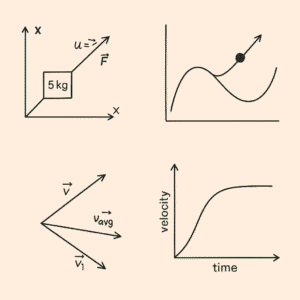
-
Conclusion
Mastering motion, kinematics, and force-based problems is essential for building a strong foundation in physics, especially for competitive exams and school assessments. The questions in this set highlight key concepts such as average velocity, acceleration, relative motion, graphical interpretation, and energy analysis. By practicing regularly and understanding the logic behind each solution—not just memorizing formulas—students can significantly improve their problem-solving speed and accuracy. Keep revising core equations, visualize motion wherever possible, and attempt similar MCQs to strengthen long-term retention. With consistent practice, these concepts become intuitive, helping you tackle even the most challenging physics questions with confidence.