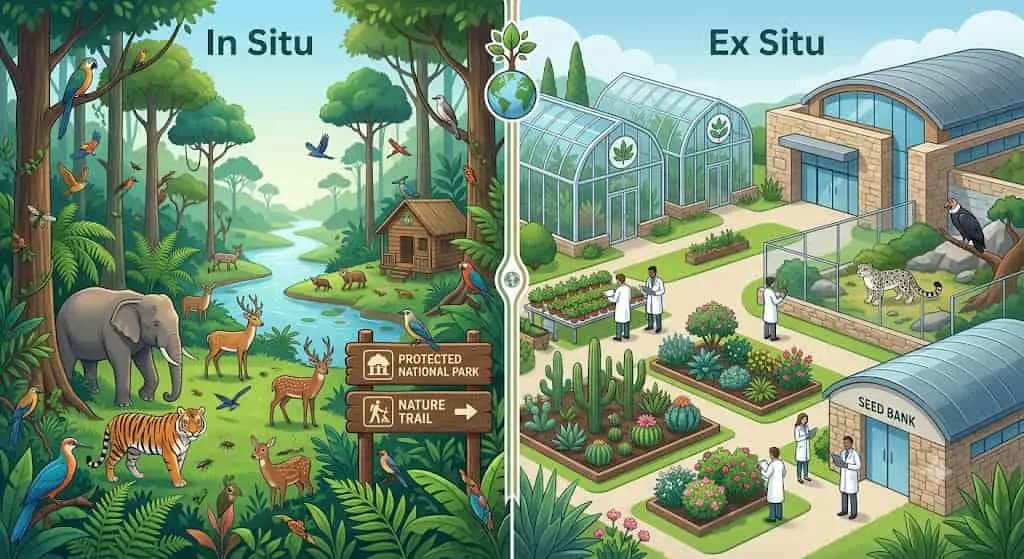
Conservation biology is one of the most important topics in Class 12 Biology because it helps aspirants understand how biodiversity can be protected for future generations. In Situ and Ex Situ Conservation MCQs with Answers PDF is a highly searched study resource among aspirants preparing for board examinations, NEET, CUET, and other competitive examinations. The In Situ and Ex Situ Conservation MCQs with Answers PDF concept of conservation revolves around preserving species, habitats, and genetic diversity, which are essential for maintaining ecological balance. In Situ and Ex Situ Conservation MCQs with Answers PDF helps aspirants revise these concepts systematically while strengthening their understanding of biodiversity conservation strategies.
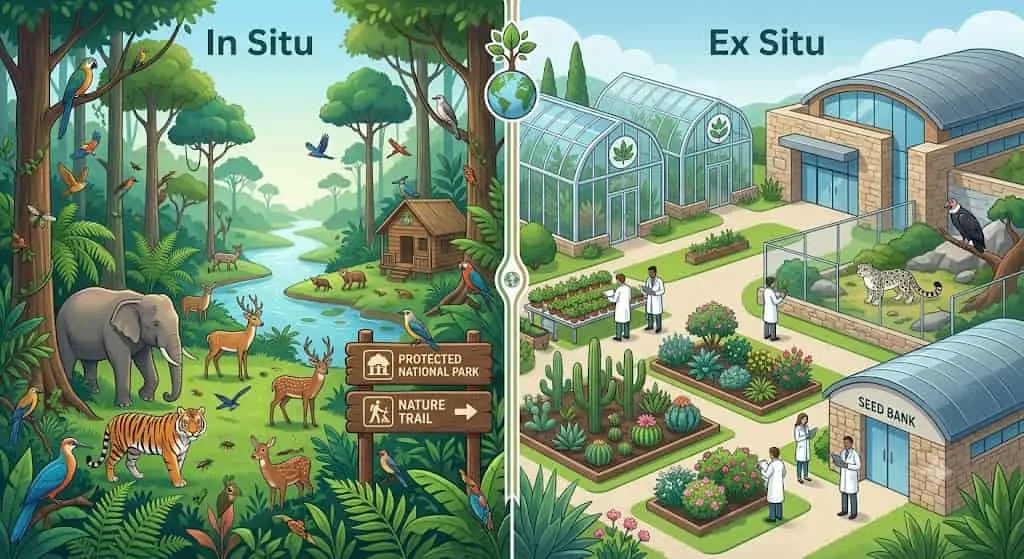
The study of In Situ and Ex Situ Conservation MCQs with Answers PDF introduces aspirants to two major conservation approaches. In situ conservation refers to protecting organisms within their natural habitats, whereas ex situ conservation involves conserving species outside their natural environments. Through In Situ and Ex Situ Conservation MCQs with Answers PDF, aspirants learn the significance of national parks, wildlife sanctuaries, biosphere reserves, botanical gardens, seed banks, gene banks, and zoological parks. These In Situ and Ex Situ Conservation MCQs with Answers PDF frequently appear in Class 12 Biology examinations and competitive entrance tests.
One of the major advantages of using In Situ and Ex Situ Conservation MCQs with Answers PDF is that it enables aspirants to understand real-world conservation practices. In situ conservation preserves the natural interactions among species and allows evolutionary processes to continue naturally. By studying In Situ and Ex Situ Conservation MCQs with Answers PDF, aspirants can appreciate why protected areas play a crucial role in safeguarding endangered flora and fauna. These protected regions help maintain ecological integrity while supporting sustainable conservation efforts.
Another important aspect highlighted in In Situ and Ex Situ Conservation MCQs with Answers PDF is the role of ex situ conservation in preventing extinction. Many species face severe threats from habitat loss, climate change, pollution, and overexploitation. Through In Situ and Ex Situ Conservation MCQs with Answers PDF, aspirants become familiar with conservation facilities such as captive breeding centers, cryopreservation units, and seed storage facilities that provide a safety net for endangered species. These methods are especially useful when natural habitats become unsuitable for survival.
For aspirants preparing for competitive examinations, In Situ and Ex Situ Conservation MCQs with Answers PDF provides a strong conceptual foundation in biodiversity conservation. Conservation-related questions are commonly asked in NEET and other biology-based entrance examinations. Studying In Situ and Ex Situ Conservation MCQs with Answers PDF helps aspirants identify key differences between conservation approaches, understand practical applications, and remember important examples associated with each method.
The importance of biodiversity conservation is repeatedly emphasized throughout In Situ and Ex Situ Conservation MCQs with Answers PDF because biodiversity supports ecosystem stability and resilience. Healthy ecosystems provide essential services such as nutrient cycling, pollination, climate regulation, and soil formation. Through In Situ and Ex Situ Conservation MCQs with Answers PDF, aspirants learn that protecting biodiversity is not merely about saving individual species but about preserving the entire web of life that sustains ecological processes.
Aspirants often find that In Situ and Ex Situ Conservation MCQs with Answers PDF improves retention of complex ecological concepts. Conservation topics involve numerous examples, definitions, and classifications that can be difficult to memorize. Repeated exposure to concepts through In Situ and Ex Situ Conservation MCQs with Answers PDF enhances understanding and promotes long-term recall, making revision more effective and efficient.
The role of governments and international organizations is another important theme covered through concepts associated with In Situ and Ex Situ Conservation MCQs with Answers PDF. Global conservation initiatives seek to protect biodiversity hotspots, endangered species, and fragile ecosystems. Aspirants studying In Situ and Ex Situ Conservation MCQs with Answers PDF gain insights into conservation policies, protected-area management, and international efforts aimed at reducing biodiversity loss worldwide.
Modern conservation strategies continue to evolve, making In Situ and Ex Situ Conservation MCQs with Answers PDF a valuable educational resource. Advances in biotechnology, genetic conservation, and habitat restoration have expanded the tools available for protecting biodiversity. By exploring topics linked with In Situ and Ex Situ Conservation MCQs with Answers PDF, aspirants can understand how science contributes to conservation planning and species recovery programs.
The educational value of In Situ and Ex Situ Conservation MCQs with Answers PDF extends beyond examinations. It encourages aspirants to develop environmental awareness and appreciate the importance of sustainable resource management. Conservation is not only a scientific concern but also a social responsibility that requires cooperation among governments, communities, researchers, and individuals.
In Situ and Ex Situ Conservation MCQs with Answers PDF:
1. Which of the following is not concerned with wildlife conservation?
A. IVF
B. IUCN
C. WWF
D. IBWL
Answer: d
Explanation:
IVF (In Vitro Fertilization) is a reproductive technology used in assisted human reproduction and is not directly related to wildlife conservation. Organizations such as IUCN, WWF, and IBWL actively work towards biodiversity and wildlife protection.
2. Core zone, buffer zone, and manipulation zone are found in
A. National Park
B. Sanctuary
C. Tiger Reserve
D. Biosphere Reserve
Answer: d
Explanation:
A Biosphere Reserve is divided into three zones: the core zone (strictly protected), buffer zone (limited human activities), and transition/manipulation zone (sustainable human activities).
3. Which one of the following pairs is mismatched?
A. Nuclear power – radioactive wastes
B. Solar energy – greenhouse effect
C. Fossil fuel burning – release of CO₂
D. Biomass burning – release of CO₂
Answer: b
Explanation:
Solar energy is a clean and renewable source of energy that does not directly contribute to the greenhouse effect. The other pairs are correctly matched with their environmental impacts.
4. Bio-indicators are used for
A. Oxygen demand
B. Air pollution
C. Mineral present
D. All of the above
Answer: d
Explanation:
Bio-indicators are organisms used to assess environmental conditions. They can indicate pollution levels, oxygen demand, and the presence of certain minerals or contaminants.
5. Which of the following is an ex-situ conservation method?
A. Sanctuaries
B. Sacred groves
C. Biosphere reserves
D. Cryopreservation
Answer: d
Explanation:
Cryopreservation is an ex-situ conservation technique in which biological materials such as seeds, pollen, embryos, or tissues are preserved outside their natural habitats at extremely low temperatures.
6. Which of the following statements is true regarding cryopreservation and Red Data Books?
Statement 1: Cryopreservation is one of the methods of in-situ conservation.
Statement 2: Red Data Books are published by the ICZN.
A. Both statements I and II are true
B. Both statements I and II are false
C. Statement I is true but Statement II is false
D. Statement I is false but Statement II is correct
Answer: b
Explanation:
Cryopreservation is an ex-situ conservation method. Red Data Books are published by the IUCN (International Union for Conservation of Nature), not by ICZN.
7. In the context of conservation approaches and methods, which option correctly matches the approach with the method?
A. In-situ Conservation → National Park and Ex-situ Conservation → Wildlife Sanctuary
B. In-situ Conservation → Botanical Garden and Ex-situ Conservation → Biosphere Reserve
C. In-situ Conservation → Biosphere Reserve and Ex-situ Conservation → Cryopreservation
D. In-situ Conservation → Seed Bank and Ex-situ Conservation → Sacred Grove
Answer: C
Explanation:
In-situ conservation involves protecting species in their natural habitats. Biosphere Reserves are examples of in-situ conservation. Ex-situ conservation involves conserving organisms outside their natural habitats, and cryopreservation is a well-known ex-situ conservation technique.
8. What does in-situ conservation refer to?
A. Conserve only extinct species
B. Protect and conserve the whole ecosystem
C. Conserve only high-risk species
D. Conserve only endangered species
Answer: b
Explanation:
In-situ conservation focuses on protecting entire ecosystems and habitats so that biodiversity is preserved naturally. Examples include National Parks, Wildlife Sanctuaries, and Biosphere Reserves.
9. Which of the following is not a method of ex-situ conservation?
A. Cryopreservation
B. In vitro fertilization
C. National Parks
D. Micropropagation
Answer: c
Explanation:
National Parks are examples of in-situ conservation because organisms are protected within their natural habitats. Cryopreservation, IVF, and micropropagation are ex-situ conservation methods.
10. Match the conservation approach with the corresponding example correctly.
A. Sacred Groves → Khasi Hills in Meghalaya; Zoological Park → Ex-situ Conservation; Nile Perch → Alien Species; Amazon Forest → Release of Oxygen
B. Sacred Groves → Biosphere Reserve; Zoological Park → In-situ Conservation; Nile Perch → Endangered Species; Amazon Forest → Desert Ecosystem
C. Sacred Groves → National Park; Zoological Park → Wildlife Sanctuary; Nile Perch → Native Species; Amazon Forest → Grassland Ecosystem
D. Sacred Groves → Botanical Garden; Zoological Park → Sacred Grove; Nile Perch → Producer; Amazon Forest → Tundra Ecosystem
Answer: A
Explanation:
The Khasi Hills of Meghalaya are famous for sacred groves. Zoological parks are examples of ex-situ conservation. Nile Perch is an alien species, and the Amazon Forest contributes significantly to oxygen production and biodiversity conservation.
11.Provide the correct descending order of organisms found in the Amazon Forest.
A. Plants > Invertebrates > Birds > Mammals > Fishes
B. Plants > Fishes > Mammals > Invertebrates > Birds
C. Invertebrates > Plants > Birds > Fishes > Mammals
D. Invertebrates > Plants > Fishes > Birds > Mammals
Answer: D
Explanation:
The Amazon rainforest contains the greatest diversity of invertebrates, followed by plants, fishes, birds, and mammals. It is one of the richest biodiversity regions on Earth.
12. Which one of the following is not a method of in-situ conservation of biodiversity?
A. Wildlife Sanctuary
B. Botanical Garden
C. Sacred Grove
D. Biosphere Reserve
Answer: b
Explanation:
Botanical gardens are examples of ex-situ conservation because plants are conserved outside their natural habitats. Wildlife sanctuaries, sacred groves, and biosphere reserves are in-situ conservation methods.
13. Just as a person moving from Delhi to Shimla to escape the heat for the duration of hot summer, thousands of migratory birds from Siberia and other extremely cold northern regions move to:
A. Western Ghat
B. Meghalaya
C. Corbett National Park
D. Keoladeo National Park
Answer: d
Explanation:
Keoladeo National Park (Bharatpur Bird Sanctuary) in Rajasthan is famous for hosting thousands of migratory birds, including Siberian cranes, during winter.
14. An example of ex-situ conservation is
A. National Park
B. Seed Bank
C. Wildlife Sanctuary
D. Sacred Grove
Answer: b
Explanation:
Seed banks preserve seeds outside their natural environment for future use and biodiversity conservation. Therefore, they are examples of ex-situ conservation.
15. All of the following are included in ex-situ conservation except
A. Wildlife safari parks
B. Sacred groves
C. Seed banks
D. Botanical gardens
Answer: b
Explanation:
Sacred groves are examples of in-situ conservation because species are protected within their natural habitats. Wildlife safari parks, seed banks, and botanical gardens are ex-situ methods.
16. Which one of the following is not used for ex-situ plant conservation?
A. Botanical Gardens
B. Field gene banks
C. Seed banks
D. Shifting cultivation
Answer: d
Explanation:
Shifting cultivation is an agricultural practice and not a conservation technique. Botanical gardens, field gene banks, and seed banks are important ex-situ conservation methods.
17. Which one of the following is related to Ex-situ conservation of threatened animals and plants?
A. Wildlife Safari Parks
B. Biodiversity Hotspots
C. Amazon Rainforest
D. Himalayan Region
Answer: a
Explanation:
Wildlife safari parks conserve threatened species outside their natural habitats. This makes them examples of ex-situ conservation. Biodiversity hotspots, rainforests, and Himalayan regions represent natural habitats and are associated with in-situ conservation.
18. Periyar Sanctuary is located in
A. Madhya Pradesh
B. Kerala
C. Uttar Pradesh
D. Assam
Answer: b
Explanation:
Periyar Wildlife Sanctuary is situated in Kerala and is famous for its elephant population, scenic lake, and rich biodiversity. It is one of India's most important protected areas.
19. Indian rhinoceros are protected in
A. Gir Forest
B. Kaziranga National Park
C. Bandipur National Park
D. Ranthambore National Park
Answer: b
Explanation:
Kaziranga National Park in Assam is world-famous for conserving the Indian one-horned rhinoceros. It holds the largest population of this endangered species.
20. Biosphere reserves differ from National Parks and Wildlife Sanctuaries because in the former
A. Human beings are not allowed to enter
B. People are an integral part of the system
C. Plants are paid greater attention than animals
D. Living organisms are brought from all over the world and preserved for posterity
Answer: b
Explanation:
Biosphere reserves allow sustainable interaction between humans and nature. Unlike National Parks, certain human activities are permitted in designated zones of a biosphere reserve.
21. One of the ex-situ conservation methods for endangered species is
A. Wildlife Sanctuaries
B. Biosphere Reserves
C. Cryopreservation
D. National Parks
Answer: c
Explanation:
Cryopreservation involves storing biological materials such as seeds, embryos, pollen, and tissues at extremely low temperatures for long-term conservation.
22.Match the following:
National Park / Zoological Park | State
a. Ranthambore National Park
b. Kaziranga National Park
c. Jim Corbett National Park
d. Nandan Kanan Zoological Park
i. Assam
ii. Rajasthan
iii. Odisha
iv. Uttarakhand
A. a–i, b–ii, c–iii, d–iv
B. a–ii, b–iii, c–iv, d–i
C. a–ii, b–i, c–iv, d–iii
D. a–iii, b–ii, c–i, d–iv
Answer: C
Explanation:
- Ranthambore National Park → Rajasthan (ii)
- Kaziranga National Park → Assam (i)
- Jim Corbett National Park → Uttarakhand (iv)
- Nandan Kanan Zoological Park → Odisha (iii)
Therefore, the correct matching is a–ii, b–i, c–iv, d–iii.
23. Which of the following is the matching pair of a sanctuary and its main protected wild animal?
A. Kaziranga – Musk deer
B. Gir – Lion
C. Sunderban – Rhino
D. All of these
Answer: b
Explanation:
Gir National Park in Gujarat is the last natural habitat of the Asiatic Lion and is famous for its lion conservation program.
24. Statement I: Sacred groves are examples for on-site conservation.
Statement II: Gene banks are examples for in-situ conservation.
A. Both statement I and statement II are true
B. Both statement I and statement II are false
C. Statement I is true but statement II is false
D. Statement I is false but statement II is true
Answer: c
Explanation:
Sacred groves represent in-situ conservation because species are protected in their natural habitat. Gene banks are examples of ex-situ conservation since genetic material is stored outside natural habitats.
25. Match the following National Parks with their respective states:
(p) Kaziranga National Park
(q) Tandoba National Park
(r) Corbett National Park
(s) Gir National Park
A. (p-i) (q-ii) (r-iii) (s-iv)
B. (p-i) (q-ii) (r-iv) (s-iii)
C. (p-iv) (q-iii) (r-ii) (s-i)
D. (p-iv) (q-i) (r-iii) (s-ii)
Answer: a
Explanation:
- Kaziranga National Park → Assam
- Tandoba National Park → Maharashtra
- Corbett National Park → Uttarakhand
- Gir National Park → Gujarat
26. Identify the odd combination of the habitat and the particular animal concerned:
A. Rann of Kutch – Wild Ass
B. Dachigam National Park – Snow Leopard
C. Sunderbans – Bengal Tiger
D. Periyar – Elephant
Answer: b
Explanation:
Dachigam National Park is famous for the Hangul (Kashmir stag), not the Snow Leopard. Therefore, this is the incorrect or odd combination.
27. Which of the following is the newly formed Biosphere Reserve of India (2013)?
A. Pachmarhi
B. Himalaya
C. Cold Desert
D. Panna
Answer: d
Explanation:
Panna Biosphere Reserve in Madhya Pradesh was designated as a Biosphere Reserve in 2013. It is known for its rich biodiversity, tiger population, and unique ecosystem of the Vindhyan hill ranges.
28. Tiger is not a resident in which one of the following National Parks?
A. Jim Corbett
B. Ranthambore
C. Sunderbans
D. Gir
Answer: d
Explanation:
Gir National Park in Gujarat is famous for the conservation of the Asiatic Lion. Tigers are not naturally found in Gir, whereas Jim Corbett, Ranthambore, and Sunderbans are important tiger habitats.
29. Match the following:
Column I
i. Biodiversity Hotspots
ii. Biosphere Reserves
iii. National Parks
iv. Sanctuaries
v. Sacred Groves
Column II
a. Minimally disturbed for the conservation of resources
b. Specific endangered faunal species
c. A grove of trees of special religious importance
d. Biologically richest and most threatened terrestrial ecoregions
e. A natural habitat strictly reserved for protection of natural life
A. (i–a), (ii–b), (iii–c), (iv–d), (v–e)
B. (i–d), (ii–a), (iii–e), (iv–b), (v–c)
C. (i–e), (ii–a), (iii–b), (iv–d), (v–c)
D. (i–b), (ii–a), (iii–e), (iv–d), (v–c)
Answer: b
Explanation:
- Biodiversity Hotspots → Biologically richest and most threatened terrestrial ecoregions
- Biosphere Reserves → Minimally disturbed for conservation of resources
- National Parks → Natural habitats strictly reserved for protection of wildlife
- Sanctuaries → Protection of specific endangered faunal species
- Sacred Groves → Groves of trees having religious and cultural importance
30. Consider the following statements:
Statement I: An area which is set aside, minimally disturbed for the conservation of the resources of the biosphere is a Biosphere Reserve.
Statement II: Specific endangered faunal species are well protected in National Parks.
A. Statement I is true, but Statement II is false
B. Statement II is true, but Statement I is false
C. Both Statement I and Statement II are true
D. Both Statement I and Statement II are false
Answer: c
Explanation:
Biosphere Reserves are large protected areas established to conserve biodiversity while allowing sustainable use of resources. National Parks provide strong legal protection to wildlife and their habitats, ensuring the conservation of endangered species. Therefore, both statements are correct.
Conclusion on In Situ and Ex Situ Conservation MCQs with Answers PDF
For Class 12 Biology preparation, In Situ and Ex Situ Conservation MCQs with Answers PDF serves as an excellent revision resource that combines theoretical understanding with practical conservation examples. Aspirants can strengthen their knowledge of biodiversity, endangered species protection, ecosystem management, and conservation techniques by regularly reviewing concepts associated with In Situ and Ex Situ Conservation MCQs with Answers PDF. A thorough understanding of these In Situ and Ex Situ Conservation MCQs with Answers PDF helps aspirants perform confidently in examinations while developing a deeper appreciation for the importance of conserving Earth’s biological heritage.
Related reading
Challenging Biopiracy and Biodiversity Conservation MCQs PDF Class 12 You Can't Afford to Miss
Master Class 12 Biology with Biopiracy and Biodiversity Conservation MCQs PDF Class 12. Learn key conservation concepts, biodiversity laws,and biopiracy issues.
Essential Endangered Species and Biodiversity Hotspots MCQs PDF with Answers for Class 12 Biology
Master Endangered Species and Biodiversity Hotspots MCQs PDF with detailed explanations, biodiversity concepts, endangered species facts, conservation strategies.