
- Amal Augustine
- December 22, 2025
Angular Momentum and Rotational Motion MCQs :Best and Powerful Concept -Based Questions for NEET,JEE & CUET
Angular momentum and rotational motion mcqs form the backbone of advanced mechanics in physics. From spinning wheels and rotating discs to dancers folding their arms and engines delivering torque, these angular momentum and Rotational motion MCQs concepts explain how objects behave when rotation replaces straight-line motion. Angular momentum and rotational motion MCQs test not only formula knowledge but also conceptual clarity about torque, moment of inertia, angular velocity, and conservation laws.
Angular Momentum and Rotational Motion MCQs:
1. The angular velocity of the seconds hand in a watch is:
-
A. 0.053 rad/s
-
B. 0.210 rad/s
-
C. 0.105 rad/s
-
D. 0.42 rad/s
Answer: C
2. A man sitting on a rotating stool folds his arms. His angular velocity:
-
A. Increases
-
B. Decreases
-
C. Becomes zero
-
D. Remains constant
Answer: A
3. The angular speed of an engine wheel making 90 rev/min is:
-
A. 1.5 rad/s
-
B. 3 rad/s
-
C. 4.5 rad/s
-
D. 6 rad/s
Answer: B
4. A wheel has angular acceleration 3 rad/s² and initial angular speed 2 rad/s. Angle rotated in 2 s is:
-
A. 6
-
B. 10
-
C. 12
-
D. 4
Answer: B
5. If a body moves in a circle of radius r with speed v, angular velocity is:
-
A. v²/r
-
B. vr
-
C. v/r
-
D. r/v
Answer: C
6. A mass moving parallel to x-axis has angular momentum about z-axis that:
-
A. Zero
-
B. Remains constant
-
C. Increases
-
D. Decreases
Answer: B
7. Angular momentum is non-zero when angle between r and p is:
-
A. 0°
-
B. 180°
-
C. 45°
-
D. 90°
Answer: D
8. A constant torque changes angular momentum from 10A₀ to 5A₀ in 6 s. Torque is:
-
A. (5A₀)/6
-
B. (3A₀)/2
-
C. (4A₀)/3
-
D. (A₀)/2
Answer: A
9. Same torque applied to a disc and ring (same mass & radius). Which rotates faster?
-
A. Both same
-
B. Ring
-
C. Same angular velocity
-
D. Disc
Answer: D
10. When net torque is zero, which remains constant?
-
A. Linear momentum
-
B. Angular momentum
-
C. Impulse
-
D. Velocity
Answer: B
11. Effect of a couple is:
-
A. Linear motion
-
B. Pure rotation
-
C. Linear + rotation
-
D. No motion
Answer: B
12. Two discs stick together. Final angular velocity is:
-
A. (I₁+I₂)/ω
-
B. (I₁ω₁)/(I₁+I₂)
-
C. ω
-
D. I₂ω/I₁
Answer: B
13. Torque τ is defined as:
-
A. r·F
-
B. r × F
-
C. F × t
-
D. r × t
Answer: B
14. A torque of 50 Nm acts for 8 s. Change in angular momentum is:
-
A. 400 kg·m²/s
-
B. 800 kg·m²/s
-
C. 600 kg·m²/s
-
D. 200 kg·m²/s
Answer: A
15. A dancer folds arms while spinning. Angular velocity:
-
A. Increases
-
B. Decreases
-
C. Same
-
D. Zero
Answer: A
16. If torque is zero, which is conserved?
-
A. Linear momentum
-
B. Angular momentum
-
C. Energy
-
D. Acceleration
Answer: B
17. Angular momentum is classified as:
-
A. Scalar
-
B. Polar vector
-
C. Both
-
D. Axial vector
Answer: D
18. Torque of 1 Nm applied for 2 s gives angular momentum:
-
A. 0.5
-
B. 1
-
C. 2
-
D. 4
Answer: C
19. Man walks toward center of rotating disc. Angular velocity:
-
A. Decreases
-
B. Increases
-
C. Same
-
D. Halved
Answer: B
20. Angular momentum L = ?
-
A. Iω²
-
B. mv²r
-
C. Iω
-
D. mr²
Answer: C
21. Moment of a couple is called:
-
A. Impulse
-
B. Force
-
C. Torque
-
D. Power
Answer: C
22. Moment of inertia from L and K is:
-
A. ωL
-
B. 2K/ω²
-
C. L²/K
-
D. Kω
Answer: B
23. If external torque is zero, angular momentum is conserved:
-
A. Always
-
B. Never
-
C. With force
-
D. When torque is absent
Answer: D
24. Angular velocity of second hand is:
-
A. π/6
-
B. π/60
-
C. π/30
-
D. π/15
Answer: C
25. A couple causes:
-
A. Translation
-
B. Both
-
C. Rotation only
-
D. None
Answer: C
26. Disc rotates faster than ring because it has:
-
A. More mass
-
B. Less radius
-
C. Lower moment of inertia
-
D. More torque
Answer: C
27. Angular velocity depends on:
-
A. Radius only
-
B. Speed only
-
C. Speed and radius
-
D. Torque
Answer: C
28. SI unit of angular momentum is:
-
A. N·m
-
B. J
-
C. kg·m²/s
-
D. kg·m/s
Answer: C
29. Angular acceleration relates to torque as:
-
A. τ = Iω
-
B. τ = Iα
-
C. τ = ω/I
-
D. τ = α/I
Answer: B
30. Angular momentum is maximum when:
-
A. r ⟂ p
-
B. r ∥ p
-
C. r = 0
-
D. p = 0
Answer: A
Conclusion on Angular Momentum and Rotational Motion MCQs
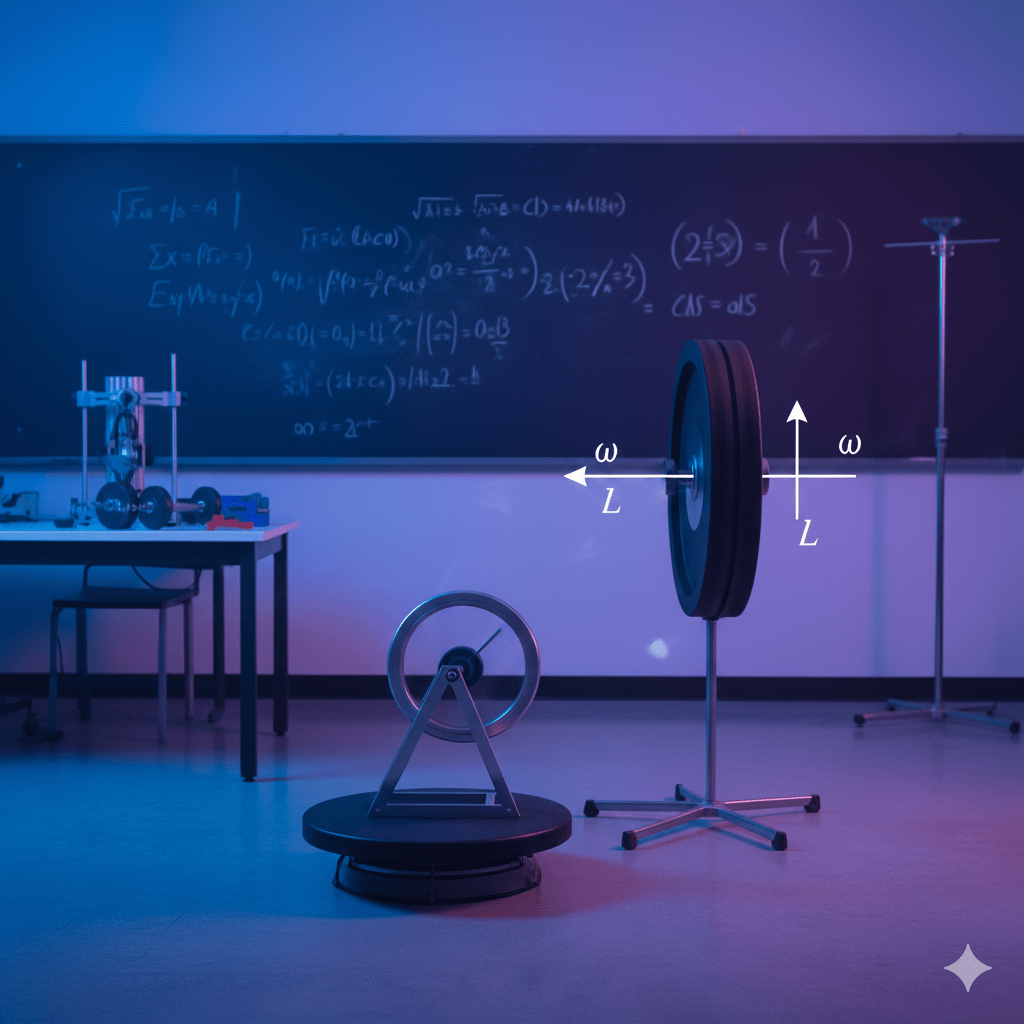
These angular momentum and rotational motion MCQs repeatedly highlight one powerful idea: when external torque is absent, angular momentum remains conserved. Whether it is a dancer folding arms, a rotating disc, or an engine shaft, changes in angular velocity arise from changes in moment of inertia—not external forces. In this angular momentum and rotational motion mcqs it understands the relationship between τ = Iα, L = Iω, and conservation laws is key to solving both numerical and conceptual questions accurate.
Angular momentum and rotational motion mcqs ,dynamics problems demand more than formula memorization—they require physical intuition. Through these Angular Momentum and Rotational Motion MCQs, it strengthen your understanding of torque, moment of inertia, angular velocity, and conservation principles. Practicing such angular momentum and rotational motion MCQs builds confidence for competitive exams, board exams, and engineering entrance tests, where rotational motion remains a high-weightage topic.
Many MCQs focus on real-life applications such as spinning discs, rotating wheels, and clock hands to strengthen conceptual clarity. By combining angular momentum with rotational motion, these problems emphasize conservation principles and highlight how internal and external torques govern rotational dynamics. Practicing such angular momentum and rotational motion MCQs builds strong analytical skills and improves accuracy in solving physics numericals related to circular and rotational systems.

Amal Augustine is the founder of ExQuizMe, a dynamic learning and quiz platform built to make education engaging, competitive, and fun. A passionate learner and an academic achiever, Amal completed his schooling at Government HSS Manjapra, graduating with 92.5% in Computer Science. He later earned his degree from St. Stephen’s College, University of Delhi, one of India’s most prestigious arts and science institutions.
Currently, Amal is pursuing his Master’s degree at National Sun Yat-sen University, Taiwan, where he continues to deepen his interest in research and technology. Throughout his school and college years, he won 50+ national-level interschool and collegiate quiz competitions, was
Beyond academics, Amal Augustine is an avid reader of science journals, a dedicated research student, and a technology enthusiast who loves programming and exploring the world of Computer Science. Through ExQuizMe, he aims to make learning accessible, enjoyable, and empowering for students across the globe.