
- iamal
- December 17, 2025
Newton’s Laws of Motion MCQs in Action: Powerful MCQs on Force, Momentum, and Motion
Understanding Newton’s Laws of Motion MCQs is essential for mastering physics, especially when it comes to force, momentum, impulse, friction, and equilibrium problems. Numerical Newton’s laws of motion MCQs based on these concepts frequently appear in board exams, JEE, NEET, and other competitive tests. These Newton’s laws of motion mcqs questions test not just formula recall, but also conceptual clarity—such as identifying action–reaction pairs, interpreting lift motion, analyzing impulse, and applying Newton’s laws of motion mcqs in real-life situations.
Newton’s laws of motion form the foundation of classical mechanics, explaining how forces influence the motion of objects in everyday life as well as in engineering systems. These Newton’s laws of motion mcqs establish a direct relationship between force, mass, and acceleration, enabling precise prediction of motion in both simple and complex physical situations.
Newton’s laws of motion mcqs are crucial for analyzing non-inertial frames of reference, such as elevators, accelerating vehicles, and rotating systems, where apparent forces must be considered. Mastery of these Newton’s laws of motion mcqs allows students to confidently tackle force–momentum MCQs, impulse problems, and equilibrium-based questions in competitive and board examinations.
This post presents a carefully curated set of Newton’s Laws of Motion MCQs with answers, focusing on problem-solving accuracy, conceptual depth, and exam relevance.
Newton’s Laws of Motion MCQs with Answers
1.
The average force required to stop a hammer with momentum 25 Ns in 0.05 s is
A. 500 N
B. 125 N
C. 50 N
D. 25 N
Answer: A
2.
A gun is fired at a target which is released simultaneously. The bullet will
A. Pass above the target
B. Pass below the target
C. Hit the target
D. Certainly hit the target
Answer: C
3.
If a body is in equilibrium under non-collinear forces, the minimum number of forces is
A. Four
B. Three
C. Two
D. Five
Answer: B
4.
The relation F = ma cannot be deduced if
A. Force depends on time
B. Momentum depends on time
C. Acceleration depends on time
D. Mass depends on time
Answer: D
5.
If gravitational pull on a book is action, the reaction is exerted by
A. Book on table
B. Book on Earth
C. Earth on book
D. Table on Earth
Answer: C
6.
Passengers fall forward when a bus suddenly stops due to
A. Relativity
B. Newton’s first law
C. Newton’s second law
D. Newton’s third law
Answer: B
7.
A man standing on smooth ice can move by using
A. First law
B. Second law
C. Third law
D. All laws
Answer: C
8.
One feels heavier in a lift when it
A. Goes down steadily
B. Just begins to go up
C. Moves up steadily
D. Falls freely
Answer: B
9.
Weight of an object is defined by
A. First law
B. Second law
C. Third law
D. Law of gravitation
Answer: D
10.
Speed of a man sitting in a moving train relative to the train is
A. 10 m/s
B. 60 m/s
C. Infinite
D. Zero
Answer: D
11.
A 40 kg boy climbing a pole applies a horizontal force of
A. 300 N
B. 400 N
C. 500 N
D. 600 N
Answer: C
12.
If a 60 kg man pushes a 40 kg man with 60 N, the reaction force is
A. 40 N
B. 0
C. 60 N
D. 20 N
Answer: C
13.
Impulse produced by force acting for 0.1 s on a ball accelerating at 20 m/s² is
A. 1.2 Ns
B. 0.3 Ns
C. 0.1 Ns
D. 0.5 Ns
Answer: B
14.
Incorrect statement about Newton’s first law is
A. It is independent
B. Defines inertial frame
C. Proposed by Galileo
D. Special case of second law
Answer: A
15.
If a lift moves upward at uniform speed, scale reading is
A. 510 N
B. 480 N
C. 490 N
D. 500 N
Answer: D
16.
Average resisting force needed to reduce speed from 65 m/s to 15 m/s in 0.2 s is
A. 12.5 N
B. 25 N
C. 50 N
D. 100 N
Answer: A
17.
Impulse is equal to change in
A. Force
B. Momentum
C. Work
D. Energy
Answer: B
18.
Resultant of balanced forces is
A. Zero
B. Non-zero
C. Variable
D. Undefined
Answer: A
19.
Passengers are thrown outward in a turning bus due to
A. Outward pull
B. Inertia
C. Change in momentum
D. Acceleration
Answer: B
20.
Rocket propulsion is based on
A. Conservation of mass
B. Conservation of energy
C. Newton’s third law
D. First law
Answer: C
21.
Impulse of force equals change in
A. Velocity
B. Mass
C. Momentum
D. Energy
Answer: C
22.
A lift accelerating upward causes apparent weight to
A. Decrease
B. Increase
C. Become zero
D. Remain same
Answer: B
23.
Coefficient of sliding friction is generally
A. Greater than static
B. Equal to static
C. Less than static
D. Zero
Answer: C
24.
Work done against friction over distance d is
A. μRd/4
B. 2μRd
C. μRd
D. μRd/2
Answer: C
25.
If static friction is 0.8 and kinetic friction is 0.6, acceleration is
A. 0.2g
B. g/32
C. 0.64g
D. g/6.4
Answer: A
26.
Force required to accelerate a 10 kg block at 3 m/s² with friction 0.3 is
A. 10 N
B. 30 N
C. 50 N
D. 60 N
Answer: D
27.
Newton’s laws apply strictly in
A. Rotating frame
B. Accelerated frame
C. Inertial frame
D. Non-inertial frame
Answer: C
28.
Impulse has the unit
A. N
B. J
C. N·s
D. kg
Answer: C
29.
Friction increases on smoothing surfaces due to
A. Molecular forces
B. Reduced area
C. Less irregularities
D. Increased weight
Answer: A
30.
Action and reaction forces
A. Act on same body
B. Act in same direction
C. Act on different bodies
D. Cancel each other
Answer: C
31.
A person attempts to lift himself by pulling his hair upward. He fails because
A. The force applied is too small
B. Gravity is large
C. Muscular force is insufficient
D. The force applied is internal to the system
Answer: D
32.
A bullet of mass 10 g is fired horizontally with a speed of 300 m/s from a gun of mass 1 kg. The recoil velocity of the gun is
A. 0.3 m/s
B. 3 m/s
C. −3 m/s
D. −0.3 m/s
Answer: B
33.
If no external force acts on a system, then which quantity remains conserved?
A. Velocity
B. Acceleration
C. Kinetic energy
D. Linear momentum
Answer: D
34.
When a horse pulls a cart, the force that actually moves the horse forward is
A. Force exerted by the horse on the cart
B. Force exerted by the cart on the horse
C. Force exerted by the ground on the horse
D. Force exerted by gravity
Answer: C
35.
Which of the following best explains rocket propulsion?
A. Conservation of energy
B. Conservation of mass
C. Newton’s first law
D. Newton’s third law of motion
Answer: D
Conclusion
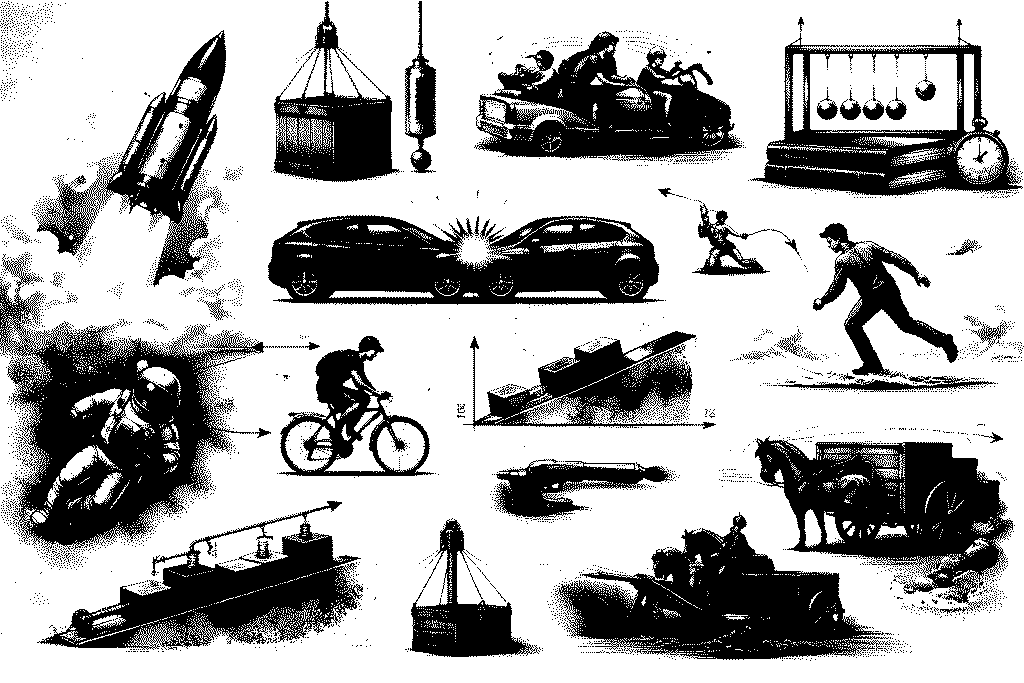
Numerical MCQs based on Newton’s Laws of Motion mcqs provide a powerful way to test both conceptual understanding and mathematical application of physics principles. Newton’s laws of motion mcqs problems involving impulse, friction, equilibrium, elevators, collisions, and inertia demand clarity in identifying forces, directions, and frames of reference.
By practicing such Newton’s laws of motion mcqs force and momentum MCQs, students develop the ability to quickly analyze real-world physics situations—an essential skill for competitive exams and higher-level problem solving. Consistent practice Newton’s laws of motion mcqs with these numericals strengthens accuracy, confidence, and exam performance.