
- iamal
- December 8, 2025
Vertical Motion Numericals & Free-Fall Numericals: 30 Powerful MCQs for NEET & JEE
Vertical motion numericals are among the most scoring yet conceptually rich topics in Physics. Vertical motion numericals also combine kinematics, free-fall motion, relative velocity, and projectile motion—making them essential for NEET, JEE, CUET, and board exam preparation.
Mastering vertical motion numericals helps students understand how displacement, velocity, and acceleration evolve with time under gravity. These vertical motion numericals problems also sharpen logical reasoning, improve conceptual clarity, and build a solid foundation for advanced topics like 2D projectile motion and rotational dynamics.
Vertical motion numericals often challenge students to combine conceptual understanding with algebraic manipulation, especially when dealing with changing velocity under gravity.Vertical motion numericals also help learners apply key kinematics equations efficiently, building confidence for competitive examinations.
30 Solved MCQs on Vertical Motion Numericals & Free-Fall Numericals
1. If a person sitting in a moving train throws a ball vertically upward, the ball will:
A. Fall backward
B. Return to thrower’s hand
C. Not return to thrower
D. None of these
Answer: B
2. A car accelerates from rest at 1.2 m/s² while a bus moves at 12 m/s. Time for car to catch the bus:
A. 17 s
B. 8 s
C. 20 s
D. 12 s
Answer: C
3. A man 45 m behind a bus accelerating at 2.5 m/s² must run at minimum velocity:
A. 12 m/s
B. 14 m/s
C. 15 m/s
D. 16 m/s
Answer: C
4. A particle moves with x = 40 + 12t – t³. Distance traveled before rest:
A. 24 m
B. 40 m
C. 56 m
D. 16 m
Answer: C
5. Distance covered in 3rd second with acceleration 4 m/s² from rest:
A. 10/3 m
B. 19/3 m
C. 6 m
D. 4 m
Answer: A
6. A monkey drops a mango from 19.6 m. A cadet below will catch it if he is:
A. 5 m away
B. 10 m away
C. 19.8 m away
D. 24.5 m away
Answer: A
7. A body with velocity 10 m/s becomes 20 m/s in 5 seconds. Distance traveled:
A. 75 m
B. 150 m
C. 300 m
D. 500 m
Answer: A
8. v–t graph of free fall (initial v=0) is:
A. Straight line with intercept
B. Straight line through origin
C. Parabola
D. Vertical line
Answer: B
9. v = 10t. Distance in 8s:
A. 320 m
B. 80 m
C. 120 m
D. 640 m
Answer: A
10. Bullet aimed at 100 m horizontal distance, u=500 m/s. Height to aim:
A. 10 cm
B. 20 cm
C. 50 cm
D. 100 cm
Answer: B
11. Two balls of different densities dropped from same height:
A. Heavy ball first
B. Light ball first
C. Both simultaneously
D. Depends on density
Answer: C
12. A block sliding 10 m/s comes to rest in 50 m. Coefficient of friction =
A. 1
B. 10
C. 2
D. 0.1
Answer: D
13. Motion in straight line is:
A. Constant velocity
B. Uniformly accelerated
C. Non-uniformly accelerated
D. Zero velocity
Answer: B
14. Car accelerates from 0 to 144 km/h in 20s. Distance covered:
A. 400 m
B. 1440 m
C. 2880 m
D. 25 m
Answer: A
15. Correct velocity–time graph for a vertically thrown ball (ignoring air resistance):
A. (a)
B. (b)
C. (c)
D. (d)
Answer: A
16. x = 37 + 27t – t³. Distance from O at rest:
A. 81 m
B. 91 m
C. 101 m
D. 111 m
Answer: B
17. a = 3t + 4. Velocity at t = 2 s:
A. 10 m/s
B. 18 m/s
C. 14 m/s
D. 26 m/s
Answer: C
18. Graph representing planets around the sun:
A. (a)
B. (b)
C. (c)
D. (d)
Answer: C
19. Distance in 4th second of motion with a = 6 m/s²:
A. 21 m
B. 35 m
C. 53 m
D. 12 m
Answer: A
20. Distance covered during last t seconds of ascent:
A. ut – ½gt²
B. (u + gt)t
C. ut
D. ½gt²
Answer: D
21. x = at² – bt³. Acceleration zero at:
A. 0
B. a/3b
C. 2a/3b
D. a/b
Answer: B
22. S = vt represents:
A. Uniform acceleration
B. Non-uniform acceleration
C. Uniform velocity
D. Non-uniform velocity
Answer: C
23. A ball dropped from height h has t1 for first half, t2 for second half:
A. t1 = √2 t2
B. t1 = (√2 − 1)t2
C. t2 = (√2 + 1)t1
D. t2 = (√2 − 1)t1
Answer: D
24. Juggler throwing n balls/sec, max height is:
A. g/2n
B. g/n
C. 2gn
D. g/2n²
Answer: D
25. Ball dropped 4.9 m then sinks with constant v. Total time = 4s. Depth ≈
A. 19.6 m
B. 29.4 m
C. 39.2 m
D. 73.5 m
Answer: B
26. Ball thrown at 30° from building, hits ground in 3s. Height =
A. 10 m
B. 15 m
C. 20 m
D. 25 m
Answer: B
27. Two balls meet 100 m above ground. Value of u =
A. 10
B. 15
C. 20
D. 30
Answer: D
28. Acceleration at highest point of projectile:
A. Zero
B. Upward
C. Downward
D. Cannot predict
Answer: C
29. First drop hits water; third begins falling then. Second drop is at:
A. 4.18 m
B. 2.94 m
C. 2.45 m
D. 7.35 m
Answer: D
30. Balloon rising at 10 m/s drops object from 75 m. Balloon height when object hits ground:
A. 300 m
B. 200 m
C. 125 m
D. 250 m
Answer: C
Conclusion
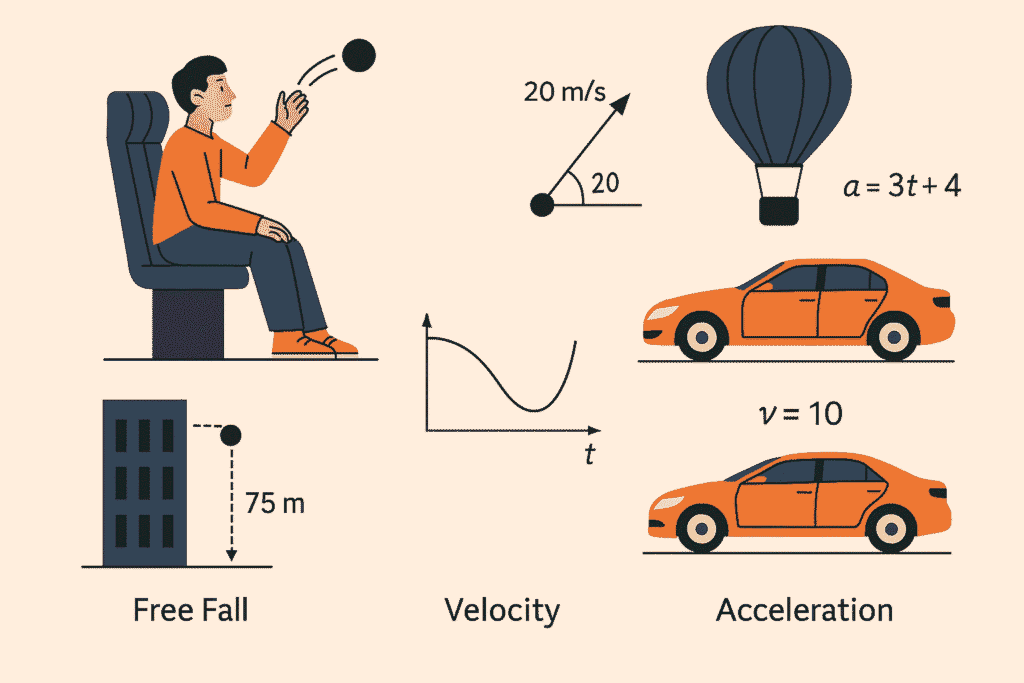
Vertical motion numericals form the backbone of JEE and NEET kinematics. By practicing structured MCQs, understanding acceleration patterns, solving free-fall problems, and analyzing velocity-time graphs, students build strong conceptual foundations. Consistent exposure to such problems enhances problem-solving speed, improves exam accuracy, and strengthens analytical ability.
With the vertical motion numericals in this post, you now have a comprehensive resource to practice, revise, and master one of physics’ most essential topics.Vertical motion numericals play a crucial role in strengthening a student’s understanding of kinematics, acceleration, and gravitational motion.
For NEET, JEE, and CUET aspirants, mastering vertical motion isn’t just about solving equations—it’s about recognising patterns, applying logic, and interpreting real-world scenarios through the lens of physics. Consistent practice with vertical motion numericals enhances conceptual clarity, builds problem-solving confidence, and improves examination performance.