
- iamal
- December 4, 2025
Motion and Acceleration: 30 High-Quality MCQs With Answers for Exam Perfection
The study of motion and acceleration is one of the most important foundations in Class 11 and for competitive exams like NEET, JEE, and CUET. Whether it is understanding displacement–time graphs, interpreting velocity–time curves, or solving real-world scenarios such as projectile motion or motion under constant acceleration, the chapter builds conceptual strength for all of mechanics.
This article presents a carefully crafted set of advanced MCQs on motion and acceleration covering topics such as relative motion, variable acceleration, graph-based problems, radial acceleration, time of flight, average speed, and Newtonian motion. Each question comes with options and the correct answer for self-evaluation. Practicing these questions regularly will help students strengthen their understanding and develop speed, accuracy, and confidence—which are essential for cracking high-level entrance exams.
MCQs on Motion in Physics (With Answers Included)
-
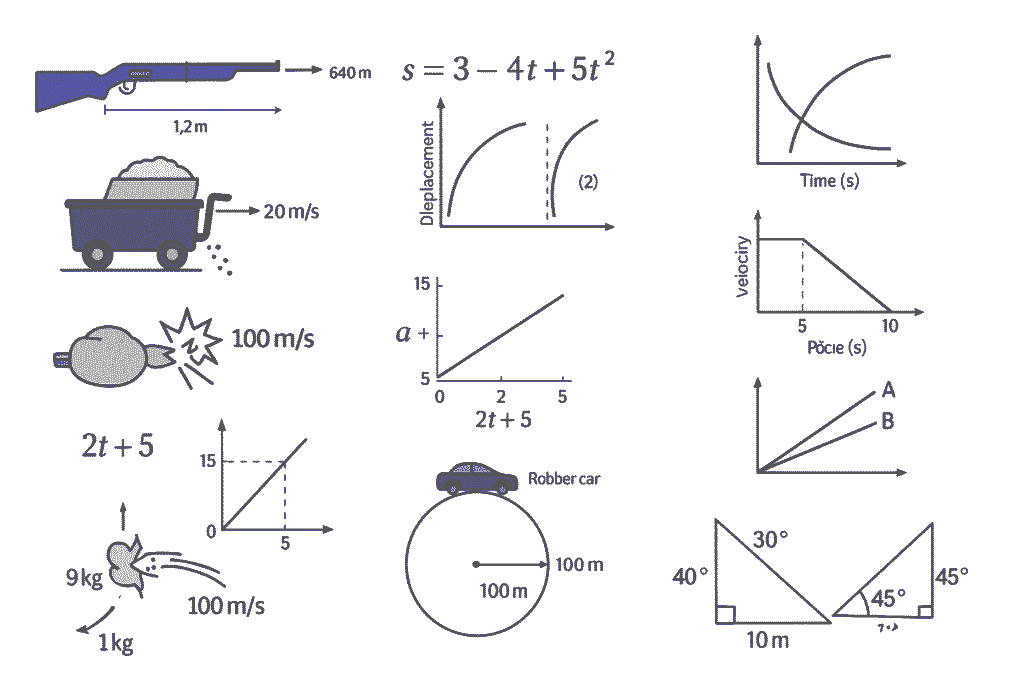
A bullet emerges from a 1.2 m barrel at 640 m/s (constant acceleration). Time inside barrel is
a) 4 ms
b) 40 ms
c) 400 µs
d) 1 s
Answer: a -
A 10 kg shell at 10 m/s explodes into 9 kg (stationary) and 1 kg fragment. Velocity of 1 kg fragment is
a) 1 m/s
b) 10 m/s
c) 100 m/s
d) 1000 m/s
Answer: c -
For s = 3 – 4t + 5t², initial velocity is
a) 3
b) –3
c) 4
d) –4
Answer: d -
If displacement x = t + 3, velocity ∝
a) t⁻¹
b) t
c) t¹ ✔
d) t²
Answer: b -
From the displacement–time graphs shown, we conclude
a) Both uniform acceleration
b) Both uniform retardation
c) Particle (1) accelerated, particle (2) retarded
d) Particle (1) retarded, particle (2) accelerated
Answer: c -
If a = 2t + 5, velocity after 5 s from rest is
a) 50 m/s
b) 25 m/s
c) 100 m/s
d) 75 m/s
Answer: a -
Velocity v = 4t² – 2t. Acceleration at position x = 2 m is
a) 28 m/s²
b) 22 m/s²
c) 12 m/s²
d) 10 m/s²
Answer: b -
From the velocity–time graph of a train, total distance is
a) 100 m
b) 1860 m
c) 9 m
d) 7.35 m
Answer: a -
A trolley (20 kg) with 5 kg grain moves at 20 m/s. Grain leaks at 0.2 kg/s. Speed at t = 10 s is nearest
a) 20 m/s
b) 25 m/s
c) 15 m/s
d) 13.3 m/s
Answer: a -
For 3s = a + 4bt³, velocity at t = 1 s is
a) 4b
b) a + 4b
c) a – 4b
d) 3√b
Answer: b -
From the velocity–time graph of robber and police car, police crosses robber
a) After 10 s
b) After 15 s
c) Never
d) After 20 s
Answer: c -
A boat has 8 km/h speed across river; resultant is 10 km/h. River speed is
a) 10 km/h
b) 8 km/h
c) 6 km/h
d) 4 km/h
Answer: c -
For s = a + bt + ct², initial velocity and acceleration are
a) b + 2ct, 2c
b) b, 2c
c) 2c, b
d) b + 2c, 2c
Answer: b -
A ball thrown up returns in 4 s. Initial velocity is
a) 30 m/s
b) 10 m/s
c) 40 m/s
d) 20 m/s
Answer: d -
For x = 2t² + 2t + 4, acceleration is
a) 2 m/s²
b) 4 m/s²
c) 6 m/s²
d) 8 m/s²
Answer: b -
A car accelerates at 2 m/s² then brakes. Total distance = 100 m in 20 s. Max velocity is
a) 10 m/s
b) 20 m/s
c) 15 m/s
d) 5 m/s
Answer: a -
A car runs in a circle of radius 100 m with speed increasing at 5 m/s². Radial acceleration after one full rotation is
a) 20π
b) 10π
c) 30π
d) 40π
Answer: a -
For x = at³ – bt⁵, acceleration = 0 at
a) a/b
b) 2a/b
c) a/3b
d) 0
Answer: c -
Area under acceleration–time graph represents
a) Displacement
b) Velocity
c) Change in velocity
d) Distance
Answer: c -
For velocity–time graphs of objects A & B, ratio of accelerations is
a) 1 : 3
b) 1 : 3
c) 3 : 1
d) 3 : 2
Answer: a -
False statement:
a) Zero velocity but accelerated
b) Constant velocity but varying speed
c) Constant speed but varying velocity
d) Velocity direction can change under constant acceleration
Answer: b -
Maximum speed from given a–t graph is
a) 110 m/s
b) 45 m/s
c) 900 m/s
d) 90 m/s
Answer: b -
A bus travels 1/3 distance at 10 km/h, next 1/3 at 20 km/h, last 1/3 at 60 km/h. Average speed is
a) 9 km/h
b) 16 km/h
c) 18 km/h
d) 48 km/h
Answer: c -
Distance in 3rd second for acceleration 4 m/s²:
a) 6 m
b) 4 m
c) 10/3 m
d) 19/3 m
Answer: d -
Car covers 200 m. First 100 m at 40 km/h, overall average 48 km/h. Find v for next 100 m.
a) 56 km/h
b) 60 km/h
c) 50 km/h
d) 48 km/h
Answer: b -
First half at 40 km/h, second half at 60 km/h → average:
a) 40
b) 48
c) 50
d) 60
Answer: b -
For x = (t + 5)⁻¹, acceleration ∝
a) (velocity)³/²
b) (distance)⁻²
c) (distance)⁻²
d) (velocity)²/³
Answer: a -
Bus 10 m/s, scooterist 1 km behind wants to catch in 100 s. Speed needed:
a) 20 m/s
b) 40 m/s
c) 25 m/s
d) 10 m/s
Answer: a -
Two displacement–time graphs make 30° and 45° angles. Velocity ratio is
a) 1 : 2
b) 1 : √3
c) √3 : 1
d) 1 : 1
Answer: b -
If weight = 90 kg at Earth’s surface, weight at height R/2 becomes
a) 135 kg
b) 45 kg
c) 60 kg
d) 40 kg
Answer: d
Conclusion
This set of challenging MCQs covers every major concept of motion and acceleration, including displacement, velocity, projectile motion, relative motion, radial acceleration, and interpretation of motion graphs. Solving these question patterns trains students to analyze motion mathematically and graphically—skills that are essential for NEET, JEE, CUET, and Class 11 Physics exams. The more students practice motion in physics, the deeper their conceptual intuition becomes, leading to faster and more accurate problem-solving in competitive settings.